

Upon arrival at the Kit Kat Klub (the former Playhouse Theatre, renamed in honour of Cabaret which has played there since 2021), you will find the front doors locked, and the windows blacked out. In order to access the theatre, you must enter through a secret side entrance, and taken down into the bowels of the theatre, where you are given a free shot of peach schnapps and stickers are applied to your phone camera to prevent any photos from being taken inside. Actors and musicians freely walk around the three different bar areas – audience members are warned to look but not touch, as scantily-clad performers weave their way between them.
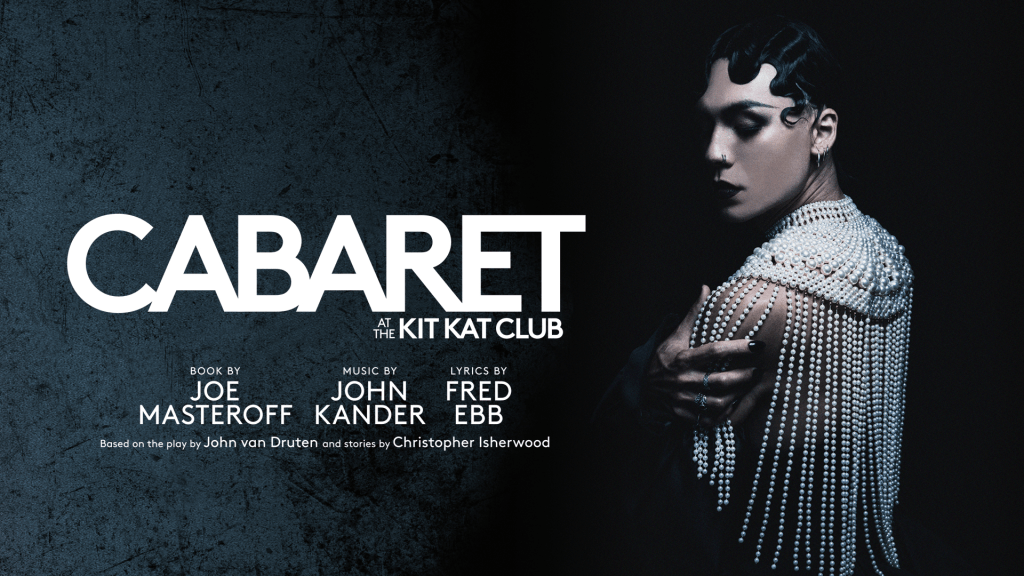
The theatre has been completely redesigned as the musical is performed in the round, with the band taking positions on two balconies overlooking the acting area. The more expensive seats are almost on the stage itself, positioned at Cabaret tables, and served drinks and nibbles. The theatre is incredibly dark, adding to the secretive nature of the underground club that Rebecca Frecknall’s direction has sought to create. Pre-show entertainment sees some dancers briefly take to the stage, although their movements seem to be improvised and are not particularly impressive.
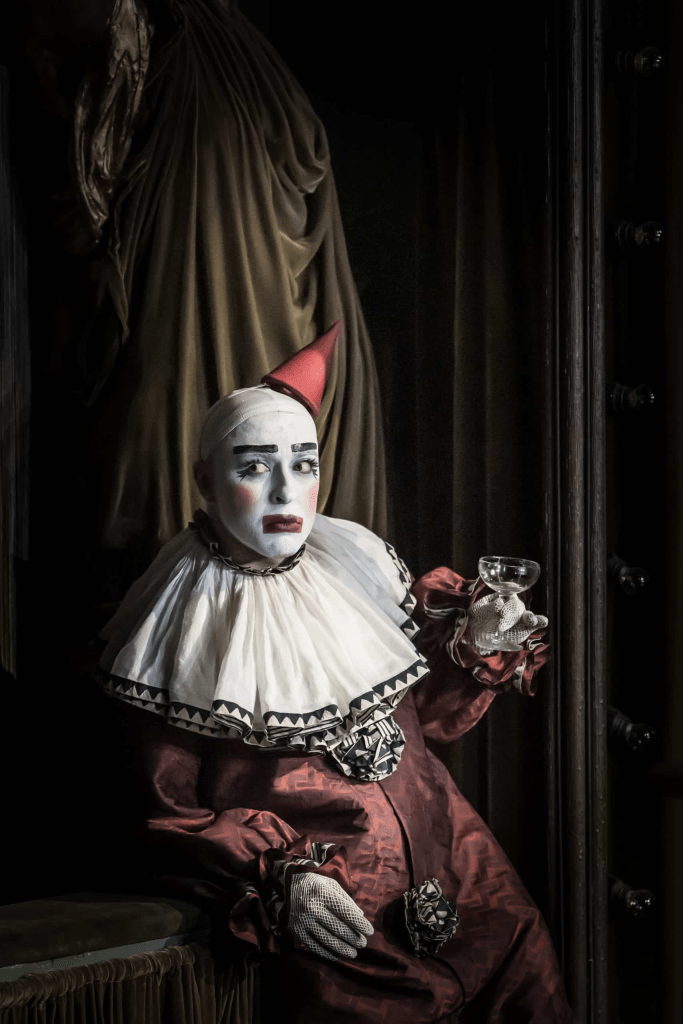
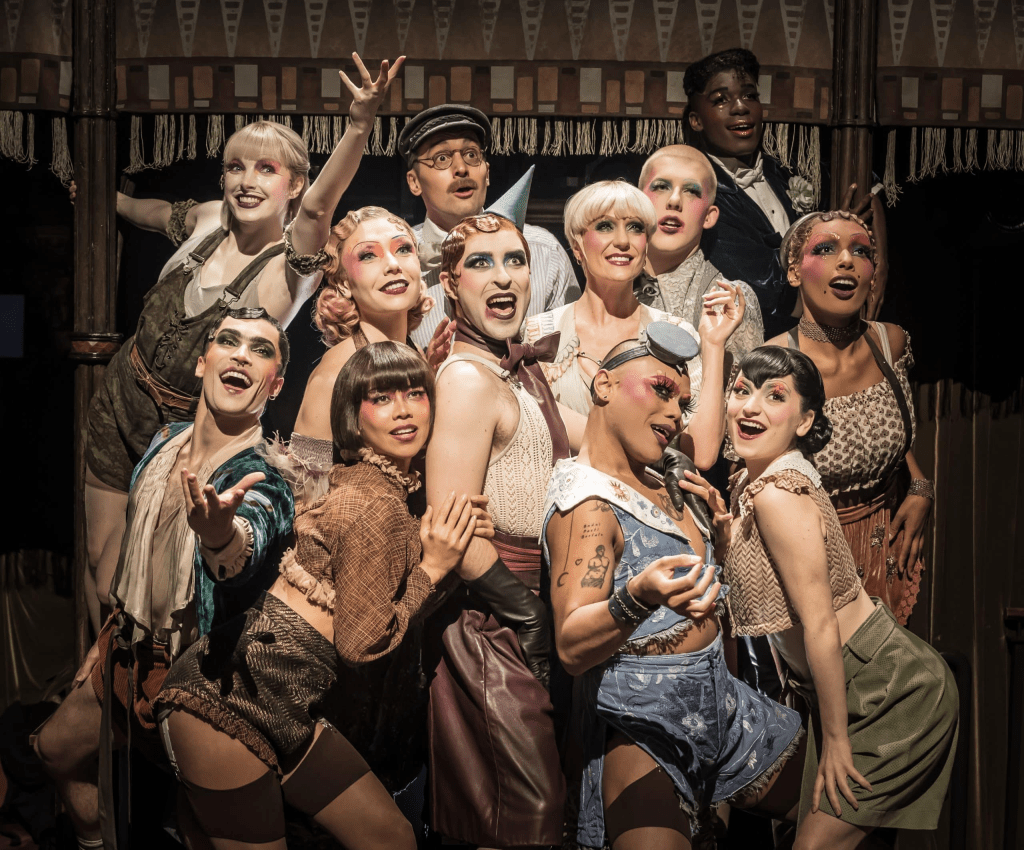
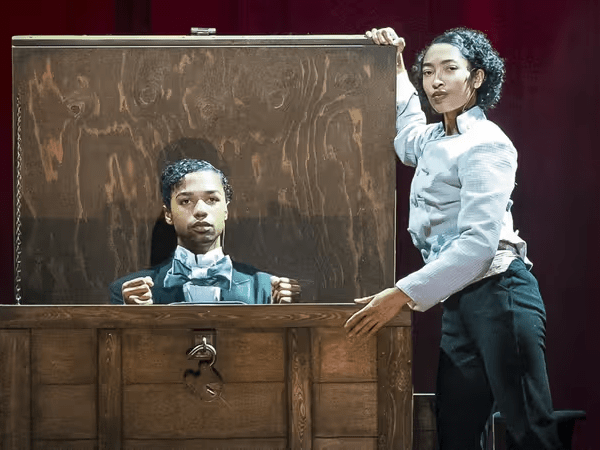
The main show is introduced with a sudden drum-roll, as Rob Madge’s Emcee is revealed, in garish make-up and party hat, to kick off proceedings. Madge is superb in the role, launching between cheeky asides and more sincere moments. He takes the lead in many of the numbers scattered throughout the show, functioning as tongue-in-cheek Cabaret performances but with deeper meanings that mimic the ongoing story elsewhere – Two Ladies, a song about a threesome which features dancers doing unmentionable things with a whisk and a baguette, is actually about hidden desires and bisexuality, whilst Madge’s make-up becomes more Harlequin-esque for the song Money, both a dig at Jewish stereotypes and a commentary on the powers of the rich. At times, Madge’s voice strays a little too far into his higher range, making some of his lyrics difficult to catch, but on the whole he is mesmerising throughout. His sudden change in the latter half of the play to become a blonde-haired, steadfast, Nazi-sympathising citizen appears so out of character that he is initially unrecognisable, lending to the musical’s downbeat ending and proving to be a true testament to Madge’s skill.
The role of the Emcee is simply a framing device for the main story that focuses on aspiring American novelist Clifford Bradshaw (Daniel Bowerbank) and his burgeoning romance with Sally Bowles (Hannah Dodd). Often, Bradshaw is portrayed as a closeted bisexual – here, although it is never truly confirmed, Bowerbank leans more into homosexuality, clearly more interested in the boys at the Cabaret club, but doing his best to hide his feelings, despite the Emcee assuring him that no one makes judgements in Berlin (useful foreshadowing for the rise of the Nazi party in the second act). His relationship with Sally acts as a useful cover-up – he is elated to write home to his mother and tell her about his new girlfriend – but there is a clear lack of chemistry between the two, which makes it hard to properly care about them. When Clifford tells Sally that he loves her, it feels insincere. When Sally discovers she is pregnant, the suggestion that the baby could be Clifford’s is almost laughed off. Bowerbank’s Clifford feels like a user, exploiting Sally’s desperation and unfortunate circumstances to allow him to create the image of the perfect straight man. It makes his character unlikeable, and when Sally reveals that she has had an abortion behind Clifford’s back, it is easier to sympathise with her than with Clifford.
Hannah Dodd’s Sally Bowles, on the other hand, is breath-taking. She fully embodies the character of a woman desperate to be a star, but constantly down on her luck. She finds it difficult to trust people, and rarely lets her guard down – she armours herself by taking on the persona of a hardened performer, deliberately eccentric, flirtatious and outrageous. Her Cabaret numbers, including Don’t Tell Mama, which sees the Cabaret girls all dressed as giant babies, and Mein Herr, where the tempo seemingly gets quicker with each verse, are all surface-level theatrical charm – Dodd’s performances are impressive in that they put a smile on your face whilst also hinting at some deeper emotional turmoil. It is when Sally is alone with Clifford that she lets her mask slip and we see a more fragile, emotional character. Dodd has an almost childlike streak, bouncing around the stage, being intentionally annoying as she does her best to hold on to Clifford’s attention, for fear that without him, she will be left with nothing.
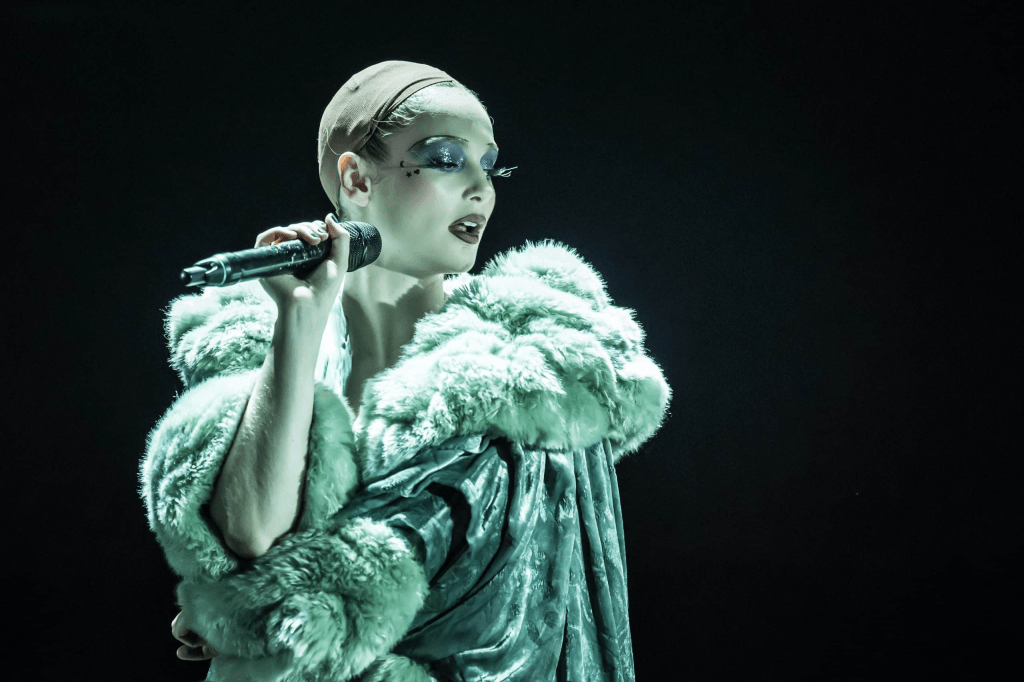
A subplot focuses on the relationship between housekeeper Fraulein Schneider (Vivienne Parry) and shopkeeper Herr Schultz (Fenton Gray). Their romance is sweet and sincere, and one that the audience immediately buys into. Parry and Gray share excellent chemistry, their rendition of It couldn’t please me more, where Schultz gifts Schneider a pineapple, is a highlight of the show. Things take a turn with the arrival of Ernst Ludwig (Fred Haig), who arrives at their engagement party wearing a Swastika on his arm, and condemning Schultz’s religious background. This leaves us on a dramatic climax for the end of Act One, as the Nazi party begin to grow in power.
This sense of impending doom continues into the second act, as Schultz’s shop is vandalised, and the glamour of the Cabaret club starts to breakdown. The stage becomes littered with paper, and Tom Scutt’s colourful costume design of the first act is replaced by grey clothing, the glamourous Cabaret girls (a mix of male, female and non-binary actors) reduced to mirror images of each other, indistinguishable and uniform. And yet, despite the growing tension, the musical remains a little too comedic in places. The Emcee’s number If you could see her sees Madge cavorting with a giant gorilla, who he claims to be in love with. This obviously draws laughs from the audience, but the choreography encourages the laughter to continue, so that instead of the song gradually becoming more twisted and foreboding, the final reveal (that the Emcee is judged, not for having a relationship with a gorilla, but for having a relationship with a Jew) is robbed of its dramatic climax due to the fact that the audience are too busy enjoying the choreographed antics. Despite Madge doing his best to silence the laughter erupting around him, it is too little too late, and the moment of clarity is lost.
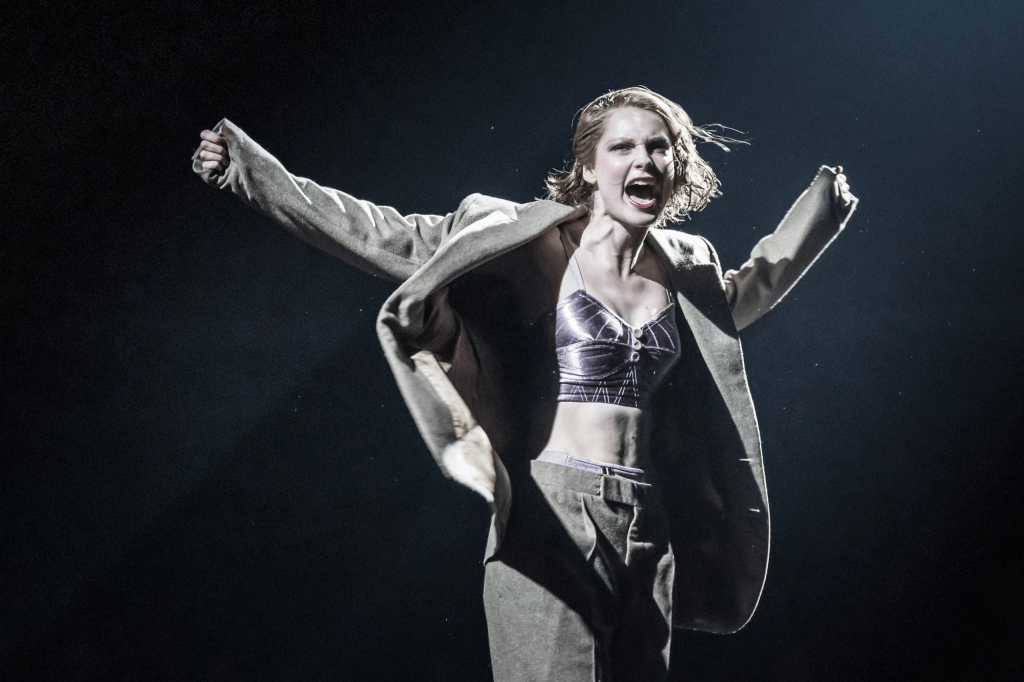
The production is slick, visually impressive and boasts a range of different musical numbers that will appeal to a vast majority of audience members. It succeeds in making subtle changes throughout to show how the Nazi party began to rob people of their liberties, and by the time Dodd performs the title number Cabaret at the end of the show, there are no backing dancers, fancy wigs or suggestive costume. The lyrics of the song are at odds with what we are seeing, in a move that is perhaps a little too literal – just in case we were in any doubt that the song was deliberately tongue-in-cheek, Bowerbank’s Clifford is also present onstage through, collapsed on the floor after being beaten up by the Nazi youth. It is enjoyable, but a bit too obvious – and the lack of chemistry between certain characters means that, by the end, it just all feels a bit empty and bland.
Tom Morley, August 2025
Review Round-up:
Mickey-Jo Theatre: how are Rob Madge and Hannah Dodd in CABARET? – Mickey Jo Theatre has a YouTube video specifically about Madge and Dodd, in which he says Madge is “absolutely fantastic in this role”, becoming “bitingly sinister” in the second act, whilst Dodd appears “younger” and “considerably more naive” than previous actors who have taken on the role, with a “haunting quality” to her Sally Bowles
The Guardian: Cabaret review – The Guardian’s 4 star review of the original West End production with Eddie Redmayne discusses Tom Scutt’s set design, calling it “expressionistic and imaginative”
Time Out London: Cabaret review – Another review of the original production (more up-to-date reviews are hard to find), which praises the costume design as being “angular, vivid, somewhat grotesque” (I think this is praise…?)







 Broken Legs Blog