
“Fast-paced, absorbing and relentlessly compelling”

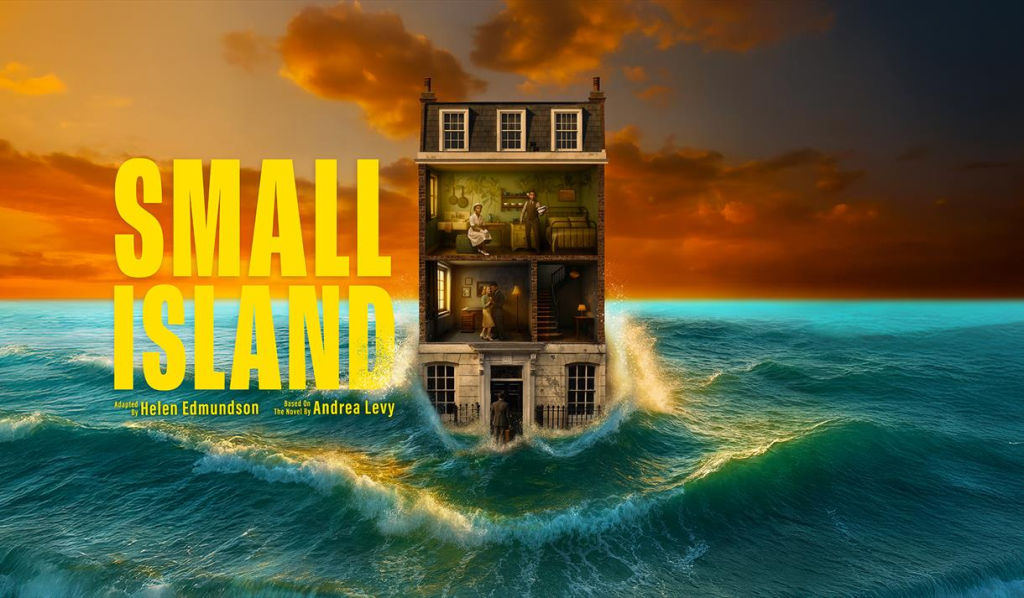
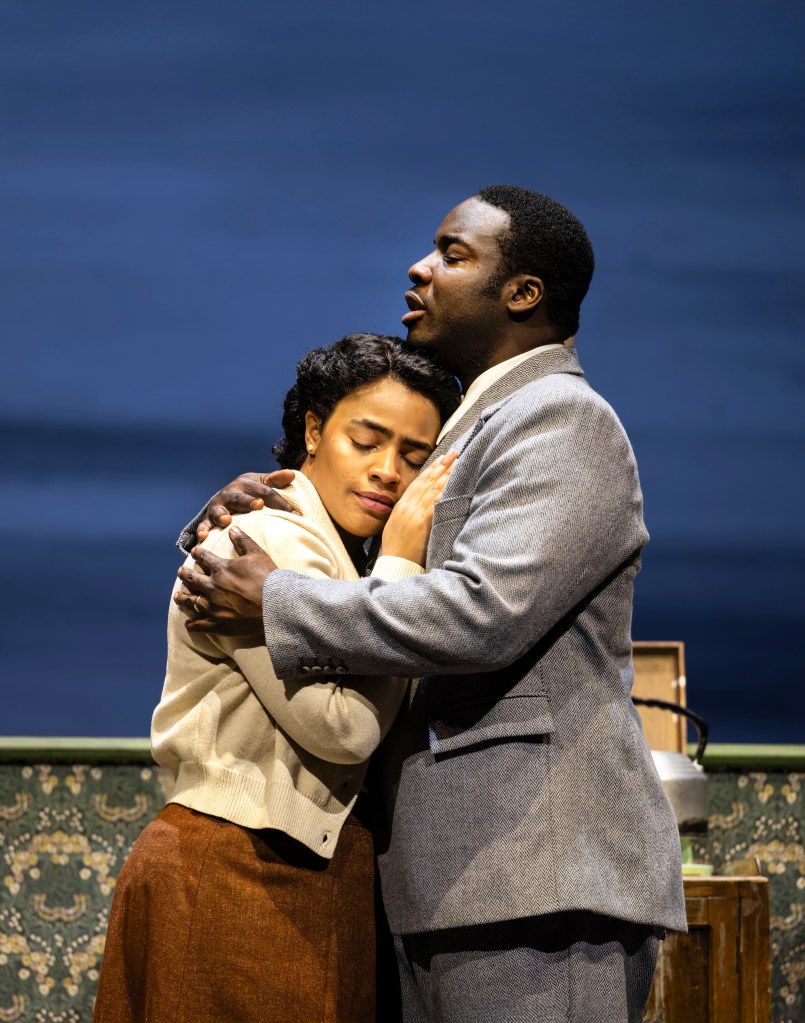
Set over a decade and taking place between the sunny shores of Jamaica and the smog-filled desolation of post-war London, this marathon of a play, based on the novel by Andrea Levy and adapted for the stage by Helen Edmunson, succeeds mostly thanks to some excellent character work and an incredibly likeable main cast. “Small Island” tells the story of three protagonists, and we are introduced to them one at a time, the first act split into three main sections where the protagonists narrate their own stories, before their lives cross and intertwine, bringing them all together for the second act. It is an ingenious way to tell the story (the original novel is told out of order, but here events are shifted around so we see everything chronologically), and helps us immediately connect with the main characters, allowing us an insight into their minds. It is all necessary groundwork for a second act that reduces in scale, becoming a more tightly focused character study that tells a story that is funny, moving and at times incredibly bleak.
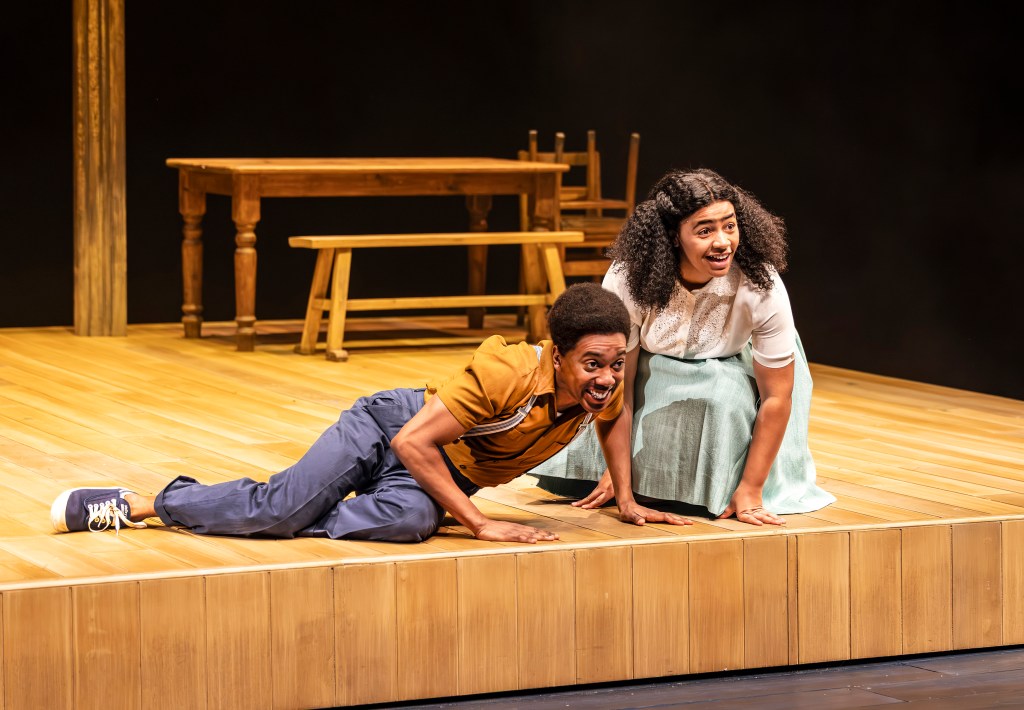
We begin with an introduction to Hortense (Anna Crichlow), a young woman brought up in Jamaica who grows up to become incredibly snobbish and standoffish. But it is via her childhood that we are made to understand how she turned out this way – the way she was treated by her aunt and uncle, and the betrayal of her childhood sweetheart. Most of this opening section revolves around Hortense’s relationship with Michael, who is at first played by Jordan Laviniere, before being taken on by Rhys Stephenson in his later years when Michael returns from boarding school. Having two actors in the role allows us to see the clear differences in Michael’s character, whilst Crichlow remains a constant, showing how Hortense has remained fairly stationary in her life, lacking the opportunities of her cousin. It means her desire for change makes complete sense, and when she decides to emigrate to England, it is easy to see why she has become disenfranchised with life in sunny Jamaica.
Suddenly we are whisked away to 1930s England, where we meet Queenie (Bronté Barbé), working in a sweetshop whilst dreaming of meeting the perfect husband and having children. The dreams are not to be – instead Queenie begins walking out with Mark Arends’ Bernard, an awkward chap who seems nice enough but is not particularly affectionate. Barbé’s asides to the audience make for some very funny moments, the narration during Queenie and Bernard’s cringe-worthy first date proving to be one of the comical highlights of the opening act. Queenie’s life contrasts completely with Hortense’s, with both ladies sharing different ambitions and different world views, and yet that is the point. It is one of the joys of this production; witnessing what happens when two completely different worlds collide.
The tale of our third protagonist helps us to bridge the gap between the two and start to get a sense of where the story is going. Gilbert (Daniel Ward), a Jamaican sent to Lincolnshire for army training, runs into Queenie who has left London to get away from the Blitz. We get glimpses of Gilbert’s life back in Jamaica, as Gilbert takes us on nostalgic detours through his childhood, whilst his life in Britain seems to not quite live up to his expectations – he faces racist comments from local residents, finds himself trained as a driver rather than a pilot, and suffers at the hands of a boss that everyone refers to as “Sergeant Bastard”. Yet all this changes when Gilbert meets Queenie, and it means that he returns to Jamaica after the war with a rose-tinted view of England, a view that will change both his and Hortense’s life and catapult us into the second act.
Between all of these scenes, we are treated to news snippets thanks to Gino Ricardo Green’s video design, projected onto a screen made to represent an enlarged early television. Complete with BBC news voiceover, these short clips help provide necessary context, updating us on the current war effort and providing information on Jamaican politics as the story moves into the 40s and Alexander Bustamante becomes leader of the Jamaica Labour Party. These provide useful breaks between scenes, but as we near the end of the first half and the stories of our protagonists begin to collide, scenes become shorter, meaning more and more intercut news articles, which can begin to feel a bit exposition heavy for very little narrative gain.
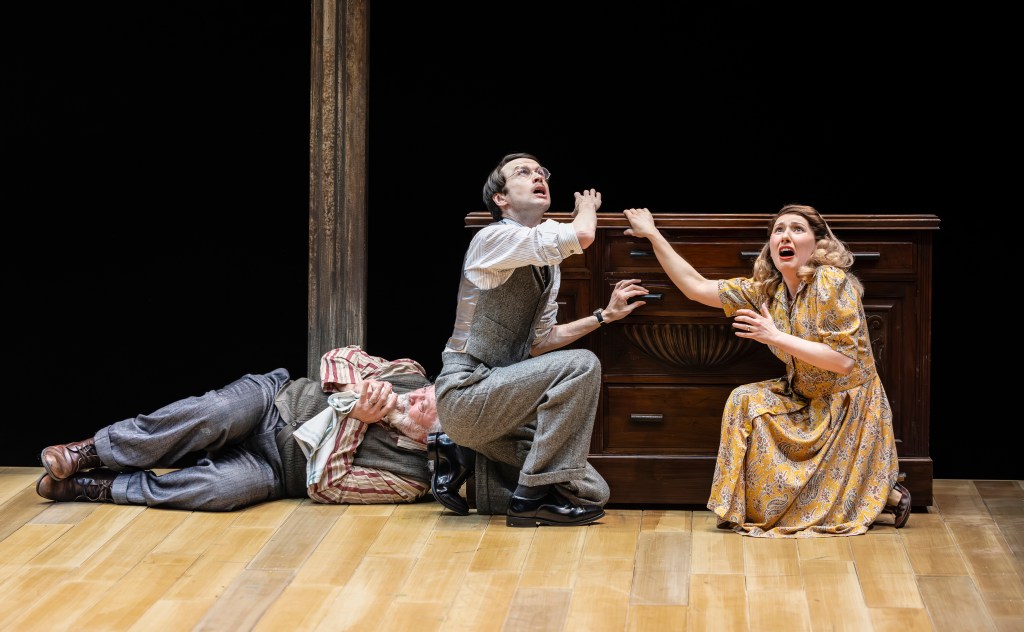
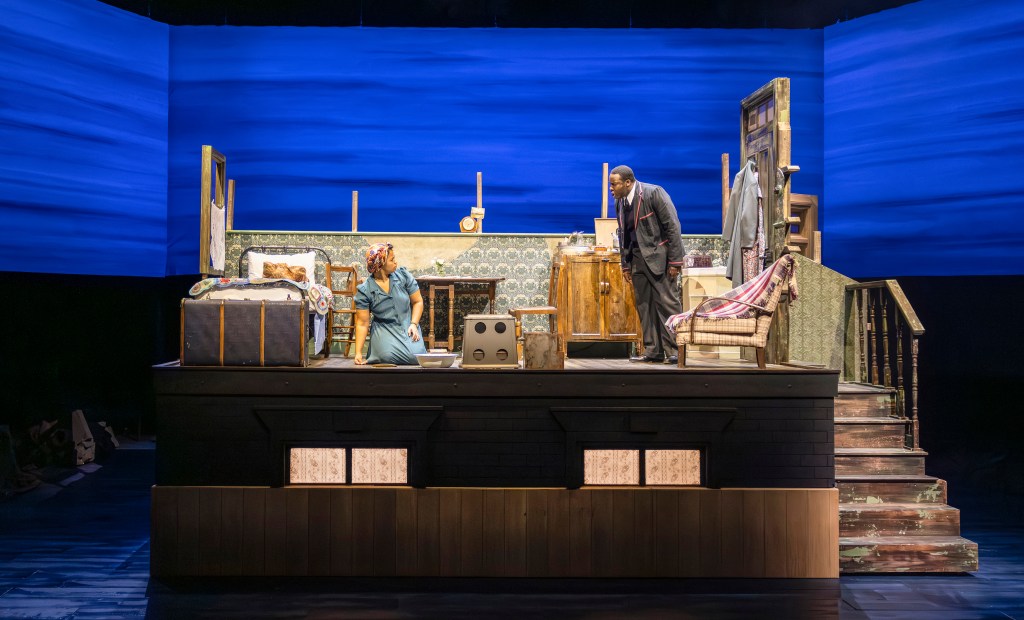
Thankfully, the second half dispatches with these updates as this section is all set within the same year, and the play transitions from a globe-trotting epic tale to something more akin to a kitchen-sink drama. Simon Kenny’s set design reflects this – the opening act sees a fairly bare stage, with key props flown in to help us easily transition from place to place, whilst the second act is a static set, built over two levels, with Queenie’s drawing room on the ground floor (which incorporates the dresser used to represent the setting in the first act) and Gilbert’s rented flat above. As the curtain lifts for the second act, the set design immediately tells us that we are in for a change of pace – it helps to set expectations, a useful marker in a play that is so different in its latter half.
There is an argument that the second act could be seen as a little slow and meandering in comparison to the action-packed first act, but this is not the case, mainly thanks to the immense character work that has been done initially. These are characters we care about and relate to. We are so invested in their stories that it is actually a pleasant surprise when the story slows down and allows us to enjoy their company at a more reserved pace. Matthew Xia’s direction finds a nice balance between trauma and comedy. Moments of racist abuse are immediately followed by endearing scenes in which Hortense and Gilbert slowly grow closer together – theirs is a love story that we completely buy into, unforced and beautiful despite being born out of necessity rather than desire.
Every character does things that are questionable, and this is what makes them all feel so incredibly real. There is no “perfect” person here, no one who can obviously take the moral high ground. We may feel angry at Gilbert for sleeping through his wife’s arrival in England, we may feel disappointed at the way in which Hortense continually shuns her husband’s romantic advances, yet it is these flaws that help us build investment in the story. This is mostly evident in the complicated character of Bernard – when recounting his experiences during the war, Arends paints a picture of a man undone by sheer trauma, timid in his retelling yet brave in the way he opens up. But later, his treatment of Hortense and Gilbert turns him into a much more unlikeable character. And that is the beauty of this piece – there are no obvious heroes and villains here, just people who are products of their history, their warped views and their current circumstances. That isn’t to say that Bernard is in any way justified in his actions – but it helps us see just how ingrained racism was in British culture that even the most genteel of men could be blinded by bigoted views. It is a comparison that we may draw with today’s culture, where fear is manufactured by politicians and media, and entire swathes of people find themselves conditioned to see immigrants and asylum seekers as problems or threats.
This is a play that is long, sure, but is fast-paced, absorbing and relentlessly compelling. When the curtain falls after 3 hours 15 minutes, it is hard to believe, but it will leave you wanting more. I could happily have spent another couple of hours with these characters. What hurts even more is that not all loose ends are tied up – there is a particular reunion that we are all waiting for, and yet never comes, but that is the nature of real life and it feels suitable that not everything is neatly tied up. A historical epic that is filled with hope, and yet quietly devastating.
Tom Morley, April 2026
For more information on how I decide on star ratings, see here: Star ratings – Broken Legs Blog
Review Round-up:
The Guardian: Small Island – 4* from the Guardian, who say “the play could feel depressingly familiar with the racist attitudes on display, […] but the promise of new life is enough to inject a note of optimism at the climax.”
WhatsOnStage: Small Island – Also 4* from WoS, who call this “a story of dreams: realised and unrealised, big and small.”
Elemental Theatre: Small Island – And finally, Elemental Theatre also award the show 4*, saying this is “a production that understands the importance of its story and commits to telling it with honesty”












 Broken Legs Blog
Leave a comment