
“Mark Gatiss [is] formidable and horrifying […] utterly chilling”

Written during the 1940s at the height of Hitler’s powers, “The Resistible Rise of Arturo Ui” reframes the rise of the Nazi party in 1920s America, with big-time gangster boss Arturo Ui standing in as Hitler, rising from down-and-out nobody to become the most powerful and dangerous man in Chicago. Written by Bertolt Brecht, the play is in the style of “epic theatre”, a theatrical movement that sought to distance the audience from the story of the play, often breaking illusions to ensure that audiences continually questioned what they were seeing and made connections with their own reality. The RSC’s version, directed by Seán Linnen, heavily leans into these themes, although often in ways that can feel repetitive and sometimes a little restrained. As a demonstration of theatrical theory, the play is undoubtedly a success – for those looking for something a little less academic and a little more entertaining, however, the production can leave much to be desired.

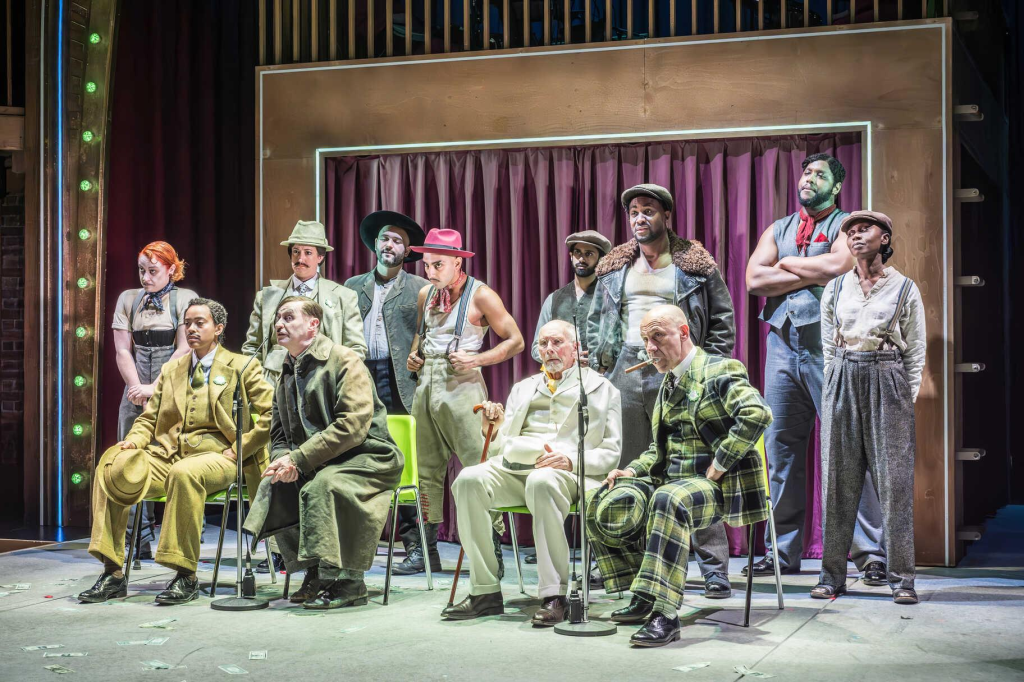
We begin with something of a blank canvas – hard plastic chairs, an RSC logo above the stage, and comedian Mawaan Rizwan dressed as a member of the front of house team making a direct address to the audience, in which he introduces the play, clearly explains exactly what we are in for, and then begins a roll-call of the main characters, each of whom emerge from the back curtains to take their seats, as though they were being called onto a late night chat show. It is all done with house lights up, and Rizwan very pointedly directing certain lines to audience members – there is nowhere for the audience to hide, and it forces you to sit up and pay attention. It is a technique that will be used throughout, bringing up the house lights to break the fourth wall and make the audience part of the action.
Rizwan slowly becomes more intimidating throughout his address, beginning to morph into the psychopathic Giri, and then Placebo’s musical score kicks in, loud and exciting. This is a production that thrives on changes in volume to continually surprise and thrill, building to a crescendo that cuts out immediately to leave the space in a deafening silence. It is undoubtedly an excellent technique when used sparingly – but here it is a technique that is used again and again, dampening the impact each time. Placebo’s music helps to bring the play to life, with heavy rock motifs covering some often lengthy and unnecessary scene transitions. In fact, the music is so good that it is a shame that we have to endure the scenes in between.
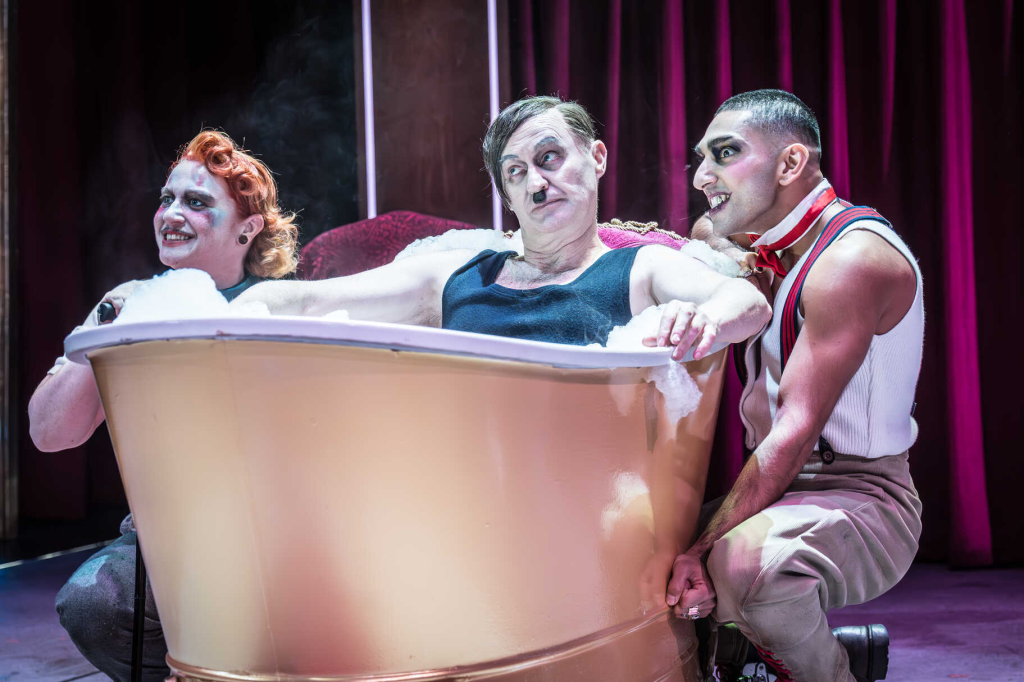
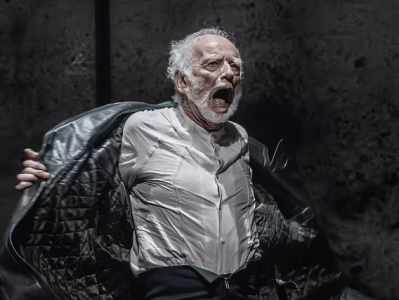
Mark Gatiss stars as Arturo Ui, formidable and horrifying. The first two times we see him, Gatiss never utters a word yet is able to command the stage just with his foreboding presence, a leering smile underneath his painted-on moustache. Ui seeks to take over the vegetable business, which is booming in Chicago. He blackmails Dogsborough (Christopher Godwin), a seemingly respectable gentleman who has been coerced into embezzling funds by ruthless gangsters of the Cauliflower Trust. Dogsborough initially resists Ui’s threats, but when his accomplices are murdered and the city begins looking into his shady deals, he is forced to rely on Ui’s support, further indebting himself to the ambitious tyrant.
The fact that a bunch of vegetable traders are so violent is inherently comical, and this production leans into that even more with corn-on-the-cobs and stalks of Brussels sprouts taking the place of weapons, whilst Georgia Lowe’s costume designs are cartoonish in appearance, beautifully supported by clownish makeup. It is all so ridiculous that we don’t buy into it at all – which is the point, of course, of epic theatre. Each scene is followed by a brief summary of real life history, showing how the events we have just witnessed relate to the Nazis. For example, Dogsborough represents von Hindenburg, the president of Germany who was forced to appoint Hitler as his chancellor following the East Aid Scandal. It is very cleverly done, and the interjections (which are delivered by the cast in their native accents rather than the American ones used when in character) help to avoid any misunderstanding or confusion.
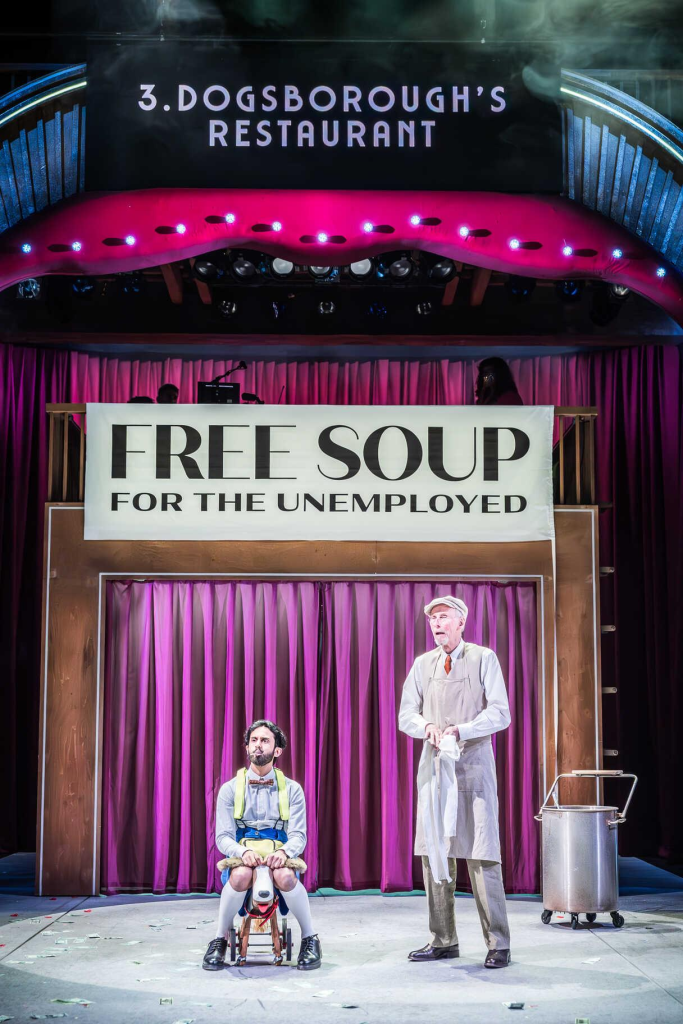
That isn’t to say that the plot is necessarily easy to follow. There are lots of moving pieces here – in its attempts to mirror real life, Brecht’s story becomes increasingly convoluted, and the play never allows us to connect with any of its characters to soften the political aspects. Again, drawing the allegories with German fascism is helpful for our understanding, but it doesn’t necessarily make for an enjoyable evening. One scene, in which Ui seeks lessons from an actor to make himself more performative, is increasingly reminiscent of current American politics, and whilst Gatiss’s movements become increasingly Hitler-esque, his American accent means that his oration often feels more akin to Trump.
Ui is surrounded by various mobsters and lackeys, including Rizwan’s Gigi, Kadiff Kirwan’s Roma and LJ Parkinson’s Givola. Of these, Kirwan gives the most successful portrayal, delivering a character that feels grounded whilst still remaining menacing. Rizwan is so manic that it becomes exhausting, and his character doesn’t really evolve over the course of the play, remaining fairly one-dimensional, whilst Parkinson gives a melodramatic performance that is in keeping with the style but begins to grate after a while. When Ui’s associates begin to turn on each other in the second half (Roma represents Ernst Röhm, so anyone who knows their German history will know how that ends), the scene is engaging but lacks tension, because there is simply no connection between the audience and the characters. It is something that the play continually struggles with. Again, this is all done very intentionally, but it feels like the play is doing “epic theatre” for the sake of it, rather than ever questioning whether it works as a theatre piece aimed at the masses.
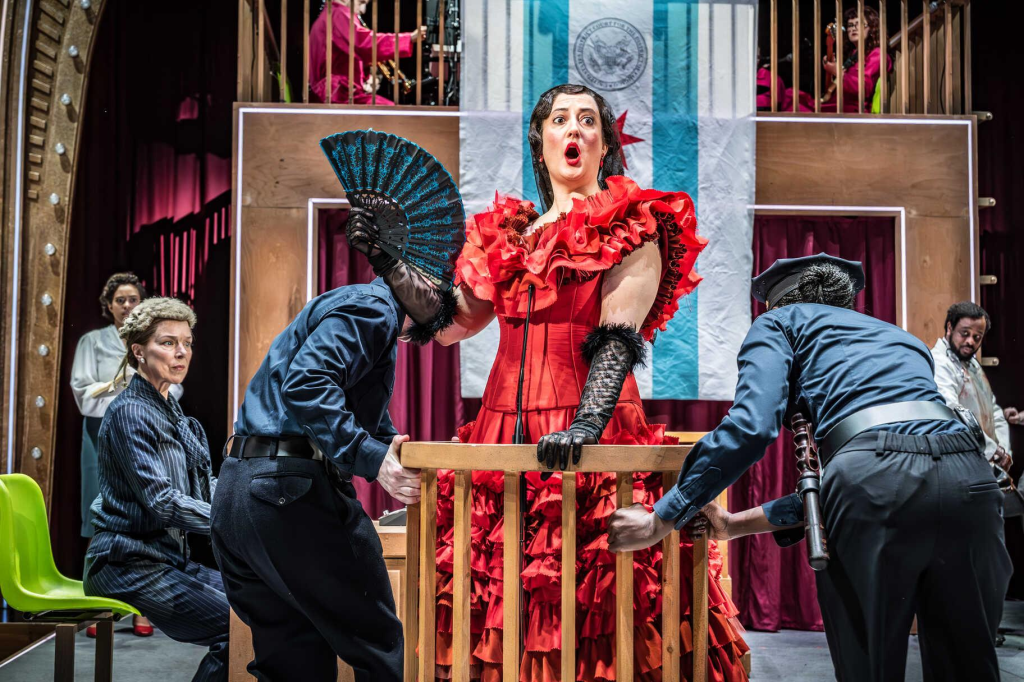
Having said that, there are elements of “epic theatre” that are not employed here. When actors swap characters, it is done offstage and with a change of costume and wig, and scene changes are continually masked with the use of a large gazebo (for want of a better term) that is brought forward over the set piece, before the curtains are drawn and any changes occur out of sight. It all seems at odds with the idea of “epic theatre”, and the constant back-and-forth of this gazebo is a faff.
If you’re a theatre or literature student that is studying Brecht, then this production is definitely for you. It is rare that a large-scale production such as this leans into a divisive theatrical technique so definitively and unashamedly, and for that the RSC must surely be commended. Whether it works or not is a different matter. There will be people who adore this, and there will be people who just don’t vibe with it. The final moments of the play, in which Gatiss drops his act and, referring to Ui/Hitler, warns that “that bastard almost won the human race”, before ending with “the bitch that bore him is in heat again” is utterly chilling, and, watching this the day after the Golders Green terror attack, has never felt more prominent. This is a timely revival, but one that feels like it possibly misses the mark for the majority of audience members.
Tom Morley, May 2026
Review Round-up:
The Guardian: The Resistible Rise of Arturo Ui – This is a play where I seemed to disagree with a lot of reviewers. 5* from The Guardian, who says the show “master[s] the balance between Bugsy Malone cartoonishness and threat”
All That Dazzles: The Resistible Rise of Arturo Ui – Also 5* from All That Dazzles, who give a much clearer idea of why they enjoyed the show so much, saying that “Gatiss’ Arturo Ui is a thriller, […] combining comedy and horror in his portrayal”
Financial Times: The Resistible Rise of Arturo Ui – 3* from FT, “there’s a relentlessness to [this play] that can be wearing and that has diminishing returns”.