

“Incredibly accessible, and ultimately very moving”
Derby Shakespeare Company’s summer offering sees them depart from their usual outdoor comedy and instead brings us the tragic, political tale of ‘Julius Caesar’, which plays at Markeaton Park before transferring to the Minack Theatre in Cornwall next month. The play features lots of characters and can appear complicated at first to the uninitiated, but Derby Shakespeare Company succeed by trimming some of Shakespeare’s text and focusing on the more human elements of the play. The main focus, therefore, becomes Brutus and Cassia (a gender-swapped Cassius), once loyal to Caesar but now wary of his growing influence and concerned about what this could mean for Rome’s future. Through these characters, the production creates a sense of growing tension as various chess pieces are moved into place ready for Caesar’s takedown.

Laura Horvath’s Cassia takes us on the biggest emotional journey here. She begins as the driving force behind the planned assassination, quietly manipulating Paul Sellwood’s Brutus into gathering a group of conspirators, who come together like a group of traitors meeting in a turret, albeit without Claudia Winkleman. But later, she is the first one to question their actions, and once war breaks out, she descends into a panic, which results in her death. It is a hell of an about-turn for our wannabe Roman hero, but Horvath charts this change with conviction, starting with a brash, confident politician but then allowing the cracks to slowly grow, leaving us with someone who is overly paranoid and struggling to maintain a grasp on reality.
Brutus, on the other hand, never seems quite in control of events. There is something of Macbeth in this tale, as Brutus is first convinced by Cassia to remove Caesar from power, and then finds himself trapped in a spiral of war and death. This production features a large cast, meaning that there is little need for multi-role, yet the choice to have both the Soothsayer, who predicts Caesar’s death, and Brutus’s wife Portia played by the same actress (Ellie Ball) reinforces this idea that there is no escape; Brutus is destined to take Caesar’s life, and then ultimately lose his own.
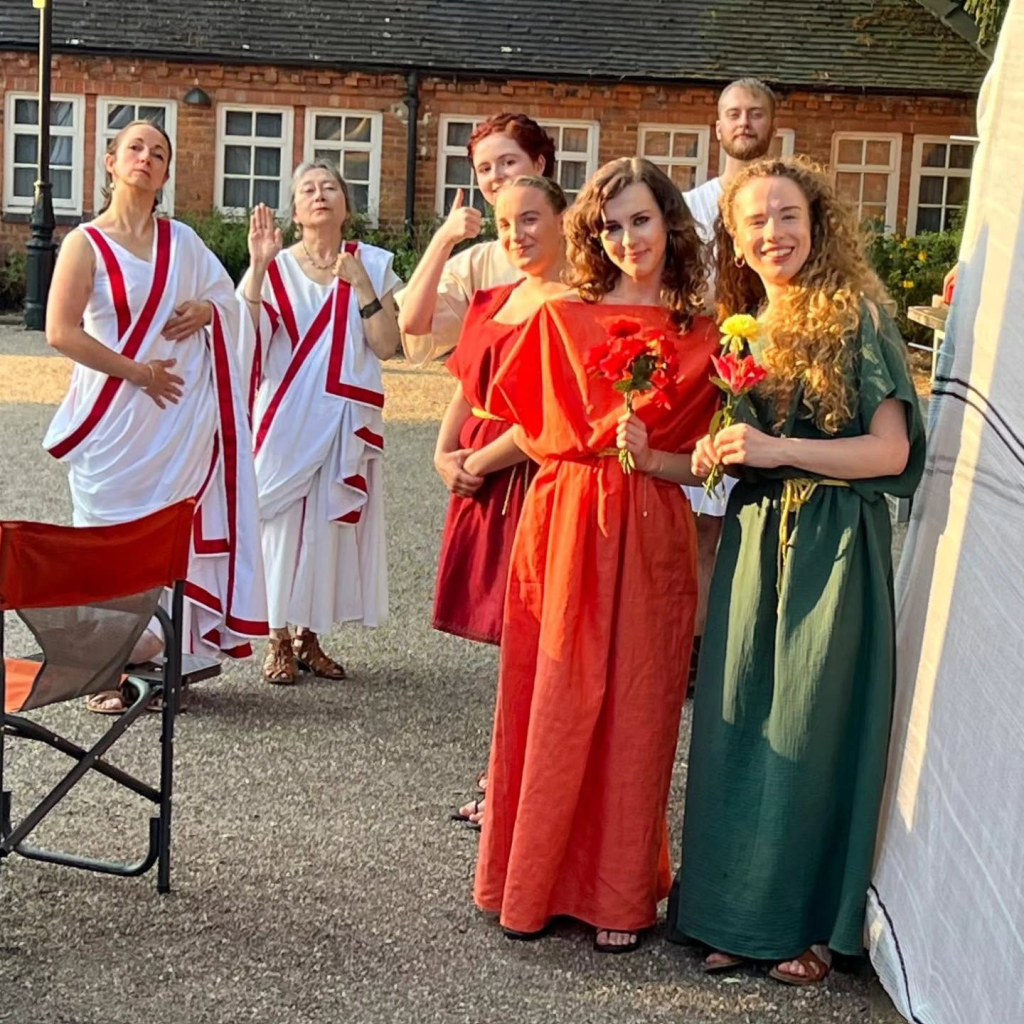
The idea of destiny is woven into this narrative throughout, and is most notably made apparent by the inclusion of Evelyn Scanlon, credited as ‘Girl’, who acts as a supernatural force, often appearing separate from the rest of the action. It is Scanlon that removes the bodies from the stage, and quietly observes events from a distance, her face set in judgement in a way that is fairly foreboding. It is notable that the only line she speaks is to bring both heads of the army, Brutus and Mark Antony (Mathew Shepherd) face to face for the first time. She is truly in control here – the Romans appear to be merely pawns in her great game.
Mark Antony takes centre stage in the aftermath of Caesar’s death. Whereas Brutus petitions the crowd from the pulpit, deliberately separated from the masses, Antony speaks from amidst the people, instantly presenting a warmer image, the type of leader “you could have a pint with”. Shepherd finds some humour in the famous ‘Friends, Romans, Countrymen’ speech, and then descends into a more traditional rallying cry as he holds Caesar’s bloodied mantle. Yet when Antony finds himself at war, Shepherd seems to lose some of his urgency. At one point, Antony’s soldiers arrest a man claiming to be Brutus (it is actually Richard Whitehorn’s Lucillius in disguise), yet Antony shows no surprise, or excitement, or even anticipation at the arrest. The moment is seemingly glossed over very quickly, and one wonders why it is included at all. At Antony’s side is Harry Hodder’s Octavius Caesar, who is a little more eager for the battles ahead, presenting a macho, reckless hero that nicely contrasts with Shepherd’s more laidback leader.
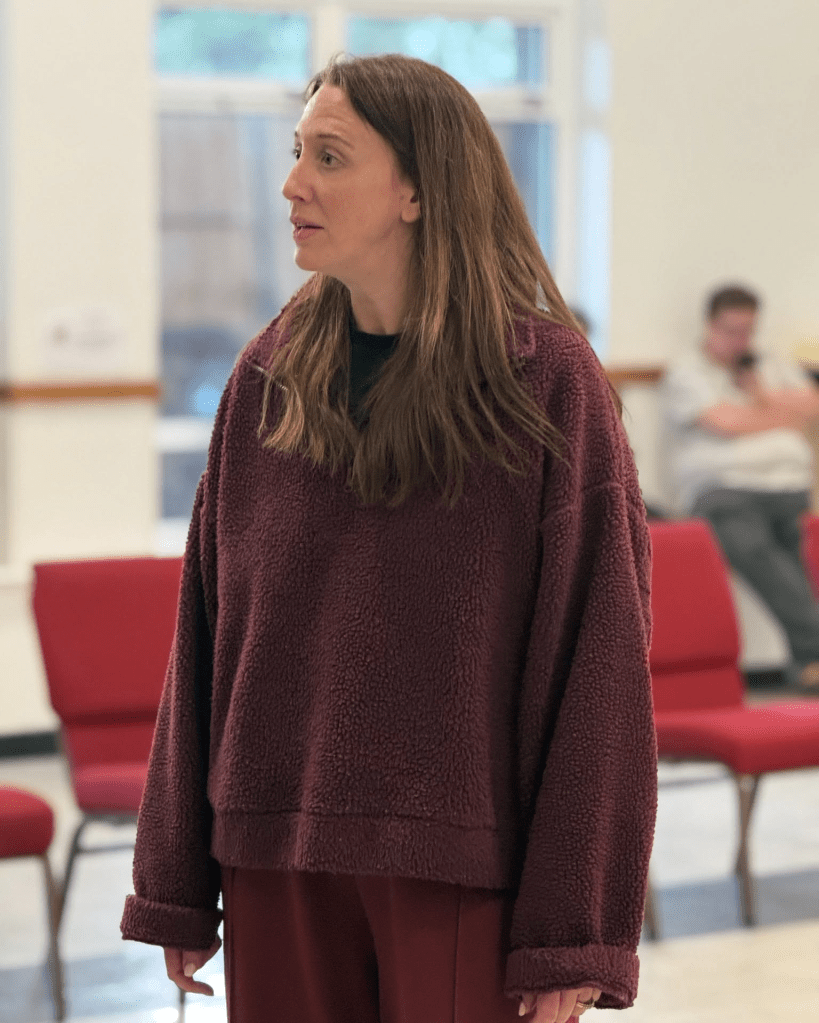
Director Leni Robson has chosen to set this production in the traditional surroundings of Ancient Rome, and there are a whole list of costumiers behind the scenes who have helped bring this to life, including Rachel Jeffree, Karen Owen, Amelia Devlin, Emma Buchanan, Louise Colver, Rachel Whitehorn and Selena Terjung. It is nice to see the play performed in a traditional sense (although as the programme informs us, Mark Antony would likely have been clad in nothing more than a loin-cloth, but perhaps it is for the best that Shepherd opts for the full toga). It does mean that there is not much variation between the costumes, but the production goes to great lengths to make sure soldiers are distinguishable, so that the plot is easier to follow.
Having a large ensemble means that lots of smaller roles are afforded much more care and attention than they might be in a production that has to keep reusing actors. Kirsty Williams’ Popilius Lena only appears briefly but is enough to set dissent amongst the conspirators with her sly suggestion that she knows more than she’s letting on. Jenny Earl’s Artemidoria tries her best to warn Caesar of his impending demise, but Ian Currie’s Caesar is too quick to dismiss her. The same happens with his wife Calphurnia (Clare Kirk), who gives a particularly moving speech to her husband which almost sways him, before he chooses to ignore her as well. In another production, these characters could have become lost amidst an ever-rotating cast, but here they have more impact.
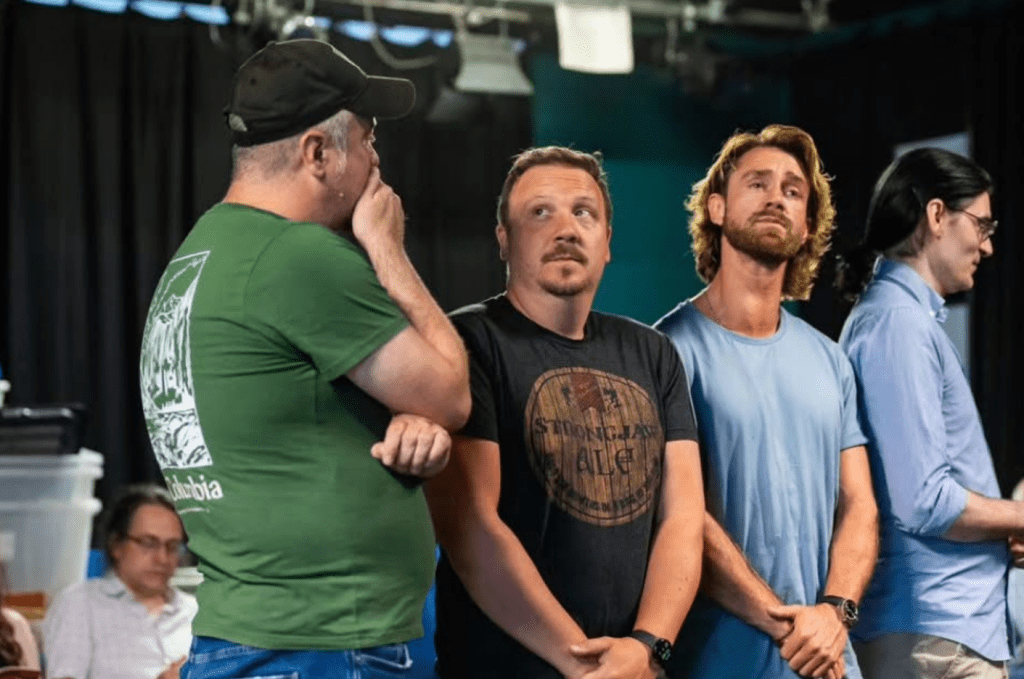
Yet it is surprising, perhaps, that the ensemble are not used more. The play struggles a little in creating the sense of a lived-in Ancient Rome. We are treated to a large group scene at the beginning, but then the play dissolves into a series of scenes featuring just two or three actors. I felt that the ensemble could have been used a bit more for scene transitions, to help give us more of an idea of the general feeling in Rome. It is hard to discern whether the general public are fans of Caesar or not – is he the tyrant that Brutus and Cassia claim he is? It’s difficult for us to make up our own minds. When the ensemble do appear at Caesar’s funeral, they seem a little subdued, and when Rome descends into chaos, we don’t really get to fully appreciate this.
When Brutus dies, the ensemble each have their own moment to mourn for him, which is a nice touch, and ends on a particularly beautiful note with Jude Grant’s Lucius, Brutus’ loyal servant, being the last to pay tribute to his body. Lucius is hardly the most important character in terms of plot – she spends most of the evening bringing Brutus messages and drinks – yet this quiet moment reminds us of the cost of war, and how it affects everyone from all parts of society. I would have loved to see more moments like this. Had the ensemble appeared more throughout, each of them taking their turn to mourn Brutus could have had a much greater impact.
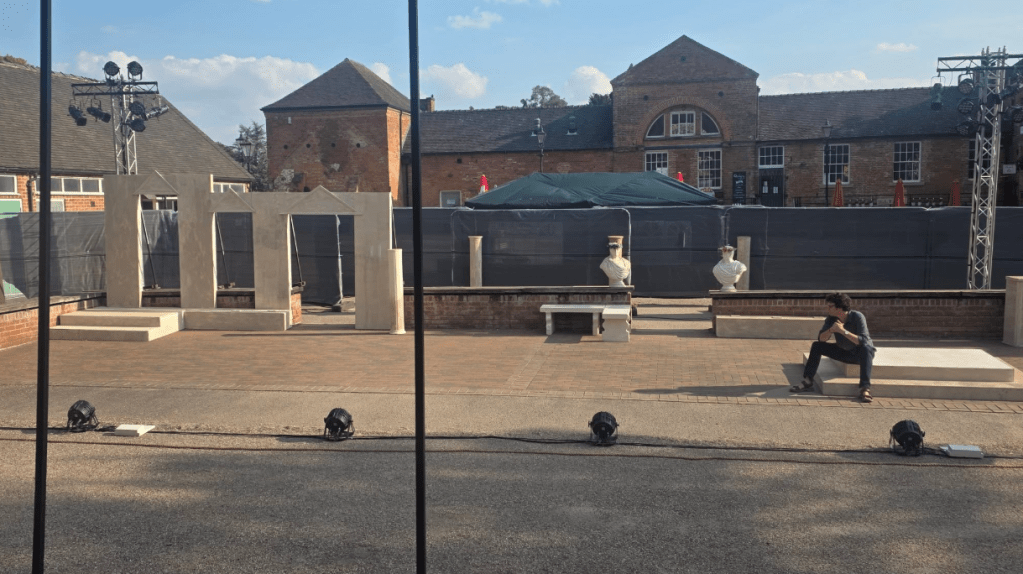
Admittedly, you cannot bring an entire war to the stage no matter how big your cast is, and thankfully we have Benjamin Lawley on hand who delivers one of the strongest speeches of the night as Pindarus, recounting the battle that is happening offstage. Shakespeare’s words do a lot of the heavy lifting here – the writer sure knows how to conjure an image – but Lawley’s delivery helps us picture exactly what is going on, giving us a sense of the claustrophobia of battle, and the exhausting twists and turns of hope and destruction. This is a key moment in the play – one that leads Cassia to make the decision to take her own life – and thankfully, in Lawley’s more than capable hands, it lands perfectly.
This is a triumphant production for Derby Shakespeare Company, and one that is bound to delight theatre-goers from across the world when it plays at the Minack Theatre in August. This company have taken a complicated play and made it incredibly accessible, and ultimately very moving. Often, ‘Julius Caesar’ struggles in that the second act can never live up to the thrills of the first act; in the wake of Caesar’s death, the play can sometimes lose its way. That is not the case here – dare I say the second half is even better than the first, mostly thanks to the strong and tumultuous relationship of Horvath and Sellwood’s Cassia and Brutus. It is the focus on character over plot that makes this such a success. After all, behind every political movement are a series of humans trying to do what they think is right, and that is exactly the idea that Derby Shakespeare gets across. Thrilling stuff.
Tom Morley, July 2026








 Broken Legs Blog