

“Dense and complicated [yet] fun, frivolous”

“Sex – the attraction that Newton left out,” proclaims mathematician Valentine in the second act of Tom Stoppard’s play “Arcadia”, currently playing at the Duke of York’s Theatre (which is due to be imminently renamed in honour of the late playwright). For all the maths and science on display here, it is truly the relationships that take precedent here, causing the chaos amidst the pre-determined in a story that flits back and forth between the early 1800s and the 1990s. “Arcadia” deals with big ideas, such as whether one can explain nature with equations or whether free will can possibly exist in a post-Newtonian world, but it is the smaller, more intimate moments that will stay with you, as Stoppard’s knotty plot takes a backseat to the fascinating characters on display.

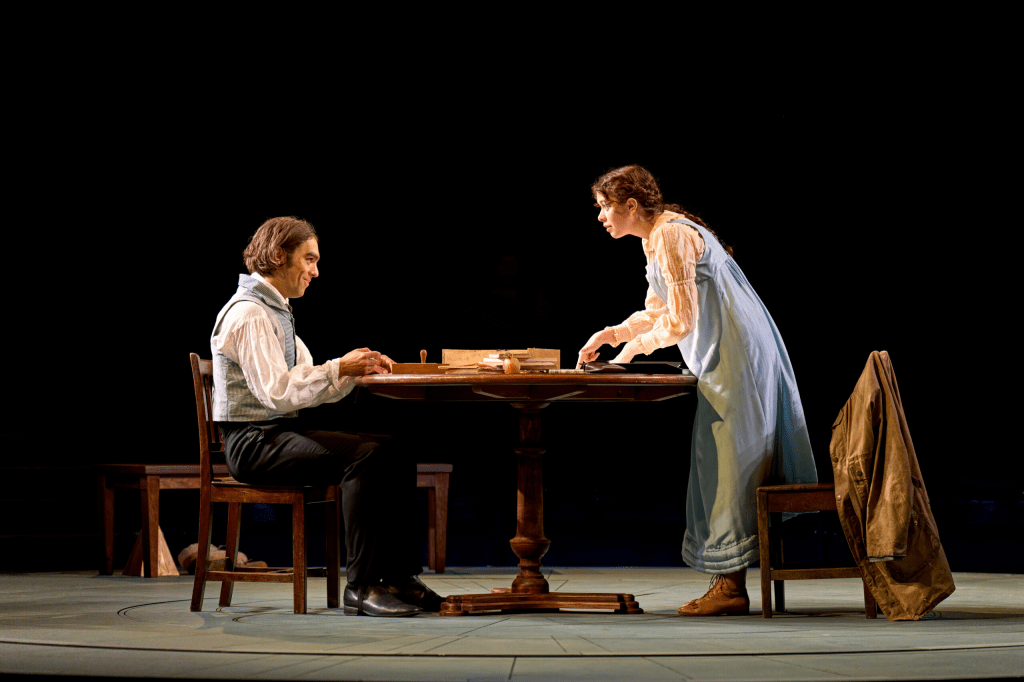
We begin in the 1800s with Isis Hainsworth’s child maths prodigy Thomasina being taught by her tutor Septimus (Seamus Dillane). The two have a complicated relationship throughout the play, part teacher-student, part older brother-sister and slight hints at something inappropriately romantic bubbling underneath. As Thomasina questions Septimus about the facts of life, one cannot help but feel she already knows more than she’s letting on, almost mocking her tutor as he stumbles in his explanations. Thomasina is blatant and to the point, yet there is a childlike innocence in Hainsworth’s performance, made all the more endearing by Thomasina’s clear fascination with mathematics and philosophy. Of all the other characters, Septimus is the only one to take her seriously, often marvelling at her intelligence, but never bestowing too much praise on her, ensuring she remains humble and unaware of her gift.
The lesson is interrupted by the arrival of poet Ezra (Matthew Steer), who accuses Septimus of “insulting” his wife. Septimus responds in his usual blunt manner, explaining that he has made love to Ezra’s wife but would never dream of insulting her. What follows is a very funny confrontation, in which Septimus continually twists Ezra’s words to make him look the fool. It helps that Steer portrays Ezra as a bumbling, childish buffoon, his bottom lip practically quivering whenever he fails to get his own way. The comedy is heightened upon the arrival of gardener Noakes (Aaron Anthony) and Lady Croom (understudy Peta Cornish), at which point there is an unfortunate miscommunication in which Septimus believes Noakes to be discussing his affair, when in actual fact he is talking about the garden. Such is an example of Stoppard’s incredible wit, which is weaved throughout this play and delivered perfectly by the cast, turning what is at times a wordy script into an engaging three-hour jaunt.
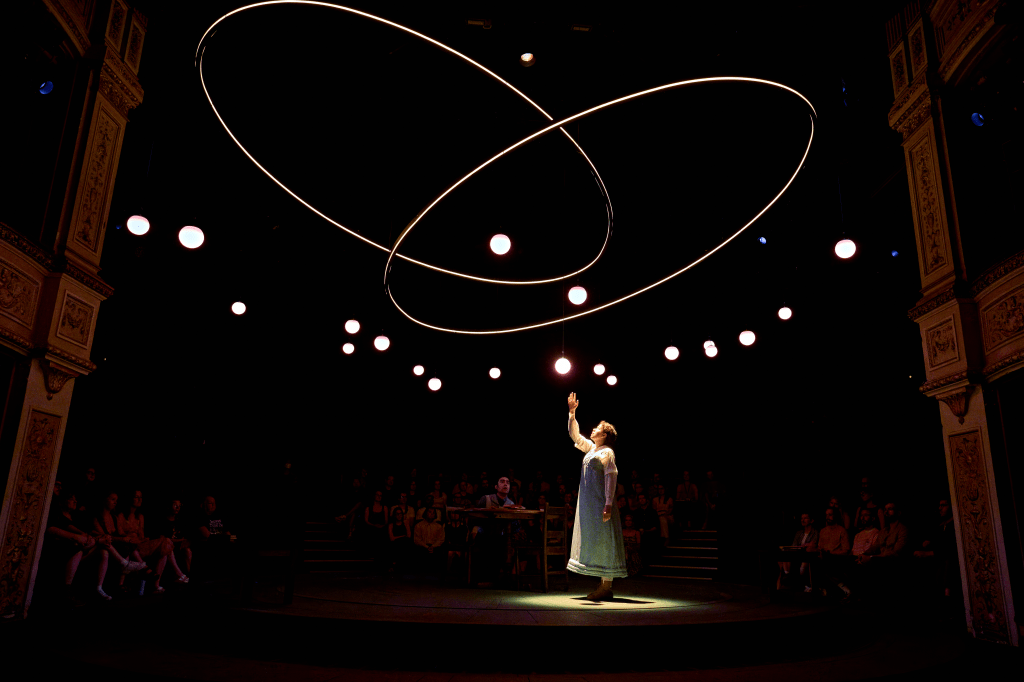
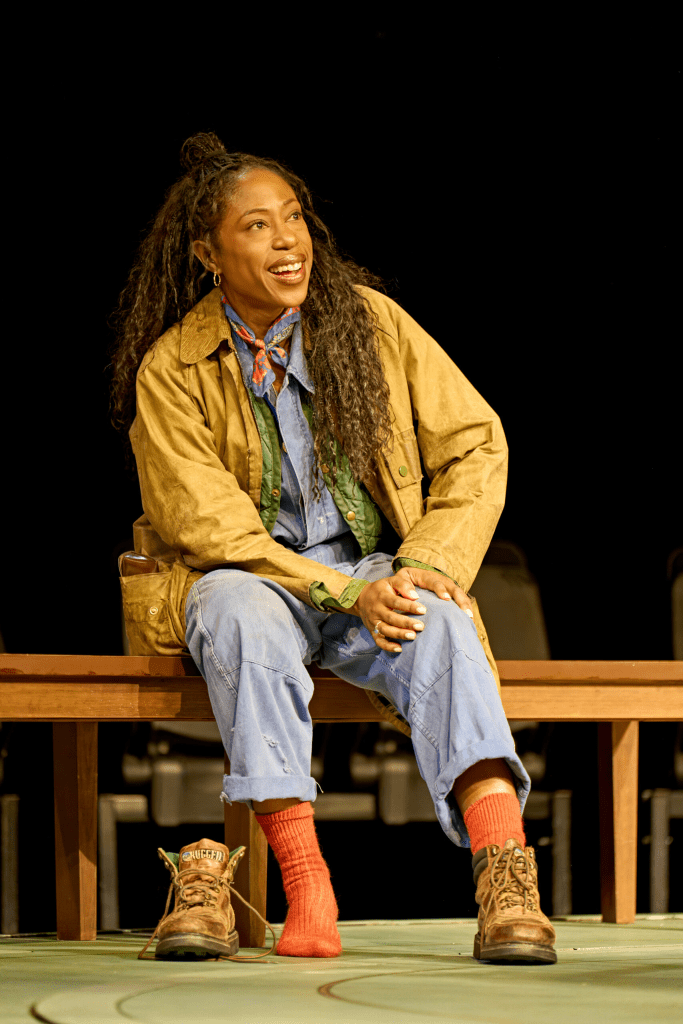
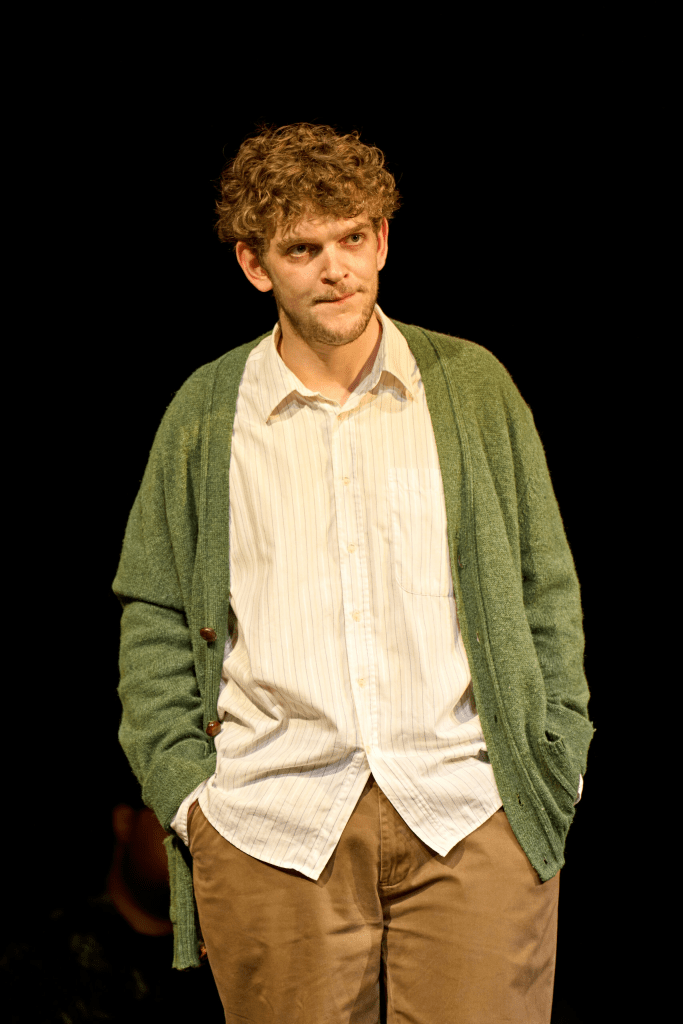
When the story flips to the 90s, the change is slightly disconcerting – the audience have just settled with one set of characters, and now we must grapple with another set. The setting is the same manor house of the first scene, but we are now almost 200 years later, and Lord Byron enthusiast Bernard (Oliver Chris) is positing a theory that the famous Romantic was responsible for the death of less famous poet Ezra. This is all based on the dedication of one of Ezra’s poems – a dedication we have seen written in the opening scene, and here is wildly misinterpreted by historian Bernard. He is not the only one making mistakes in his research – gardening historian Hannah (Nikki Amuka-Bird) is trying to dig up some information on the house’s hermit, seen drawn in a sketch from the 1800s. But the audience know full well there is no such hermit – we saw Thomasina add the hermit to the sketch as a joke in the earlier scene. And so this continues, with both historians chasing stories, digging up ancient artifacts and manuscripts and constantly jumping to the wrong conclusions. Interspersed with this, we continue to see the lives of Thomasina, Septimus and Ezra playing out, showing exactly how many mistaken conclusions the 90s characters are making. The dramatic irony on display is almost of Shakespearean proportions.
Hannah and Bernard have a particularly feisty relationship, and their back-and-forth is highly enjoyable, helping to keep things light even when the plot becomes a little heavy, Amuka-Bird often drawing laughs from the audience in her put-downs and vicious mocking of the over-enthusiastic Bernard, who has a bit of a nasty streak at times. Also thrown into the mix are descendants of Lady Croom, Valentine (Angus Cooper), Chloë (Holly Godliman) and Gus (Matthew Doswell). Cooper’s mathematician has such passion for the subject it is infectious, and he is able to take complicated ideas and make them seem simple, straightforward and, dare I say, romantic. On a personal note, as someone who often works with population forecasts as part of my day job, Valentine’s description of how forecasts are made is practically poetic and delivered with utmost precision by Cooper, in a way that is engaging and heartfelt.
The Duke of York’s Theatre has been adapted to present the play in the round, with additional seating added at the back of the stage, whilst Alex Eales’ set design is fairly sparse, a desk and some chairs set amidst two revolving floors, an interior that spins clockwise and an exterior that spins anticlockwise. Both revolves are used to great effect during the transitions between time frames, almost showing time stretching and running backwards and forwards concurrently, as the past influences the future, and future occurrences mimic the past. Comparisons between past and future are also drawn in Suzanne Cave’s costume design, which sees characters don similar colours where there are clear connections to be drawn – for example, between Chloë and Thomasina who both arrive at similar ideas about chaos theory, and both proclaim to be the first person to have ever thought about it.
As the play continues, both time periods start to intermingle, and we see two scenes playing at the same time. Director Carrie Cracknell has great fun moving two different sets of characters between each other in interesting and sometimes comical ways. For instance, as two characters in the 1800s break off a passionate embrace, Bernard immediately storms between them to collect some more research materials. It is incredibly well choreographed, and done in a way that makes both strands of the story easy to follow. Later, a pair of characters in the 90s share a waltz at the same time as a pair of characters in the past, and we begin to question whether there is such a thing as free will after all, or whether everything is determined as in Valentine’s theories. After all, such repetition seems to recall the earlier references to mathematical algorithms.
This production is dense and complicated, and demands your attention, especially if one is to pick up on all the answers that are sprinkled through the text but not always made totally clear to the audience. Stoppard’s script is rich with details, and every single one is important – often details are recalled later to help audience members join the dots. For those more interested in light-hearted drama, there is plenty of that here too – there are scenes which tip over into farcical territory as characters try to hide their affairs from each other, as well as some scenes which perfectly build tension as characters find themselves in almighty arguments with each other. Upon opening the accompanying programme, which features a glossary of terms and extra details on such things as fractal geometry, Capability Brown, the Newcomen Steam Engine and Fermat’s Last Theorem, audience members may feel overwhelmed and start to be concerned that what they are about to watch is too highbrow for them. Believe me, it isn’t – the more difficult concepts are explained well, and are mere backdrop to a story that is fun, frivolous and absolutely fantastic.
Tom Morley, July 2026
Review Round-up:
Theatre & Tonic: Arcadia – 5* from T&T, who say this is “a profound piece that challenges ideas, and the writing is beautifully genius”
London Theatre: Arcadia – 5* from LT, who explain that “Stoppard’s genius is that you don’t have to comprehend all the theories to understand the soul of the play”
WhatsOnStage: Arcadia – And 4* from WoS, who say that Hainsworth’s “transformation from wide-eyed 13-year-old 19th-century student to young woman is a masterclass in control and tender love for character”











 Broken Legs Blog