
“A perfect representation of the difficulties we face as a society today – all wrapped up in a camp, sci-fi cliché”
Camp 80s sci-fi is back with a bang in this production that mixes everyone’s favourite tropes with a nuanced discussion around gender identity. Structuring this discussion around the story of two genderless aliens may seem an odd choice, but it allows for a unique exploration of the impact of a biased media and how easily dangerous ideology can influence people’s own opinions. ‘Hindsite’, written by Órla Conder, was first performed last year at Derby Theatre, but here it is given a thorough update, with extra detail added to the alien protagonists’ backstories, and a second act that allows for a more satisfying conclusion to the story.
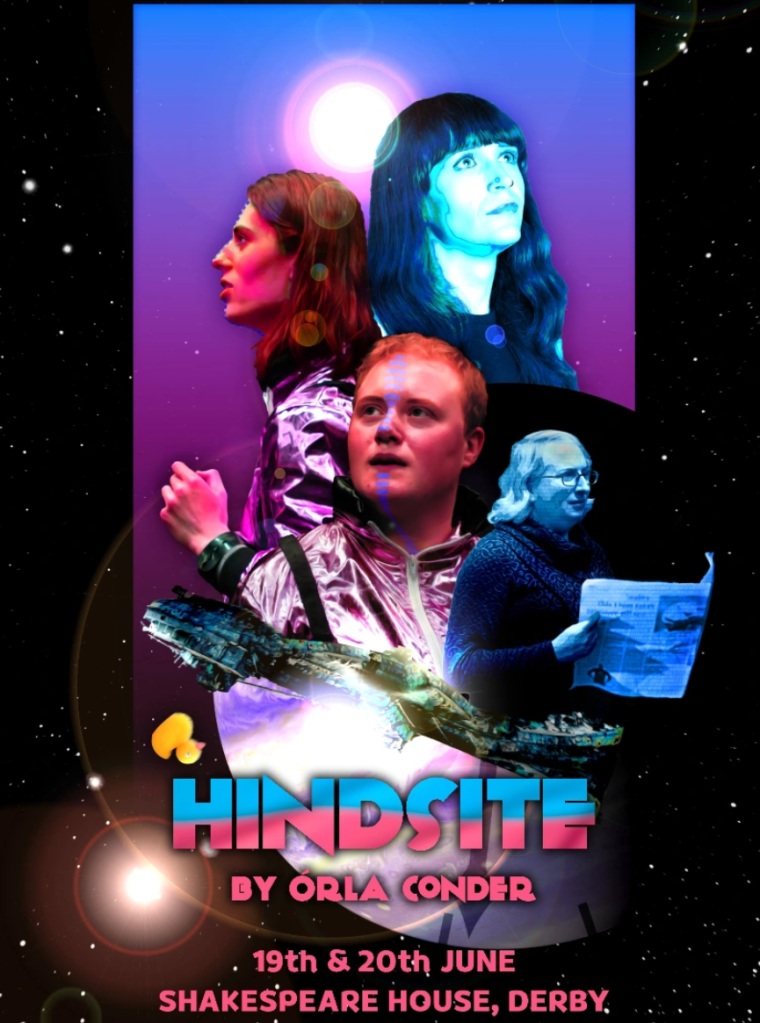
It is several thousand years in the future, and alien historians Tee (Charlie Anthony) and Etcha (Haisely Jane) come across a wreck of a human spaceship. It turns out that aliens also have dysfunctional families, with Tee struggling to find the right ways to connect with their child back home, and Etcha growing ever more estranged from their parents and wider family. From the outset, both aliens are at odds with each other – one longing for a closer family, the other keen to put the past behind them – and it is this difference of opinion that leads to a feisty relationship that grows ever more fraught as the play continues.
The human spaceship is named Chevaliere, and shares its name with a famous 18th Century trans historical figure Chevaliére d’Éon. The costume of the fussy AI (Kay Fowler) emphasises this historical connection, elements of French aristocracy mixed with tech chic. Whereas in the previous version Fowler appeared only via screen, here they are a fully-fledged hologram, allowing Fowler greater ability to interact with the other cast members, with some excellent sassy dialogue and sarcastic quips. Tee and Etcha take the AI back to their own ship in the hope of using it to garner information about the lost human civilisation.
Much of the human data has been lost, but thankfully some has been retained in the form of video diaries of a young trans woman, Iris (Conder). Throughout the first half of the play, these diary entries provide us insight into snippets of Iris’s life, as we see her slowly come to terms with her identity, whilst also facing hate and verbal abuse from her peers. It is particularly moving and at times hard to watch – Conder delivers these segments with such sincerity that one cannot help but feel there is some sad truth to these events. As time passes, Iris’s appearance also changes – her hair is let down, trousers become a skirt, and in spite of the discrimination she faces, she becomes visibly more confident. Etcha takes solace in these video diaries, obsessing over them and watching them again and again – an outsider in their own family, Etcha is able to relate to Iris’s situation even though they have no understanding of gender.
Tee, meanwhile, relies on historical newspaper reports which are delivered in suitably melodramatic fashion by Fowler’s Computer. The reports are all clearly biased views of transgenderism, and the language they use is shocking to hear – the fact that they are taken from actual newspapers ranging from the 80s to just last year is particularly harrowing. Fowler softens the blow slightly with a humorous exaggerated narration, almost spitting the words at Tee as they recite the nasty articles. Tee, however, is completely taken in by the media narrative, coming to view transgender people as terrorists and a danger to children. This particularly strikes a chord with Tee, whose mind keeps drifting back to their own child at home. Before we know it, Tee has been completely indoctrinated into an anti-trans mindset, and both aliens find themselves at loggerheads.
The second act adds a third dimension to this argument, as Etcha makes the decision to resurrect Iris thanks to a clever bit of sci-fi wizardry (and some gadgets that look suspiciously like a Sega Megadrive and a Ben 10 Omnitrix). Etcha believes that allowing Tee to speak to Iris is the best way to convince them that trans people are not as evil as they have been led to believe – but it is, of course, more complicated than that, and Iris instead turns on Etcha, accusing them of seeing her merely in terms of her gender and not treating her as a person. This takes a seemingly two-sided debate and helps us see past the politics to focus on the people underneath. It lends a more personal aspect to proceedings – the focus becomes less on political messaging (although that is, of course, still present) and more on character.
I won’t go too much into the resolution here, but needless to say there is an enjoyable heart-to-heart between Conder and Anthony that wraps things up nicely. There is still some unresolved tension, but things begin to drift towards an amicable conclusion. The second act does get a little caught up in too many ideas – there is a subplot about Iris realising, upon her resurrection, that all her friends and family are no longer alive, which is an idea already covered by plenty of sci-fi franchises and doesn’t really add much to Conder’s character other than to get in the way of the more meaty conversation around gender.
This is a play that explores themes and ideas that are often hard to talk about without it feeling like a lecture – and yet, it does it in a way that is entertaining, interesting and incredibly funny. The humour is one of the biggest selling points of this piece – anyone who is a fan of Red Dwarf, 80s Doctor Who or Star Trek will be right at home here, with just the right amount of blaring sirens and technobabble to inject some tension to proceedings. But where the play truly excels is in its character moments, watching arguments unfold and seeing how the characters have to work through their problems to find a way to resolve this knotty disagreement. It is a perfect representation of the difficulties we face as a society today – all wrapped up in a camp, sci-fi cliché. A fun, thought-provoking night of theatre, and a play that seems destined for future Fringe events. To infinity and beyond!
Tom Morley, June 2026
For more info on ‘Hindsite’, listen to Kev Castle’s interview with Órla, Charlie and Kay here.