
“A fascinating premise […] visually stunning”
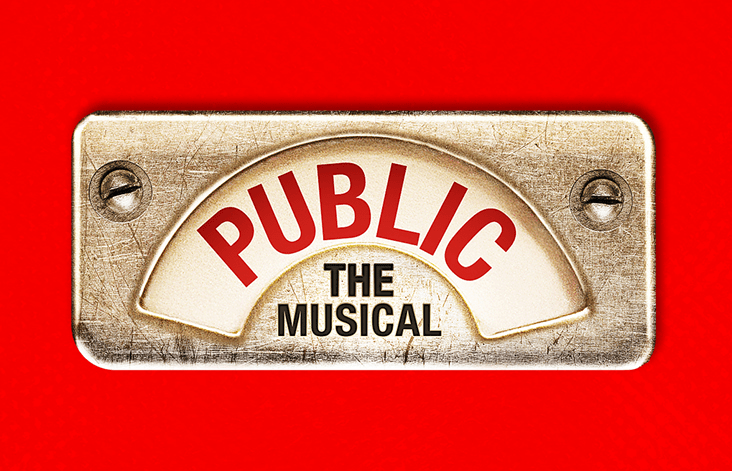
A musical set in a toilet is an excellent hook for a production, and one that is sure to have people intrigued. The central conceit for “Public” is that four strangers end up having to spend a night in a public toilet after they get locked in. Cue lots of initial panicking, before the strangers decide to accept their fate and spend their time getting to know each other, moving from awkward small talk to more in-depth, emotional conversations. It is a scenario that is easy to relate to – all of us can put ourselves in that situation and picture what our own reactions would look like. Unfortunately, it is also a story that is hampered by the fact that the characters portrayed here are simply not that interesting, the dialogue often feels unnatural, and the script is bogged down by heavy-handed political correctness.
By far the most engaging storyline comes courtesy of Cole Dennis’s Laura, who becomes trapped inside the toilet on the eve of their wedding. Throughout the course of the musical, we learn more about Laura’s reservations regarding marriage, although it takes a while to get there (the other characters spend a decent proportion of the play believing Laura is on the way to a friend’s wedding rather than their own). Dennis also gets most of the laughs thanks to their dry delivery of some excellent put-downs, and some awkward comments that have to be immediately followed by “that was a joke” when they inevitably create tension. Laura goes on the most clearly defined journey here – the play obviously wants to convey the idea that each character leaves the toilet changed by their experience, but this is not so apparent in other characters.
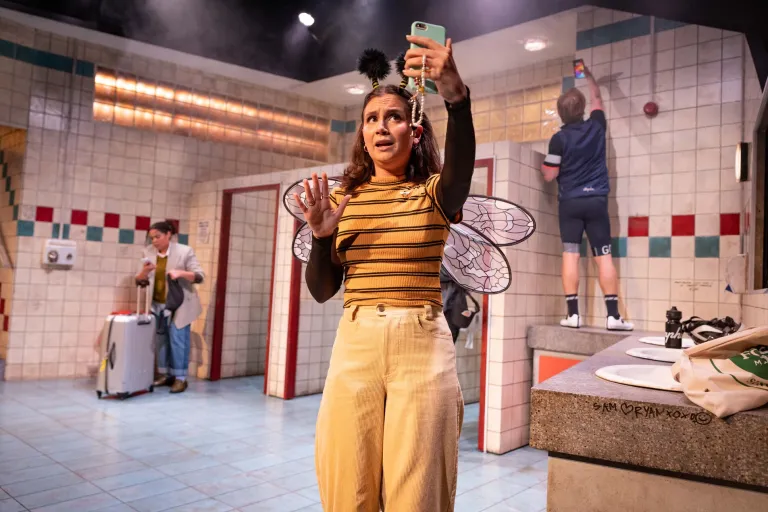
Social media addict Zo (Grace Towning) begins as an insufferable Gen-Z influencer and mostly remains that way. She comes across as incredibly false and overly familiar with the other characters – which is the point, of course, emphasising how Zo’s online personality has slowly bled into her everyday personality in a way that is not particularly healthy. Unfortunately, the script doesn’t properly deconstruct her character or offer enough backstory to allow us to better understand her, nor does it give her much room to grow and change. In fact, by having the only female character begin as overly opinionated, and her endpoint leaving her as more considerate yet also a little bit quieter, the play risks pushing a fairly anti-feminist agenda.
The backstories to the characters just aren’t engaging enough to hold our attention. Ivano Turco’s Finlay hints at having a sick grandmother that he has to care for, although when the others question the nature of his grandma’s illness, the response is that “she’s 92 so everything is going wrong”, which isn’t a particularly interesting reply and leaves the script with nowhere to go. There is some tension created when it becomes apparent that Zo is able to live comfortably with her parents without paying rent, whilst Finlay is forced to work extra hours at the pizza takeaway to make ends meet, but again these differences in upbringing are never properly explored, instead treated as throwaway comments. There are glimmers of interesting stories to tell here, but those glimmers are never properly utilised.
The show lends itself well to the ongoing debate surrounding gender-neutral public toilets, and by including characters of different genders and sexualities, it creates an interesting melting pot in which to explore the concept. It is, therefore, slightly concerning that writers Hannah Sands, Kyla Stroud, Natalie Stroud and Olivia Zacharia choose to make their only straight male character overly aggressive and prone to angry outbursts. This is hardly likely to convince those audience members who may be concerned about female safety in gender-neutral bathrooms otherwise. Andrew (Matt Corner) is a walking caricature, embodying the tired trope of a guy in finance who thinks he’s more important than everyone else, is number one mansplainer and hates working in finance. As the only straight male, he quickly is turned into the villain of the piece (sigh), refusing to use correct pronouns, and continually following his derogatory comments with the quip “I’m not allowed to say that anymore, am I?”
I’m all for plays that try to educate and push forwards ideas surrounding sexuality and gender identity, and at times “Public” handles this well. Laura’s discussion of why they identify as non-binary is one of the best articulated I have heard, and the explanation that it is currently impossible for non-binary people to get married (they must identify as either male or female on their marriage certificate) is something I was unaware of beforehand. But this scene is preceded by so much back-and-forth over pronouns that the point feels like it has been hammered home and then some. In my opinion, the best way to get people to accept pronouns is to use them without question, to normalise the use of different pronouns and just make them part of everyday language. Yet the emphasis put on pronouns here makes them feel jarring and out-of-place, which feels like shoe-horned political correctness rather than anything overly progressive. At times, it feels like we’re watching four drama students interact rather than four fully fledged characters, the language is unnatural and trying too hard to be inclusive. I want to stress that I am fully in support of inclusiveness, but the best way of being inclusive is when it feels natural – when it is unnecessarily forced like it is here, the show is in danger of ‘othering’ people, making them feel like someone purposely upsetting the status quo and going against the norm.
The music throughout is upbeat and pop-infused, yet there are lots of songs here, most of them a little too short and none of them having a particularly strong identity – they all seem to merge into one after a while, and very few will stick in the mind long afterwards. By far the best song is “Minute by Minute”, which really should be longer and enjoy a reprise or two later in the musical. Andrew’s “Missing Pieces” is a standout moment, possibly the best written as Andrew opens up about his childhood and his failed marriage, whilst Finlay’s “Nervous Disposition” is a nice, quieter moment for the musical, and is beautifully performed by Turco.
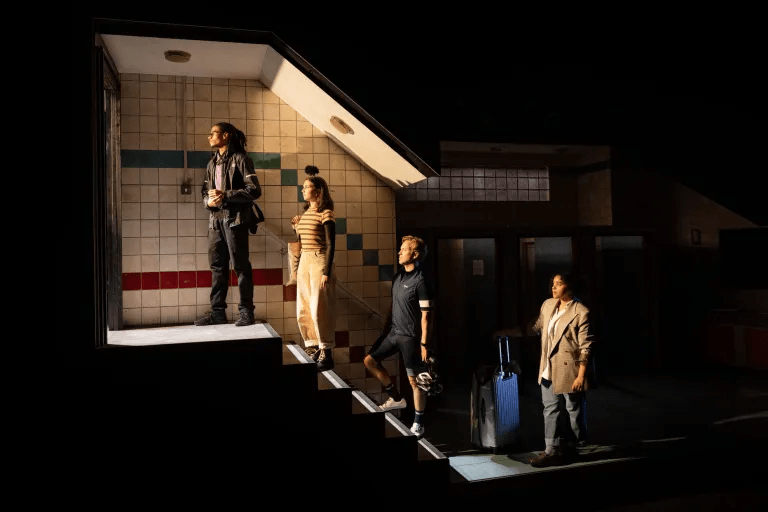
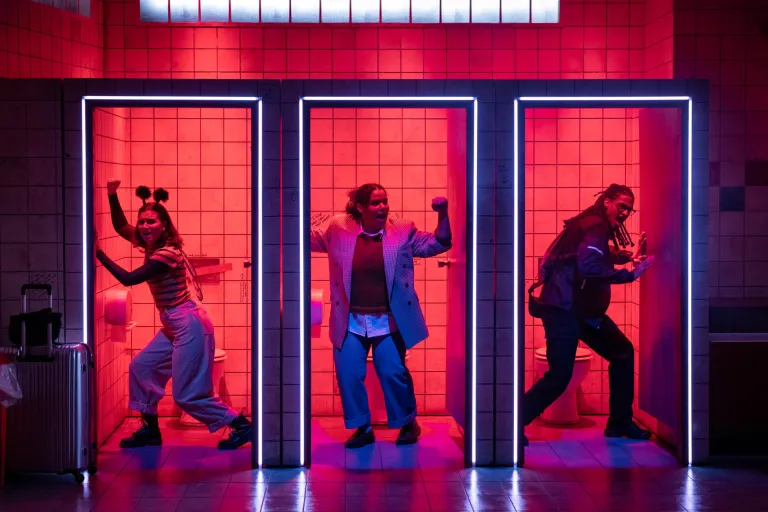
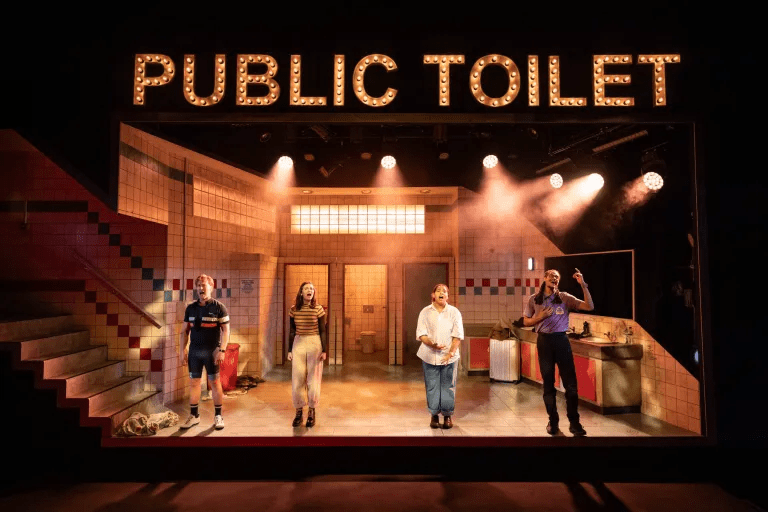
Amy Jane Cook’s set design is absolutely stunning, your usual public toilet with hidden musical glitz. The mirror lights up like an actor’s dressing room, the cubicles move back to create a dancefloor in the centre of the stage, and neon lighting around the handrails and cubicles help to quickly change the tone of the piece as required. What starts off feeling like a lived-in, natural space quickly becomes something more theatrical. It is truly an inspired design.
Visually, this musical is stunning, and a lot of the musical numbers are exciting to watch. Unfortunately, in my opinion, the production does not handle its political messaging particularly well, does not feature very interesting characters and has a non-existent plot, making for a fairly dry and unengaging night of theatre. Is there the makings of something special here? Potentially – it is certainly a fascinating premise, and feels timely amidst ongoing conversation surrounding gender. But it needs better dialogue, a tighter plot and characters that are easier to invest in and identify with. It has a long way to go.
Tom Morley, June 2026
For more information on how I decide on star ratings, see here: Star ratings – Broken Legs Blog
Review Round-up:
Elemental Theatre: Public The Musical – 4* from Elemental Theatre, who call the show “entertaining, frequently funny and anchored by a heartfelt central message”
JackStage: Public The Musical – 5* from JackStage, who says that the “beautifully diverse cast allows all audiences the opportunity to connect with someone on that stage”. He also points out that it “feels like the right time for this show to come around, where public restrooms are becoming increasingly weaponized as a political target against transgender inclusion” – although the show doesn’t really explore transgenderism in any way.
East Midlands Theatre: Public The Musical – 4* from EMT, who commend the “great songs and soaring harmonies in the quartet numbers”, although point out that the “important messages about queer identities […] can come across as a little bit too earnest at times”










 Broken Legs Blog
Leave a comment