
“A breathless rollercoaster ride of pantomime, punchlines and plants”

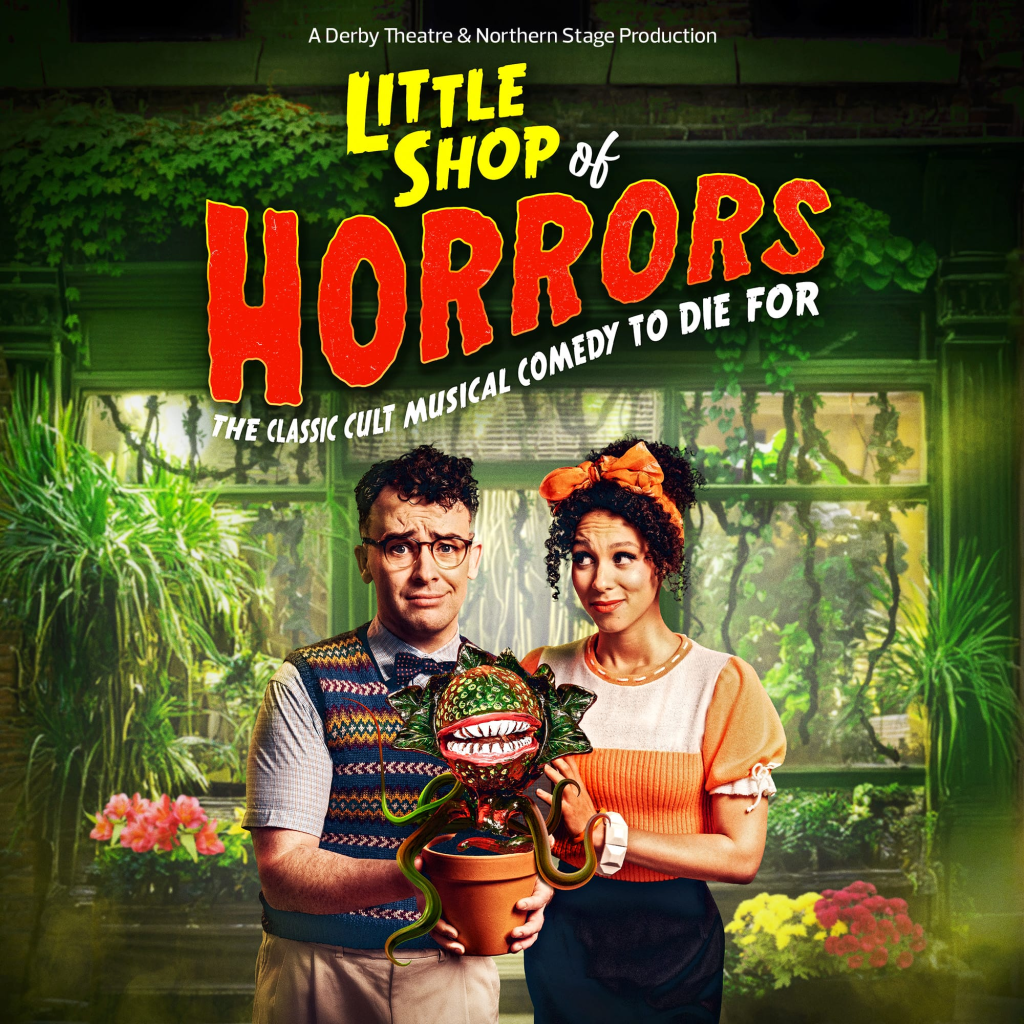
Leaning heavily into B-movie comedy-horror tropes, Derby Theatre’s revival of “Little Shop of Horrors”, produced in collaboration with Northern Stage, is fast-paced and ferociously funny. Telling the story of Skid Row florist Seymour (Kristian Cunningham), who discovers a strange and mysterious plant that turns out to be a sassy human-eating murderer, the show is incredibly cartoonish and over-the-top, the design and direction matching the ludicrous plot with a hefty dose of tongue-in-cheek. That’s not to say that the show doesn’t find more tender moments – the developing romance between Seymour and Audrey (Amena El-Kindy) is sweet and endearing, although some underlying commentary around domestic abuse feels a little jarring amidst the rest of the frills.
Mushnik’s Florists is struggling, and business man Mr Mushnik (Jon Bonner) is about the shut the shop down for good, when Seymour reveals his latest project – a small venus flytrap that he has lovingly named ‘Audrey II’ after his co-worker. Upon revealing the plant, business immediately picks up – literally immediately, as no sooner has Seymour brought the plant from the back room than a customer arrives and purchases $100 worth of roses. It is all silly comedy, but played with sincerity – the joy and excitement shared between Mushnik, Seymour and Audrey is infectious, and immediately turns them into characters that we want to succeed. It isn’t long before Seymour discovers that Audrey II has a taste for human blood, however, and things begin to take a more sinister turn…
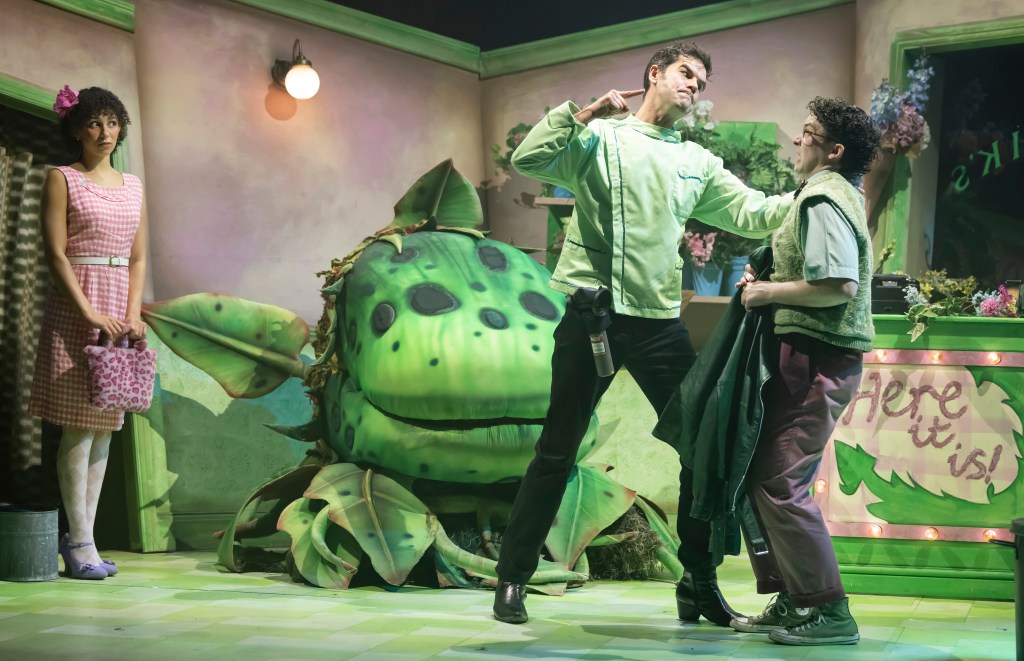
Whilst Audrey II brings Seymour fortune and fame, his main desire lies in winning Audrey I’s heart, and standing in his way is David Rankine’s Orin Scrivello, a no-good sadist who treats Audrey particularly badly, both physically and verbally attacking her. The show treads a fine line here – Rankine is incredibly pantomime-esque in his outbursts, so never comes across as particularly threatening, and when he smacks Audrey it is again not made to feel particularly realistic. Some may take issue with this, but it works in the overall context of the show, which never tries to take itself too seriously, and means that the show mostly remains firmly in family-friendly territory. However, it then feels particularly jarring when Orin suddenly dials up the taunts by calling Audrey a ‘slut’, which come across as a bit too adult and out-of-place.
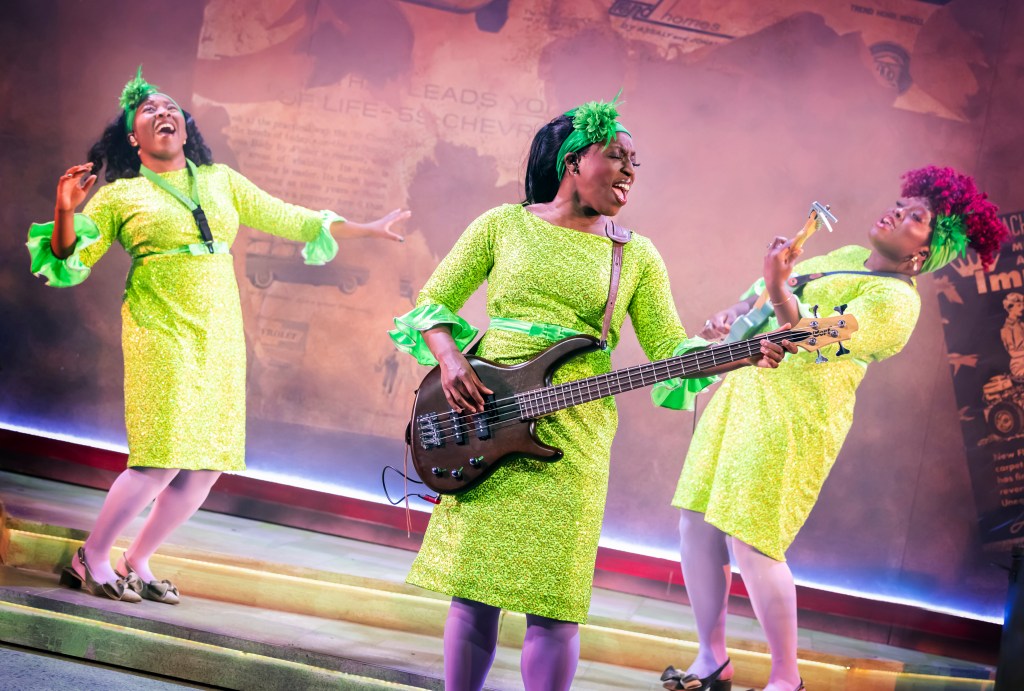
Throughout the play, street urchins Crystal (Shekinah McFarlane), Chiffon (Chioma Uma) and Ronnette (Emmanuella Chede) act as narrators of sorts (the accompanying programme refers to them as all-seeing Fates), providing additional context to the scenes as well as some stellar vocals, in particular McFarlane during the opening to song ‘Skid Row’. Despite all three characters serving the same purpose, the show succeeds in making them feel distinct – Chiffon is clearly the more gullible of the three, easily taken in by Rankine’s Dentist whilst her peers are not so easily fooled. It is aspects like this that make the Fates more enjoyable and engaging to watch, something that wasn’t quite achieved by the current Legally Blonde tour in which Delta Nu girls serve a similar purpose but with less success.
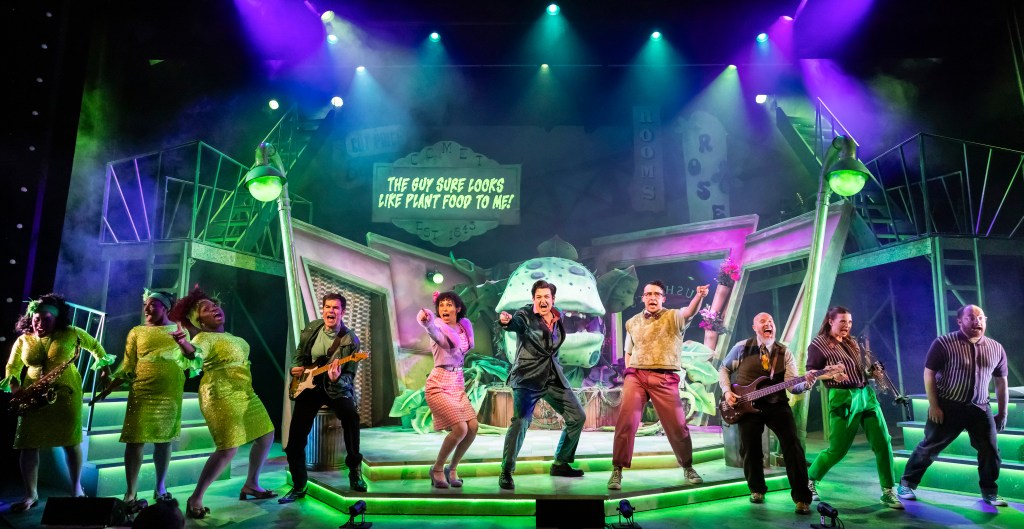
Verity Quinn’s set design is reminiscent of a comic-book come to life, walls and lamp posts built at goofy angles, a palette of pastel greens and pinks bleeding into Quinn’s costumes as well, which is all beautifully cohesive. The show features integrated captions courtesy of Ben Glover, improving accessibility whilst also adding to the comic-book style, the captions making use of different font styles for different characters and different songs, and appearing in different projections around the set, sometimes as speech-bubbles directly next to the actors, and sometimes framed above the actors’ heads. Thankfully, a voice-over at the start states very clearly that the captions are not there to encourage audience members to join in with the songs – and one cannot help but wish that all musicals would feature a similar instruction, regardless of whether there are captions or not.
Director Sarah Brigham and Dramaturg Emma Jude Harris take a sensitive approach to Bonner’s Mushnik, reducing Jewish stereotypes present in the original production, although in doing so, it does leave Mushnik as a little bland in comparison with the other larger-than-life characters on display. In musical number ‘Mushnik and Son’, Bonner never quite hits the comedic highs that are strived for, and Myles Brown’s choreography feels a little lacklustre. At other points in the play, choreography is virtually non-existent – this isn’t a show that calls out for huge dance numbers, but there are lots of songs here that are left with actors simply singing with very little else going on. This is appreciated during ‘Somewhere That’s Green’, in which El-Kindy gives a jaw-dropping performance that is more than enough to hold our attention, but can’t help but leave the stage feeling a bit empty at other times.
Not only does Audrey II develop a taste for flesh, but she also develops her own voice and personality, with Tasha Dowd lending her vocals to the man-eating vegetable whilst Ross Lennon controls the puppet, which gradually grows from a hand-puppet to a huge behemoth that fills the stage and features a mouth wide-enough to swallow some of the actors whole. Despite not appearing on stage until the bows, Dowd and Cunningham share excellent chemistry together, their vocals complimenting each other during duet ‘Feed Me’, whilst the puppet is incredibly responsive throughout to Cunningham’s movements. The puppet is excellently supported by KJ’s lighting design, which, during moments when certain characters are eaten, sees the plant lit in red from below, becoming incredibly foreboding and even a little scary.
This is a joyous night of theatre, one that is sure to delight and entertain audience members of all ages. It is light-hearted and camp for the most part, and whilst the show may try and force some underlying political statements (‘Don’t Feed the Plants’ appears to carry a particularly anti-capitalist or anti-establishment message), it is all nicely concealed beneath a fun and frothy exterior. At just 2 hours in length, the musical zips by in a heartbeat, a breathless rollercoaster ride of pantomime, punchlines and plants. A brilliant treat for anyone who enjoys a silly plot with lovable characters and excellent songs.
Tom Morley, June 2026
Review Round-up:
The Guardian: Little Shop of Horrors – 3* from the Guardian, who point out that “this version is a tad lighter on humour, and the plot’s more sensitive elements, such as Audrey’s domestic abuse, are also scaled back”
JackStage: Little Shop of Horrors – Jack gives the show 4*, sharing some interesting thoughts about casting Audrey II with a female voice rather than a male voice, pointing out that “with a lack of lower-register vocals, we miss some of Audrey II’s crucially sinister moments”
WhatsOnStage: Little Shop of Horrors – Also 4* from WoS, who call this a “deliciously nostalgic, camp and visually electric night of theatre”, although they take some issue with the “potentially unnecessary disclaimer at the beginning of the show asking audiences to refrain from singing along [which] could arguably take some of the joy out of the room before the scene is even set”









 Broken Legs Blog
Leave a comment