
“Slick and precise, with many hidden layers”

It might be one of the hottest Junes on record in the UK, but in Nottingham Theatre Royal, a cold war is raging, as John Le Carré’s spy thriller is brought to the stage. “The Spy Who Came In From The Cold” is filled with espionage, intrigue and double-crossing, in a plot that can be fairly difficult to keep up with at times, but remains engaging nonetheless. As the titular spy, Ralf Little’s Alec Leamas is a man that becomes ever more disenfranchised with his career, but remains caught in such a web that it is difficult for him to make a swift exit. This adaptation, by David Eldridge, moves quickly, plot hurtling at the audience thick and fast, but it comes at the cost of some character work that feels a little thin on the ground, making the emotional heart of the story more tricky to engage with.
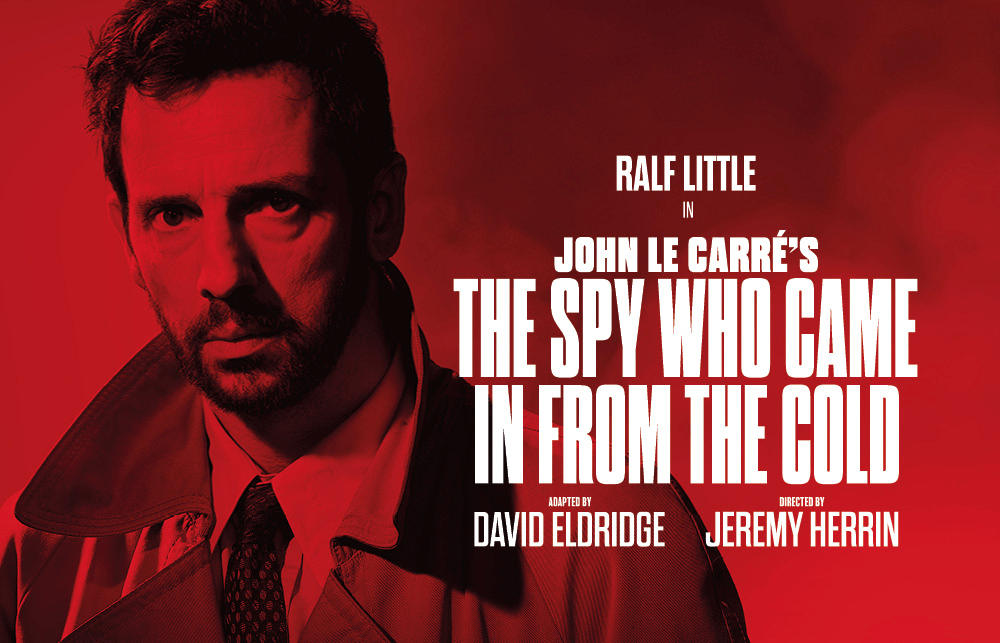
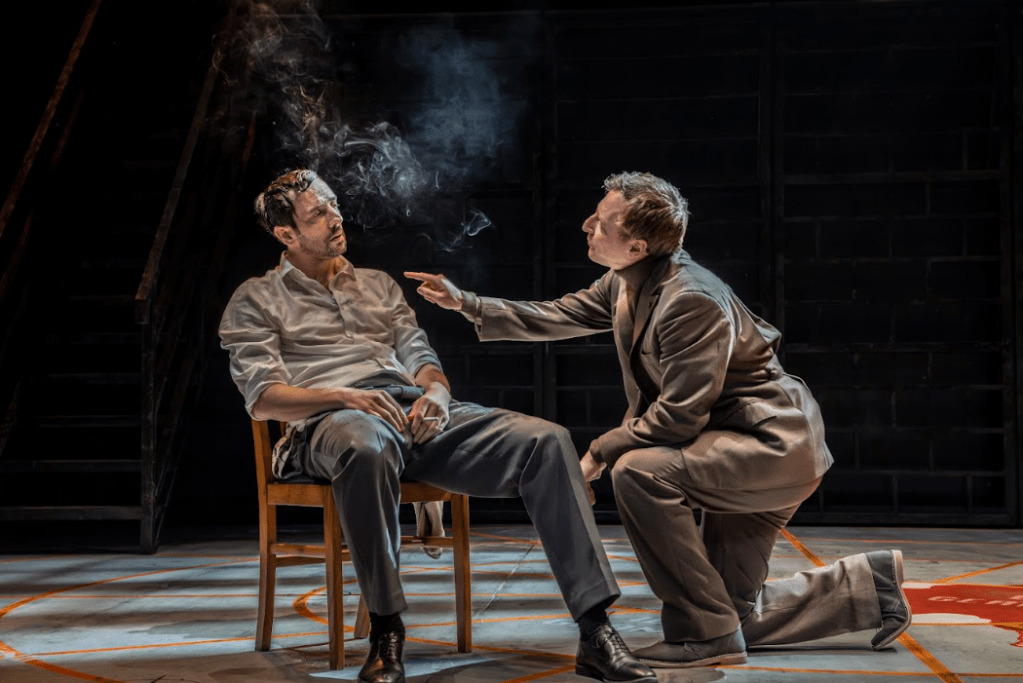
The story begins with Leamas returning home from East Germany after his agent is killed by the evil Hans-Dieter Mundt (Peter Losasso). From the outset, Mundt is set up as the “Blofeld” to Leamas’ “Bond”, although in truth we see very little from Mundt until the climax of the production. Instead, the show goes to great lengths to tell us that he is evil, but doesn’t provide us with any visible demonstration to back it up. It is a fault of the play that recurs throughout, as there is a continual barrage of exposition to fill in the characters’ complex history. Upon his arrival in London, Leamas is met by Nicholas Murchie’s Control, his handler at the British Intelligence Services who comes up with a plan to catch Mundt. In order to do this, Leamas must go undercover as himself, pretending to have been dismissed from the intelligence services, and ultimately defect to East Germany to expose Mundt as a double-agent. It is a knotty plan, and one that is a little difficult to get your head around, although it is all explained fairly clearly in the second half as a courtroom scene sees characters recount the plan.
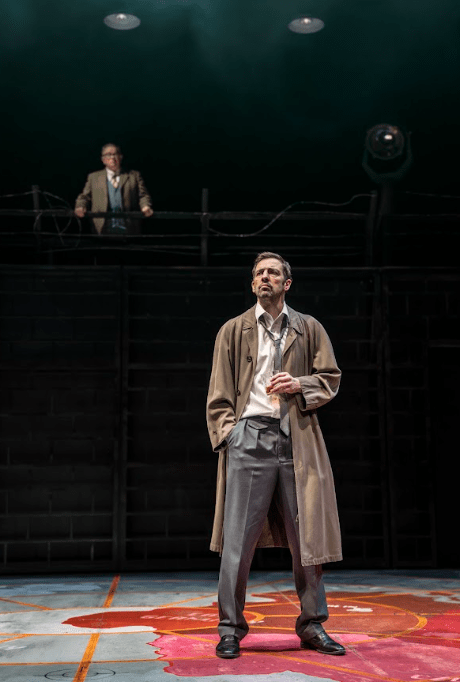
The convoluted plot is not helped by the fact that Leamas is continually plagued by the ghosts of his past, in particular retired agent George Smiley (Tony Turner). Anyone familiar with Le Carré’s work will immediately recognise Smiley as the protagonist of ‘Tinker Tailor Soldier Spy’, but here we mostly see Smiley as a voice inside Leamas’ head, as the spy becomes ever more paranoid and begins to question the true motivations of the Brits who seem to be pulling all the strings. Leamas often breaks out of conversation to talk to Smiley, who stands above the scene as a forbidding presence, looking down on the action with an omniscient air. The fact that this adds to the confusion appears to be on purpose, showing exactly how difficult it is for Leamas to trust anyone in this world. Le Carré was certainly not one to glorify this shady business, and the story here is in keeping with that theme, often fairly bleak and seemingly hopeless.
There is a little light at the end of the tunnel in the form of Gráinne Dromgoole’s Liz Gold, a librarian that Leamas meets and falls in love with after his faux-dismissal from the intelligence services. Dromgoole presents a confident, forceful woman who knows her own mind and is more than a match for Leamas, but there is little chemistry between her and Little. The main issue here is that the script never properly allows us to see them together – their initial relationship is rushed so much that when Leamas is arrested, we are not sure whether Gold is telling the truth or not when she promises to wait for him to be released. In a play where we are asked to continually question what is real and what isn’t, this relationship feels as fake as everything else. It doesn’t help that Gold’s character is very thinly characterised as “communist” without ever really exploring why or what that means for her. She exists merely as a plot device, and never seems to shine as a character in her own right.
Other characters come and go, and they are merely stereotypes there to serve the plot as well – Jeff D’Sangalong’s Ashe is referred to numerous times as the “homosexual” but never really makes much of an impact with the audience, and Eddie Toll’s Fiedler again toes the line between trustworthy and not trustworthy, but beyond that there is little substance. The play is so full of plot that it spends little time building character. It makes for an interesting discussion on the way home, as audience members try to untangle the narrative, but it doesn’t go very far to make you care about the characters or their situations. The play strives for an emotional climax that is likely to leave you feeling empty.

Max Jones’ set design recreates part of the Berlin wall, tall, ominous and lined with barbed wire, a constant reminder of the visible split in Europe. The static set allows for lots of different locations to be imagined merely with tables and chairs, but it is rather bleak, and when the action moves away from England in the second act, there is no visual clue to suggest new locations. Laura Rushton’s costumes are all trilby hats, flat caps and long coats, whilst Azusa Ono’s lighting design is perhaps the most interesting aspect of the piece, especially a scene set in darkness that sees the stage lit in red as Leamas fumbles around blindly.
This is a play designed to keep you on your toes and make you think. The story remains faithful to Le Carré’s novel, and the fast-paced plot will hold your attention throughout. Little’s Leamas might not be the sort of protagonist we are used to, and some of his outbursts do not quite land, but the show immediately draws us into his world, and by the interval you will be second-guessing everything you have seen, exactly as intended. Any confusion at the interval will be cleared up in the second half, which goes out of its way to ensure all loose ends are properly explained, and most audience members will leave feeling at least satisfied by the conclusion, even if the show never quite has you on the edge of your seat. Slick and precise, with many hidden layers.
Tom Morley, June 2026
For more information on how I decide on star ratings, see here: Star ratings – Broken Legs Blog
Review Round-up:
Elemental Theatre: The Spy Who Came In From The Cold – 4* from Elemental Theatre, who says “if this genre is already your go-to theatre style, you’ll likely devour every twist and betrayal”
All That Dazzles: The Spy Who Came In From The Cold – Just 2* from ATD, who say the production “remains watchable, occasionally atmospheric and led with commitment, but too often feels distant from the human cost of the lies and deceit it is trying to expose”
Lisa in the Theatre: The Spy Who Came In From The Cold – And finally 3* from Lisa in the Theatre, who call this “an excellent adaptation of a very complex spy novel, but […] often more clever and visually impressive than riveting”