
“A show that finds heart amidst the brutality”

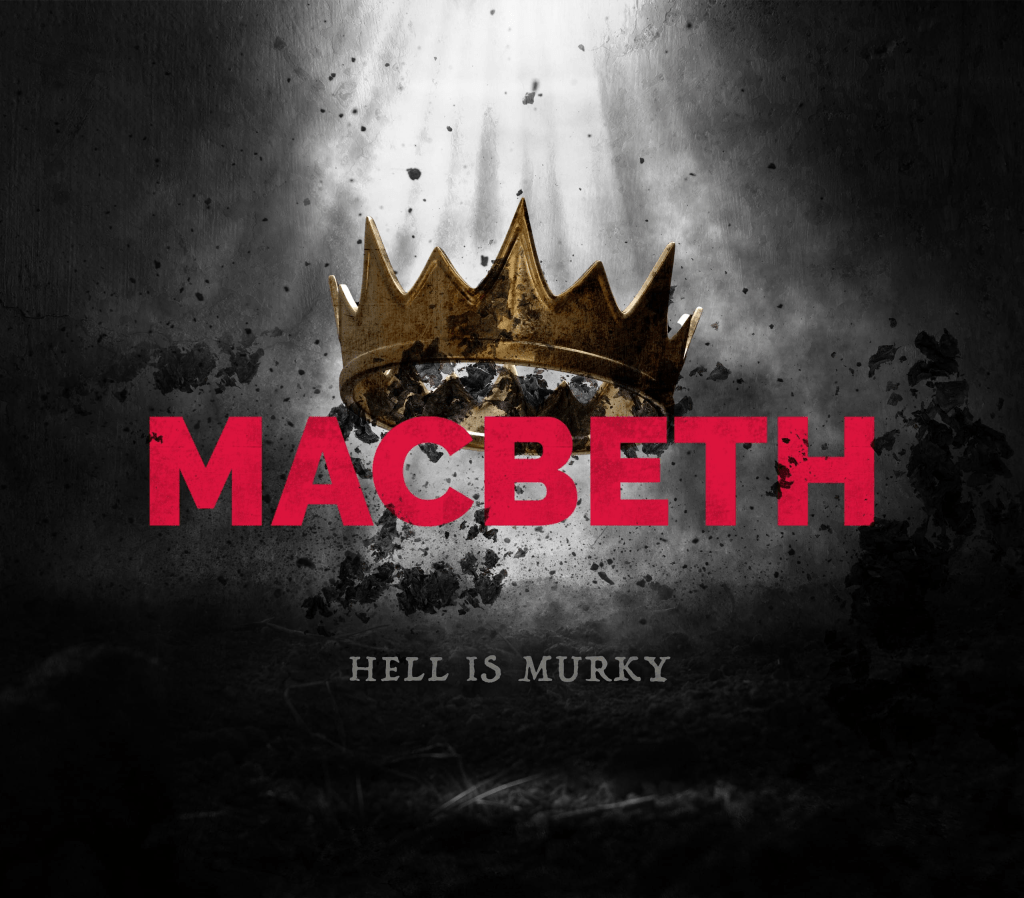
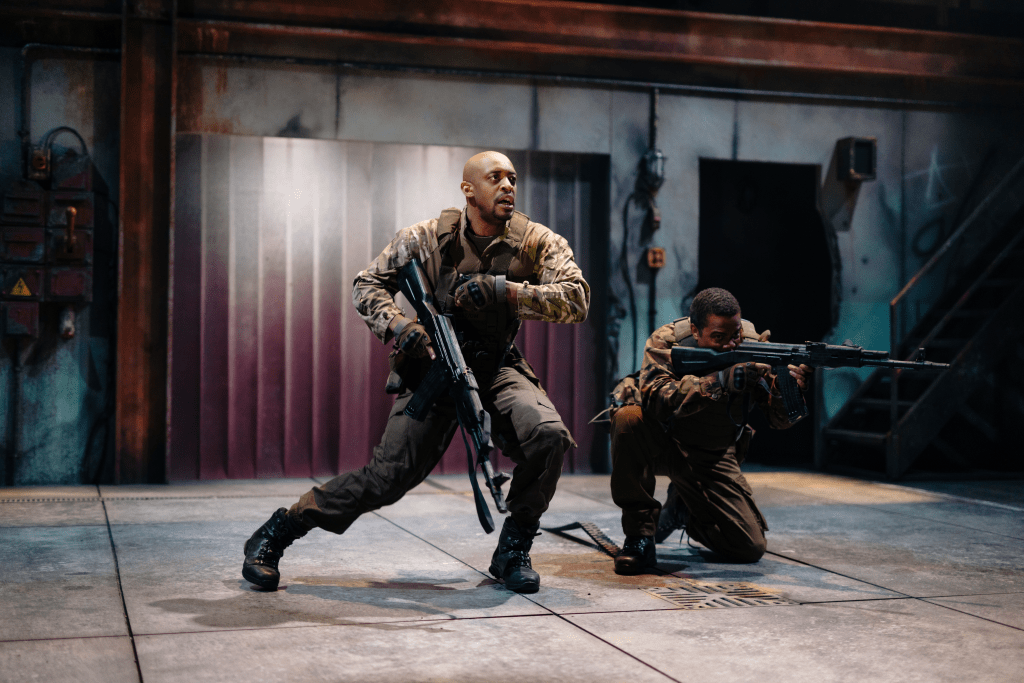
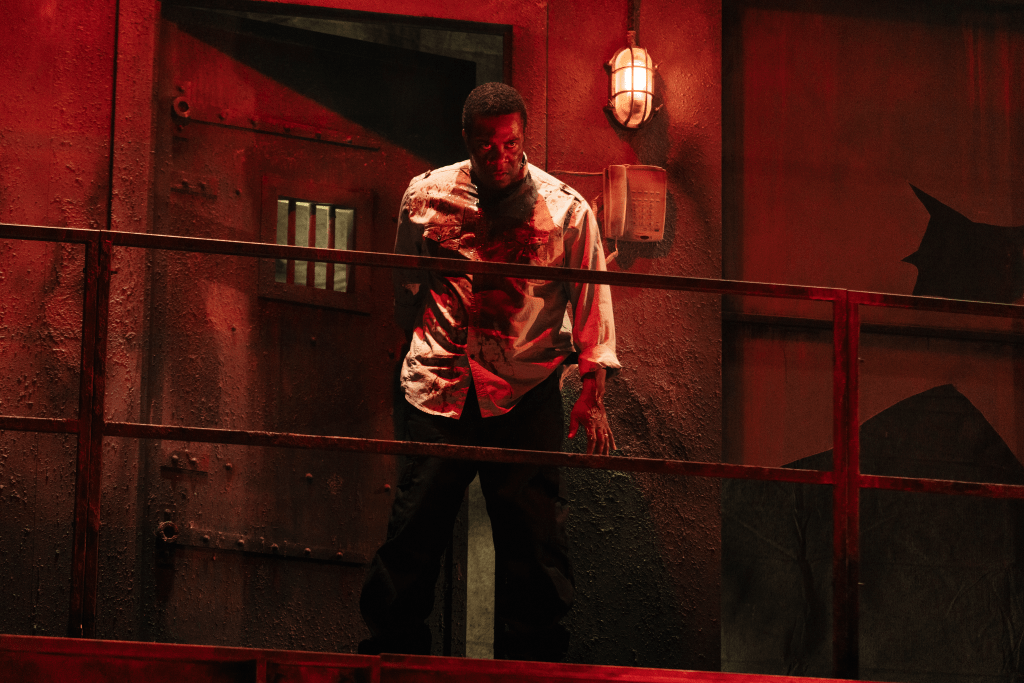
Set amidst a dystopian futuristic warzone, Derby Theatre’s “Macbeth” takes the original Shakespearean play and gives it a fresh, modern update. This action-packed production sees men in combat gear and army fatigues racing around the stage, rifles across their shoulders, as Macbeth seeks to achieve his ambition to become King. Yet beneath the violence and the hyper-masculinity lies a much more tender story – under the direction of Mark Babych, there is a clear focus on children and innocence, and it is in these quieter moments that the production soars, exploring themes that are often overlooked in favour of brutality and witchcraft.
In the title role, Oliver Alvin-Wilson gives a masterful performance, a Macbeth that teeters between anger and passion, yet bubbles with grief beneath the surface. In Alvin-Wilson’s hands, Shakespeare’s soliloquies are performed clearly and precisely, building in speed and volume until Alvin-Wilson expertly slows the pace, helping to distinguish between moments of indecision and sudden realisation. For a production ostensibly aimed at GCSE students, it is this clarity that makes this production worth your time, helping to bring Shakespeare’s words to life and make sense of dialogue that can feel convoluted when reading from a text.
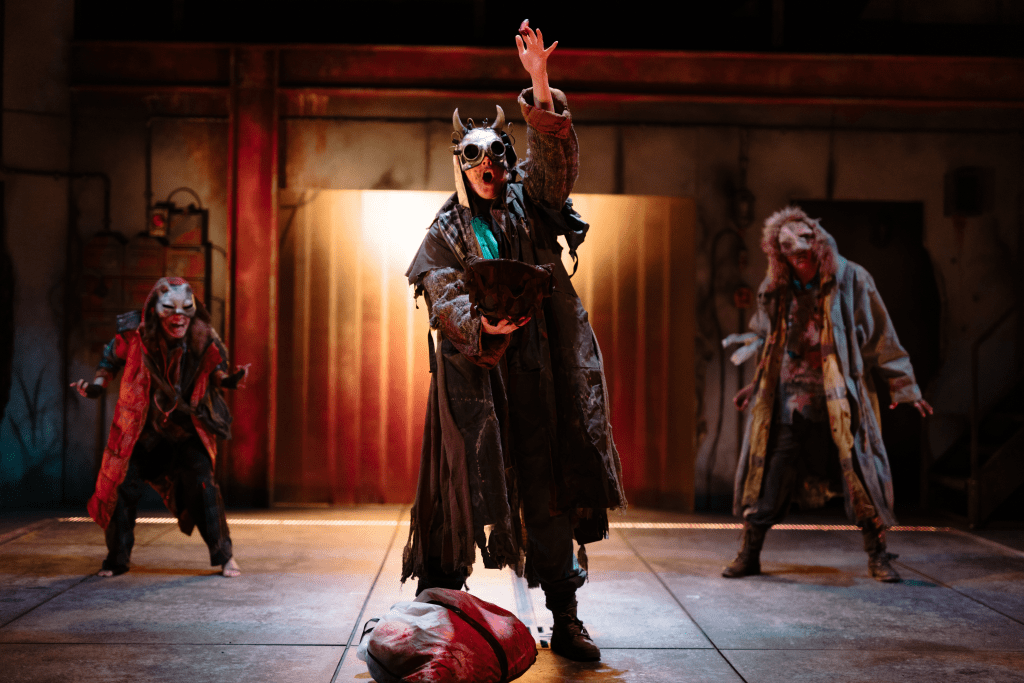
Macbeth receives prophecies from three witches, here portrayed as ‘Mad Max’-esque miscreants, heavy goggles and thick shawls. It is an interesting setting, although one that the production doesn’t quite lean into enough – the snippets involving the witches feel oddly disconnected from the rest of the piece, which plays more like modern warfare than anything particularly futuristic. As first witch, Deborah Pugh effects her voice in a way that adds to the mystery and horror of the piece, but comes with a loss of clarity – something that can cause issues when the witches’ dialogue is the driving force for much of the plot.
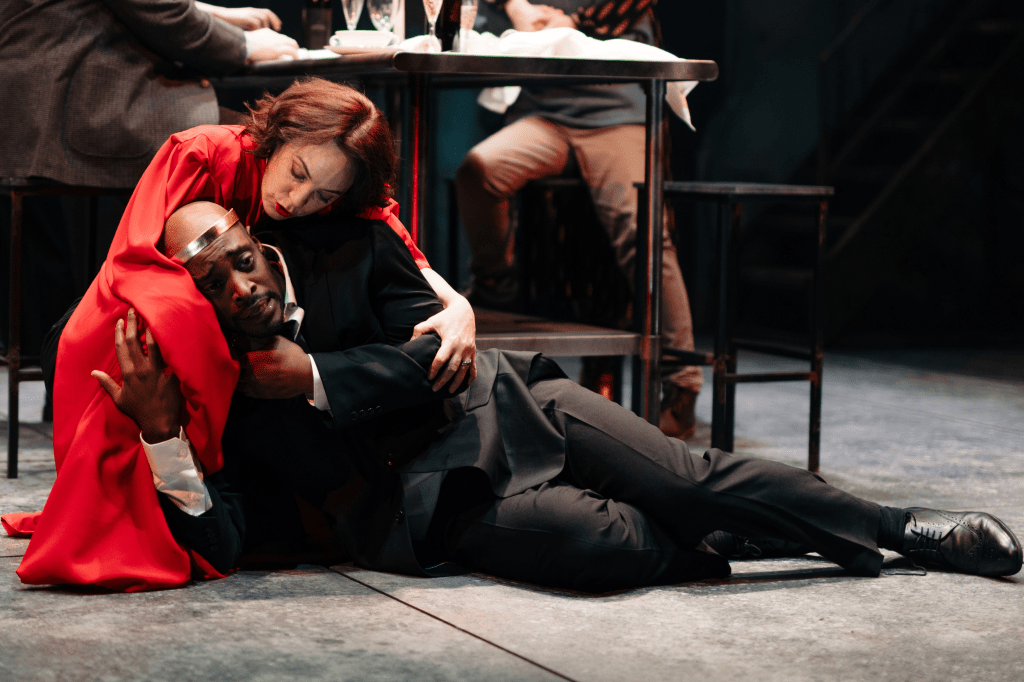
Spurred on by these prophecies, Macbeth works together with his wife (Jo Mousley) to manufacture a situation that would allow him to take the crown. The chemistry between Alvin-Wilson and Mousley is intense yet deliberately fractured. This is a couple struggling with the death of their child, first hinted at when Macbeth accidentally pulls a teddy bear from his rucksack, and it becomes clear that their ambitions are merely something to fill the void rather than any serious political endeavour. Their relationship rocks back and forth between forced passion and utter venom, each of them constantly fighting for the upper hand, Mousley’s Lady Macbeth attempting emotional maneuvers whilst her husband resorts to shouting and displays of physical dominance. It is a fascinating study of masculinity and expectations placed on the modern-day man.
The themes of children run far beyond the Macbeths’ offspring. Children are present throughout, their roles far more prominent than in the original text, Harry Carter’s Fleance present during early celebrations of Macbeth’s victory, and Livie Dalee’s messenger being played as particularly young and innocent when delivering news of the approaching Birnam Wood. This point is truly hammered home with the appearance of the witches cradling dolls, taunting Macbeth over the death of his child. Shakespeare never gives us the proper context, beyond Lady Macbeth’s “I have given suck” speech, but this production allows us to easily fill in the gaps.
Not everything is so successful. Benjamin Wilson’s Ross leans too far into the comedy in the opening act that it is jarring amidst the foreboding atmosphere. This comic angle is dropped in the latter half of the play, and Wilson is much better here. Simon Trinder’s Macduff delivers his lines with too much gesticulation and over-enunciation. It is too performative, and results in us struggling to connect with his character. When Macduff’s family are killed, we feel oddly detached from it – this is particularly surprising given that Lady Macduff (Josie Morley) and Young Macduff (Alexandras Argyrakis) are given additional scenes, appearing in the aftermath of Duncan’s death and at the infamous banquet. Seeing the Macduffs more should help to endear them to us (Morley is given lots of Lennox’s lines from the original), yet their deaths still lack impact, mostly due to Annie May Fletcher’s sound design, which results in gun shots that are clearly not real, and the fact that the deaths happen off-stage.
This is a show that begins with brutality and violence. An injured captain rises from an operating table, and Cawdor is assassinated via sub-machine gun whilst tied to a chair. Yet as the play continues, the violence and gore is toned down, meaning that later events, which are more impactful on the story and should stick in the mind more, are instead underplayed and anticlimactic. It feels like a missed opportunity. Explicit violence is obviously not a necessity for any production, but this version goes out of its way to set up this gore in its opening scenes, so when it is then hidden off-stage in later scenes it feels particularly lacklustre.
There is a lot to like here – the production holds your attention and serves as a good introduction to Shakespeare’s text for the uninitiated. Sally Ferguson’s lighting design features subtle shifts as the witches prophecies come true (the moving Birnam Wood, Macduff ripped untimely from his mother’s womb), which goes a long way to help with understanding. Yet it is a show that often doesn’t seem to trust itself, and as a result doesn’t lean into the setting as much as it could. Ending the first half with Muse’s “Feeling Good” is an incredibly odd choice and completely at odds with the rest of the tone. With a bit more care and attention to the design of this piece, this could be a stellar production of Macbeth – a show that finds heart amidst the brutality, and clearly demonstrates why ‘Macbeth’ is considered one of Shakespeare’s best tragedies.
Tom Morley, April 2026
For more information on how I decide on star ratings, see here: Star ratings – Broken Legs Blog
Review Round-up:
Elemental Theatre: Macbeth – ETC don’t hold back in their 2* review, calling this a production “without cohesion, clarity, or a unified voice”
East Midlands Theatre: Macbeth – The show fares better in its 3* review from EMT, who say the show’s “visual language is striking, its storytelling clear, and its engagement with power and violence feels timely rather than forced”
The Guardian: Macbeth – The Guardian also give the show 3*, saying “Alvin-Wilson [is] a thoughtful, reflective Macbeth whose good sense is overcome by blunt rage” although “it does not set the pulse racing”








 Broken Legs Blog
Leave a comment