
“Beautiful, yet haunting”
A new Shakespeare season at Sheffield Crucible kicks off with “King Lear”, with Ian McDiarmid in the title role (the same company will return next month with “Twelfth Night”). Shakespeare’s carefully constructed tragedy of a King descending into madness begins with the irascible monarch looking to divide his kingdom between his three daughters, a decision which leads to familial infighting and sees Lear turn on his own children. McDiarmid’s performance is sharp and biting, yet he manages to find a surprising amount of humour in these early scenes too – sarcastic putdowns that are directed at his daughters with such vehemence that they cannot help but draw uneasy laughs from the audience. Alongside this, a tussle between brothers Edmund (Fode Simbo) and Edgar (Harry Redding) culminates in a thrilling fight sequence at the end of the play, although it is the themes of family and mortality that will linger in the memory.
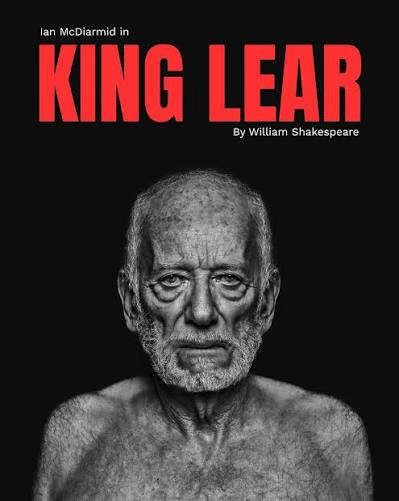
Scholars have speculated over Lear’s illness for many years, most settling on some form of dementia or Alzheimer’s that has afflicted the elderly King. McDiarmid’s performance here definitely gives hints of such an illness, sudden bursts of anger being quickly washed away by a calmer, yet confused, manner. Even as his madness grows worse, there are still flickers of the tyrannical King, offering some beautiful juxtaposition as McDiarmid strips to his underpants and yet still proclaims himself ruler of the Kingdom. Although there are certainly elements of humour, it is tinged with sadness. The most moving moment comes when Lear is reunited with his youngest daughter Cordelia (Bebe Sanders). By this point, Lear’s mental state has declined to such a point that he is barely coherent, and yet upon seeing his daughter, he recognises her – there is a moment of lucidity, played with such nuance by McDiarmid. It is beautiful, and yet haunting.
Lear’s eldest, Goneril (Katie Wimpenny), is the most strong-willed, often overshadowing her husband Albany (Milo Twomey) as she seeks to get the upper hand over her siblings. Occasionally, Wimpenny’s performance slips into melodrama, some lines cackled with an almost witch-like quality, whilst her sister Regan (Justina Kehinde) remains more composed. It is slightly surprising, then, that it is Regan who is seemingly more psychologically damaged by her actions. When Regan and Cornwall (Jay Saighal) pluck out Gloucester’s (David Birrell) eyes, black ink pours from his sockets. The ink stains Regan’s hands, and the stains continue to grow, infesting her skin and her clothes as she struggles to break free from her guilt. Under Titas Halder’s direction, it certainly offers a shocking visual, but it doesn’t quite feel justified given the preceding performances.

Richard Kent’s set design is vast and empty – a concrete backdrop onto which Ryan Day’s lighting design casts some formidable shadows, whilst the floor is a simple stone circle surrounded by gravel, bringing to mind ancient spiritual sites. This is accompanied by Emma Laxton’s sound design, which is mostly made up of birdsong, whilst Sarah Angliss’s composition uses eerie vocals to create tension. It all feels rather Pagan or prehistoric – it is a shame, then, that this theme isn’t carried through to Kent’s costume design, which, whilst being mostly in-keeping with the colour scheme of greys, blacks and beiges, brings a modern touch to the production, particularly with Max Revell’s Fool, who is dressed in trainers and an Adidas sweatshirt.
Revell’s performance is also occasionally at odds with the rest of the production, performed at times as an interpretive dance, Revell showing off some incredible flexibility as he breakdances across the stage. The Fool initially humours Lear’s ravings, but there comes a moment when he realises the game has gone too far, and Lear is seriously ill. At this point, Revell becomes totally still, and remains that way for the rest of the play. The difference is immediate, and has quite the impact. Whereas the production has often lent into the comedy that comes with Lear’s insanity, now the tone shifts, and everything becomes a little bit darker as we are catapulted to the bloody ending.

Whilst McDiarmid is quite clearly the integral piece holding this entire production together, there is a lot to enjoy from the supporting cast – Birrell and Redding get some excellent scenes together as Edgar nurses his father following his blinding, and there is a lot of fun to be had with Mark Holgate’s Kent, who adopts a Yorkshire accent when he disguises himself as a peasant, much to the joy of the Sheffield audience. This is a fine production, and one that is moving but not depressing – in fact, you may find yourself laughing more at this than you would expect. It is all thanks to a masterful performance from McDiarmid, who understands exactly what it means to be old and young at the same time. Even amidst sickness, there is still joy to be found, and that is exactly what this production does.
Tom Morley, September 2026

Review Round-up:
JackStage: King Lear – Three stars from Jack Davey, who points out that “King Lear is one of Shakespeare’s tragedies that is devoid of anything supernatural, though there is something imminently mystical about Halder’s concept”
AllThatDazzles: King Lear – Four stars from ATD, who say “this production is a real treat with gorgeous performances and an interesting take on what is often considered a sub-plot [Edmund and Edgar’s feud]”
Everything Theatre: King Lear – Finally, five stars from Everything Theatre, who call this “a compelling, stunning production of Shakespeare’s most uncompromising tragedy, with impeccable performances throughout, especially from the hugely impressive Ian McDiarmid in the title role”










 Broken Legs Blog
Leave a comment