
“a proper riot […] will have you laughing from start to finish”
It’s back to the 60s for this latest offering from the Lace Market Theatre, for an excellent satire about business moguls and office culture. The musical has the potential to feel a little dated, with lots of sexist stereotypes on display, but, under the direction of Linda Croston and Alison Hope, this production manages to avoid all of that by making the play incredibly tongue-in-cheek, over-the-top, and, above all, very very funny. This is the first musical offering I have seen from Lace Market Theatre, but everything is on top form here, from superb vocals to fun and clever choreography, courtesy of Arthur Jones. In the ever ambitious J Pierrepont Finch, played by Bara Erhayiem, the show finds a likeable protagonist that we cannot help but root for.
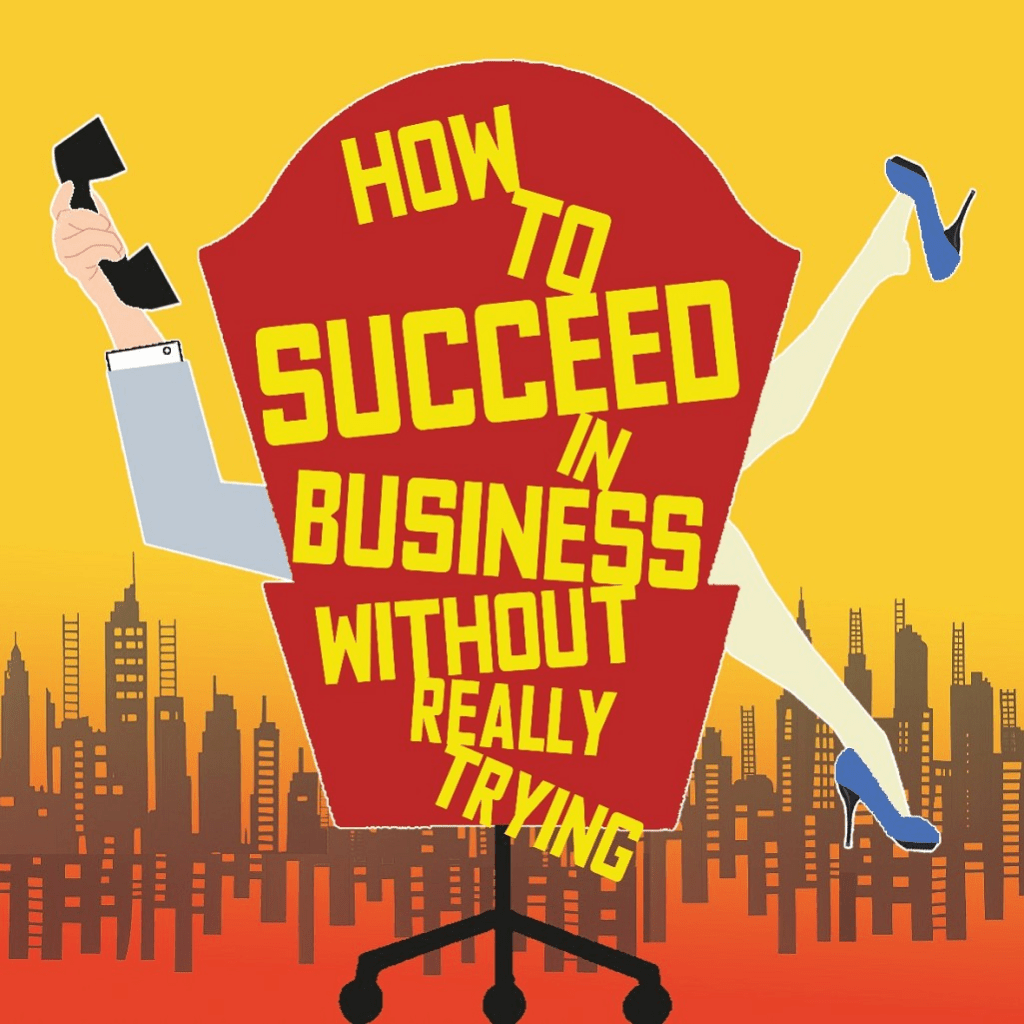
Finch wants to be big in business, and seeks help from a book that shares its title with the musical. Sections of the book are narrated via voiceover provided by Ian Smith, which helps to cover some scene transitions. The book begins by encouraging Finch to seek employment in a business that is so big, no one has any idea what anyone else does and therefore you can get away with doing relatively little (as someone who works in the civil service, I make no comment). Finch therefore gets a job at the WorldWide Wicket Company, run by JB Biggley (Nik Hedges), who is introduced as a formidable boss but quickly becomes an affable character who enjoys knitting and golf. The business itself is exactly like the book describes, and Finch follows the instructions to the letter, beginning in the mail room and very quickly working his way up thanks to multiple hilarious coincidences.
Along the way, Finch finds a love interest in the shape of Rosemary (Steph Jones), a secretary who instantly falls for Finch even if the feelings aren’t immediately reciprocated. The relationship is never built up that much, but that isn’t the point – in this heightened reality, everything is so overly stereotypical to the point of ridiculousness that there isn’t space for any sort of realism. Instead, it seems that Rosemary is chasing the idea of a relationship, longing to be a typical housewife, a desire expressed in the song ‘Happy to keep his dinner warm‘. In the same way that Finch wants to succeed in business without really trying, Rosemary expects to succeed in her romantic conquests in the same way, glossing over first dates and butterflies, with her sole focus on marriage.
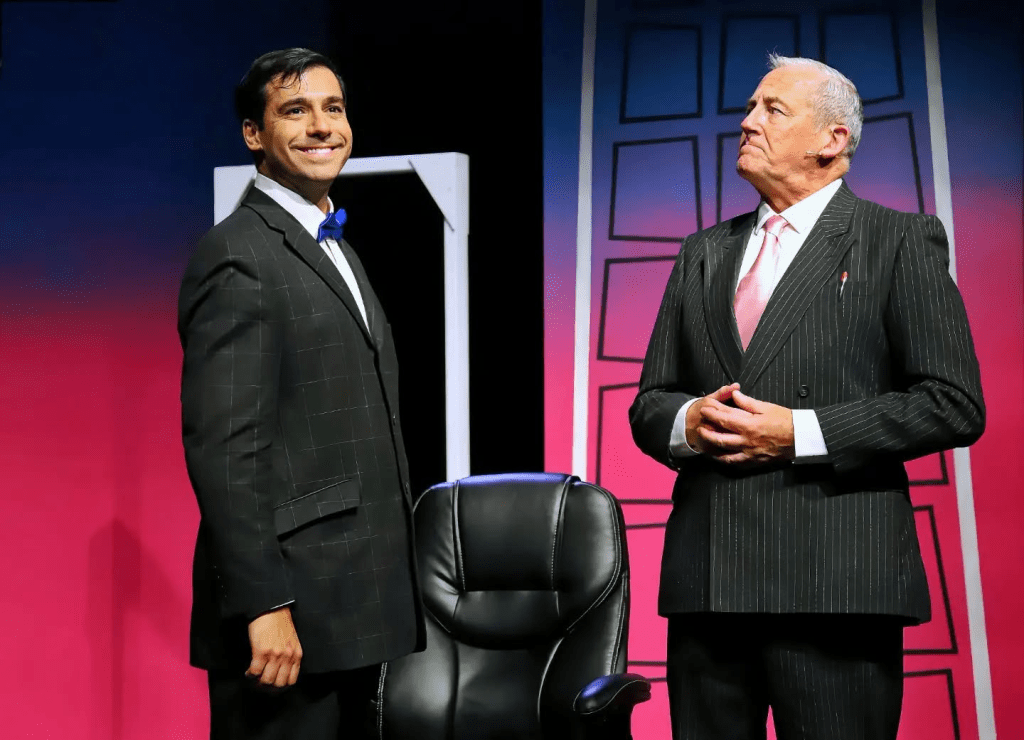
Standing in Finch’s way is Bud Frump (Matthew Thomason), a fellow mailroom assistant who just happens to be Biggley’s nephew. Frump seems destined to succeed in business thanks to his multiple complaints to his mother, which often helps him climb the ranks. Thomason is a joy to watch – he has excellent comic timing, superb facial expressions and brilliant musical talents. He is the sort of spoilt brat we usually love to hate, but here it’s very difficult to dislike him. It helps that Biggley doesn’t take any nonsense from him, and makes his feelings very clear – at one point, when Bud complains that he has to walk down 30 flights of stairs, Biggley is quick to suggest that he could always jump instead, a suggestion that is only half-joking. The two have a fun, combative relationship that keeps things exciting.
There is a danger that Finch could become dislikeable thanks to his overly ambitious nature – usually characters like this are the antagonists, especially in musicals. Thankfully, Erhayiem doesn’t struggle to keep the audience on his side, constantly flashing a killer smile (accompanied by a comedy ding!) whenever things just happen to go his way. Despite his ambitions, he never uses it to screw over other people, although he can sometimes come across as a little cold to his secretaries.
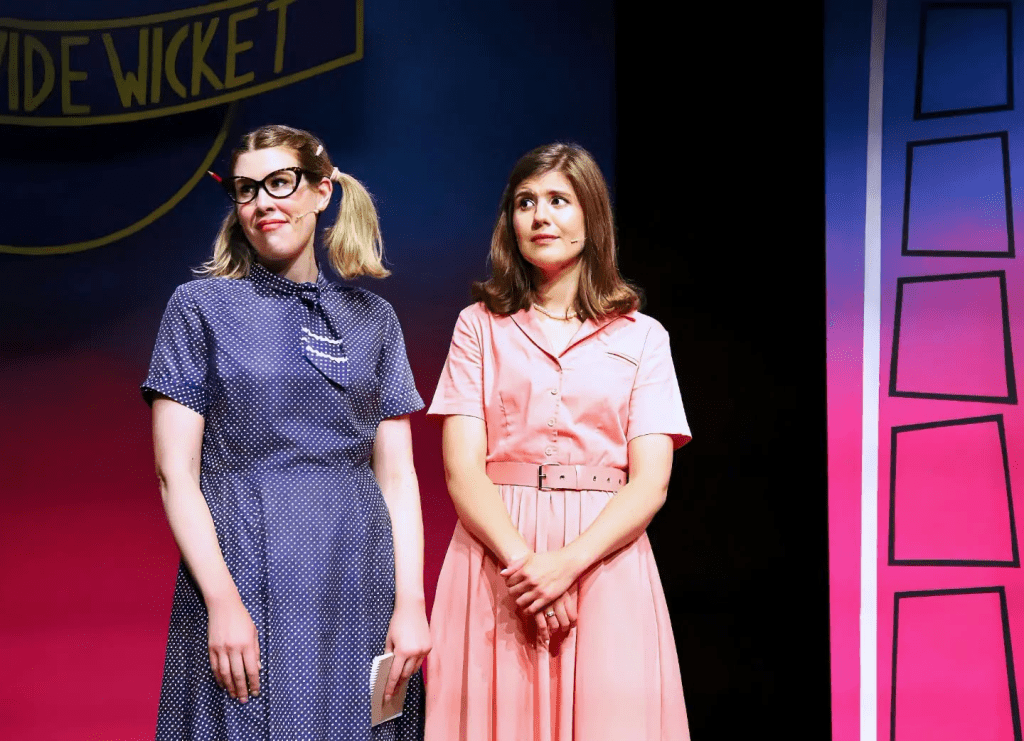
Whereas the businessmen are all exactly that – men – the secretaries are all female, and often suffer from harassment in a way that one would hope is unacceptable in the 2020s. But the fact that the show is so obviously set in the 60s (thanks to Croston and Maddie Gould’s costumes) helps to distance the show from the present day and emphasises its satirical nature. The production never goes down any darker routes, although they are lingering there just out of sight, and the play certainly highlights how far gender equality has come over the last 60 years, even if it still has a way to go. The satire is mirrored in Croston’s cartoonish set design, painted with office blocks that look like they’re straight out of a comic book. The rest of the set is minimal – two empty door frames bring to life various offices and lifts, whilst we know Finch has the made the big time when his desk is suddenly adorned with a Bonsai tree.
There are many other larger-than-life characters that help to keep things fun and exciting. Rosie Poesl’s Smitty serves as Rosemary’s dorky work friend, often putting her foot in it thanks to her tendency for gossip. I was waiting for Smitty to get her standard musical glow-up, although unfortunately it never happens – it’s a shame that the script never allows Poesl to develop Smitty further than the nerdy stereotype. On the other end of the spectrum is Danielle Easter’s Hedy LaRue, who has all the men’s eyes out on stalks when she arrives as a new receptionist. Easter is perfect at flipping between a giggly, flirty persona, and a much more fiery character, as she uses all of her assets to get exactly what she wants. It’s an aspect of the show that might not totally fly through a modern day lens, but the men at least get a telling off in the number “A Secretary is not a Toy”.

Some of the musical numbers exist purely for comedy purposes rather than to advance the plot, such as “Coffee Break”, which sees the office workers start to panic when the office runs out of coffee, which is a funny moment but doesn’t play into the overarching story. It is all accompanied with excellent dancing, perhaps most notable during the song “Company Way” which sees the ensemble throwing cardboard boxes and sealed envelopes around the stage, whilst Finch and colleague Mr Twimble (Gareth Morris) do their best to stamp the packages. The musical style is very much what one would expect from a musical written in the 60s, and I was a little unsure it would be to my tastes at first – but needless to say, by the end, I was tapping my feet and clapping my hands with everyone else, blown away by show stopping number “Brotherhood of Man”, which has the entire cast involved for a lively performance.
There are still so many characters here that I haven’t mentioned and that doubtlessly add to the fun of this show. Will White’s Bert Bratt is wonderfully sycophantic, Sally Eaton’s Miss Jones has some great visual comedy moments (when entering Biggley’s office to find him arguing on the phone to his wife, she simply turns around again and leaves), and Max Bromley’s Wally Womper doesn’t appear until late in the play but still manages to make a big impression. I didn’t know what to expect from a Lace Market musical, but I shouldn’t have doubted them – this is a proper riot, and will have you laughing from start to finish. A great production and thoroughly recommended!
Tom Morley, July 2026















 Broken Legs Blog
Leave a comment