
“As an extension of the Westerosi universe, this mostly lives up to expectations”

Based on the characters from George R. R. Martin’s novels, “The Mad King” acts as a prequel to the books and TV series, written by Duncan MacMillan, directed by Dominic Cooke and set around 15 years before the action kicks off in “A Game Of Thrones”. The long winter is coming to an end, and magic has been lost from the world – so don’t expect dragons or white-walkers or any surprise resurrections. In fact, this play feels more akin to a historical epic rather than fantasy, the focus on politics and shady deals as each of the main houses tries to strengthen their positions in a kingdom that is on the brink of collapse.

The first thing to strike you upon entering the Royal Shakespeare Theatre is the significant redesign that the space has undergone specifically for this show. The audience now sit in the round, the stage is shaped like a cross, with each of the four points of the cross serving as entry points for the actors. It means we feel constantly part of the action, actors brushing past audience members as they head to the stage, although it does often reduce the stage to a catwalk, and there are a lot of times where actors merely cross from one side to the other without anything much happening in between.
The story begins with the tourney at Harrenhal, an important piece of Game of Thrones lore for anyone familiar with the books, where small developments spiral into a full-blown rebellion that results in the end of the Targaryen dynasty and leaves a Baratheon on the Iron Throne. In fact, this tourney takes up the entirety of the first act, and for the opening 45 minutes this feels hardly like Game of Thrones at all – never have we seen the characters so happy, the first hints of spring bringing old friends back together whilst new romances are beginning. Anyone who recalls the events of the Red Wedding, however, will be aware that happiness never lasts very long in Westeros, and needless to say, a dramatic arrival soon throws everything into chaos.

The focus of these early scenes are the Stark family, and their antics are joyous to watch, the four young Stark adults trying their best to rub shoulders with other rulers whilst still maintaining a childish playfulness. Of these four, it is Lyanna (Harmony Rose-Bremner) who proves the most likeable, something reminiscent of Arya in her, a young girl who enjoys fighting and yet finds herself engaged to Robert Baratheon (Callum Woodhouse) and expected to settle down as a wife rather than a warrior. There is a complicated love triangle between Lyanna, Robert and Prince Rhaegar Targaryen (Noah Ritter), and we get a wonderful segment that sees Rhaegar teaching Lyanna how to dance, with fight choreography mirroring dance choreography.
The production does its best to build up the chemistry between Rhaegar and Lyanna, who are clearly the couple the show wants us to root for, but we are kept at arms length by the fact that Rhaegar is already showing signs of madness, haunted by visions of dragons and red comets, and the first time we are introduced to him he is with his pregnant wife Elia (Elizabeth Ayodele), who we find ourselves immediately drawn to as a strong, female character in a world that is heavily male-dominated. We can never quite forgive Rhaegar for cheating on his wife, who certainly doesn’t seem to deserve such treatment. It means the burgeoning love story between Rhaegar and Lyanna lacks our emotional buy-in and doesn’t quite live up to those powerful romances that we are used to from Game of Thrones.

Where the show succeeds is in the character of Howland Reed (Islam Bouakkaz), who finds himself drawn into the Stark family after they rescue him from an assault by some lowborn squires. He instantly becomes an audience favourite, and this thread offers some light-hearted fun amidst all the more difficult political musings – Reed is constantly egged on by Ned (Michael Abubakar), Benjen (Miles Barrow) and Brandon (Luke Brady) to get some petty revenge on the squires. In fact, the characters of Lyanna and Howland feel the most rounded here, and it is probably worth noting that neither appear in the books or TV series, giving writer MacMillan full reign to create these characters from scratch. Other characters are clearly heavily influenced by the TV appearances, and the play seems to rely on this foreknowledge and never bothers to take the time to introduce them properly.
This is probably hindered by the fact that there are a lot of characters, and so proper focus can never be granted to all of them (despite the play being almost 4 hours long). Some characters are seemingly thrown in as mere fan service and don’t really have much influence on the plot (such as Edem-Ita Duke’s Oberyn Martell and Daisy Franks’ Cersei Lannister), while other storylines are introduced but never properly expanded upon, like Daniel Hawksford’s Barristan Selmy, as a member of the Kingsguard, being prevented from loving Tanisha Spring’s Ashara Dayne. This is a plotline explored in the books, but it doesn’t have a big impact on the events of the play, and one wonders if it could have been cut to save time.

Throughout the play, puppetry is used to help bring to life the jousting tournament, with horses large enough for the characters to ride, each having three puppeteers and overseen by Nick Barnes and Finn Caldwell. Occasionally, puppets of the actors are used for certain sequences as well, which makes sense for some of the more dramatic scenes – a puppet can fall from a horse in a much safer way than an actor, for instance – but feels a little odd when used during some of the rebellion fight scenes of the second act, especially when Robert takes on Rhaegar at the battle on the Trident. The actors are constantly swapped out for puppets, but there appears to be very little reason for this except the fact that it looks artistic – although one cannot help but wonder if the fighting might feel a little more brutal and visceral without these artistic flourishes.
In fact, anyone expecting levels of violence akin to the TV series should very much temper their expectations. Certain fight sequences are intercut with blackouts, which means we don’t get to enjoy much fight choreography and often robs the scenes of any growing tension. The fight choreography that we do see is often played in slow motion. Other gruesome deaths are played offstage – anyone familiar with the source material will be aware of how Qarlton Chelsted (Fred Davis) meets his end, but don’t expect to see it dramatised here, as Chelsted is simply led offstage to his doom instead.
The design of the play is phenomenal. All House Sigils have been redesigned by Georgia McGuinness to set the piece apart from the TV series (similar redesigns have been employed in Harry Potter and the Cursed Child, for example, to allow the show to standalone from other media), and they look glorious. McGuinness’s costumes are simply beautiful, and help to reflect the sheer diversity in the characters, from the Stark’s northern cloaks to the Martell’s silk gowns. When Robert dons his stag’s head helm, or Maxim Ays’s Jaime Lannister puts on his golden helmet complete with lion’s mane, the fans in the audience will feel a thrill of excitement, whilst the white armour of the Kingsguard help them stand out amidst the other characters.

This is a show definitely designed for the fans, and as certain elements of the story come to pass in the second act, taking us from the throne room at King’s Landing to the Tower of Joy, there is a simple pleasure in seeing these scenes acted out at last, stories that we have only heard characters talk about in the main series. For those that have seen the entire TV series, there will be very little surprise as to what happens here, but there are a few long-standing mysteries that are resolved, such as the true identity of the “Knight of the Laughing Tree” (but I will give no spoilers here). For those unfamiliar with the books, the accompanying programme does offer a glossary of terms and some much-needed family trees, but the convoluted plots will likely prove difficult to follow. Despite being a prequel, this production does very much rely on some pre-knowledge of Westeros and the many families that populate the land.
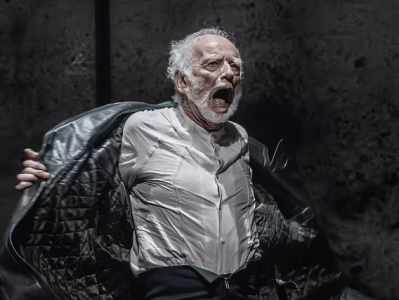
Being produced by the RSC may feel like an odd choice to begin with, although Game of Thrones has always borrowed elements from Shakespeare, and even the text has Shakespearean elements, the speeches given an extra poetic quality for the stage. Michael Shaffer’s Mad King Aerys II is obviously reminiscent of Lear, whilst Mariah Gale’s Queen Rhaella delivers monologues that seem to mimic Lady Macbeth, and later scenes see Lyanna overcome by some sort of madness which feels akin to Hamlet’s Ophelia. As the play continues, one cannot help but be reassured that the RSC are the correct company to produce this play, lending it a certain gravitas that it definitely deserves.
The main aspect that lets this show down is its length, especially when elements of the story feel like they could have been easily cut to make the running time more palatable. There is not enough action to sustain four hours, with lots of scenes simply being groups of people talking, which makes the play ever more Shakespearean, but even then, the RSC usually cut Shakespeare’s plays down to a more suitable length. Despite some humour courtesy of Richard Hansell’s Grand Maester Pycelle and Hughie O’Donnell’s Lord Varys, the play is mostly very serious and sincere, which can be hard-going at times. Fans will love this, and as an extension of the Westerosi universe, this mostly lives up to expectations – but it feels like it is relying too much on Game of Thrones nostalgia rather than trying to do anything different.
Tom Morley, August 2026

Review Round-up:
WhatsOnStage: “Game of Thrones: The Mad King” review – 5* from WoS, who call this “a brilliant exhibition of how theatre can create magic”, a demonstation of “the power of imagination and skill in telling stories for the ages”
The Guardian: “Game of Thrones: The Mad King” review – 4* from The Guardian, who conclude by saying “this feels like a five-star production for most devoted throners but a three-star for those who haven’t seen the TV series”
The Times: “Game of Thrones: The Mad King” review – 3* from The Times, who say that “Macmillan’s script is sorely lacking in poetry” and “too many lines are simply shouted”