
“One of the most poignant, believable love stories of any musical I have seen”
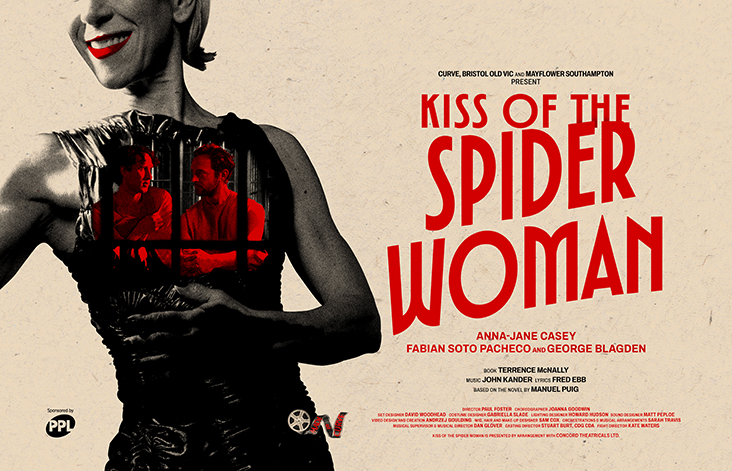
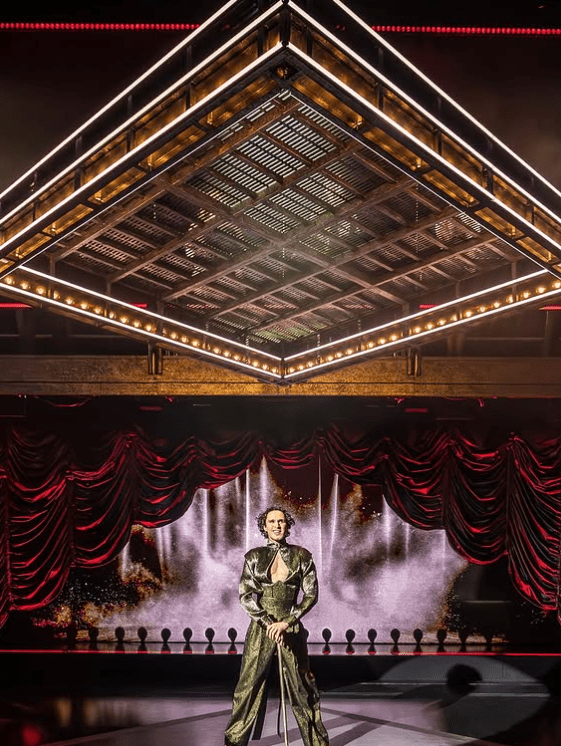
Set in a men’s prison in Argentina, “Kiss of the Spider Woman” follows the story of Molina (Fabian Soto Pacheco) who is arrested after being tricked by the Argentinian police. Throughout the story, Molina faces homophobic abuse from the guards and fellow prisoners, but he rarely rises to their taunts, instead finding solace in the fantasy of movie star Aurora (Anna-Jane Casey). In the intimate surroundings of Curve’s studio theatre, this is a musical that is introspective and character-driven. There are some bigger dance numbers, mostly courtesy of Casey, but it is the softer, emotional songs that carry the most power here, whilst Howard Hudson’s lighting design features some superb effects that help to meld Molina’s despicable conditions with the glitzy Hollywood glamour of his dreams.
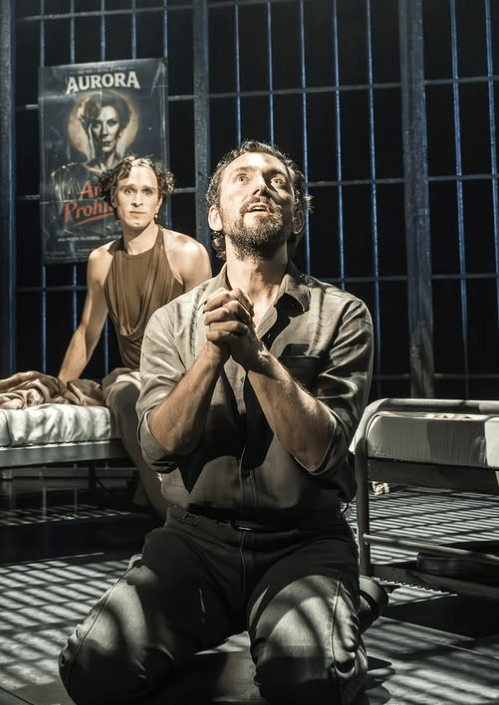
Molina is clearly set apart from the others thanks to his costume design (Gabriella Slade), a long dressing gown and headband that gives the impression of a backstage actress rather than a prisoner, and yet it isn’t jarring, as the world between fantasy and fiction is continually blurred throughout. Pacheco brings a necessary element of flamboyance to Molina, yet it is all so beautifully underplayed that it doesn’t become tiresome or over-the-top. There is an undercurrent of sadness and insecurity to Molina, one that makes this flamboyance feel clearly performative and disingenuous. It is credit to the subtlety of Pacheco’s acting, and makes the character vulnerable and instantly likeable. The violence and insults thrown at Molina are not gratuitous either – yes, we are forced to endure an onslaught of homophobic slurs courtesy of the guards, and Molina undergoes his fair share of beatings, but this is mostly hinted at rather than explicit, one scene seeing Pacheco simply react to the torture without us having to watch a guard enforce it.
Molina shares a cell with political prisoner Valentin (George Blagden), although the nature of Valentin’s political activity is never properly explored beyond his obsession with Marxist ideology. Their relationship begins off particularly vitriolic – Valentin draws a line across the cell and insists that Molina doesn’t cross it – and yet, as the musical continues, they grow closer, Molina sharing the plots of Aurora’s films with Valentin that helps to calm him when the guards begin their interrogations. It is a relationship that builds slowly, in a way that feels genuine and believable. It means that, when the relationship takes on romantic undertones, it doesn’t feel forced or shoe-horned in any way – the characters have reached a point where the audience are willing this to happen, regardless of the consequences. This culminates in Molina stepping across to Valentin’s side of the cell, asking the double-entendre “have I crossed a line?” The audience hold their breath as they await Valentin’s answer.
As their conditions worsen (the guards starve and torture the pair for information), Molina leans more and more into his fantasy world. These snippets see Casey emerging from a black-and-white backdrop, the lighting slowly changing from stark whites to golden hues, the golden age of Hollywood softly bleeding onto the stage. The other prisoners become backing dancers, at one point using their metallic dinner plates in place of top-hats, and mop handles in place of canes. These elements hark back to traditional musical theatre in a way that feels comforting and easy to relate to for the musical theatre fans in the audience – and that is, of course, the entire point. That is why Molina relies so much on these fantasies – they comfort him when all else seems hopeless.
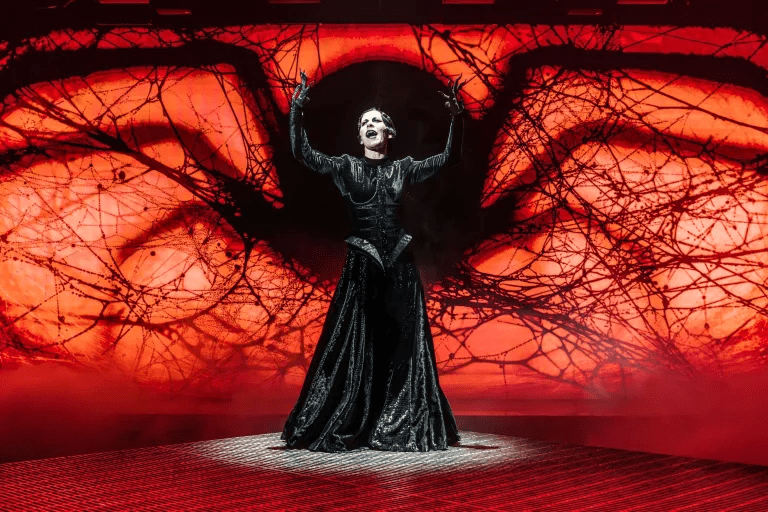
Yet there is one aspect to Casey’s Aurora that Molina remains afraid of – her role as the formidable spider woman, a film that still haunts him from his childhood. When Molina is urged by the guards to betray his cell mate, Casey becomes the spider woman, a manifestation of Molina’s temptations as he struggles to resist the lure of freedom promised to him if he gives up his friend’s secrets. Casey’s costume and wig, often dazzling technicolour in the jazz age sequences, is replaced with black counterparts, and spider’s webs begin to cover David Woodhead’s set design, whilst a large silhouette of a spider appears behind the actress. Matt Peploe’s sound design adds the sense of scurrying legs, projected from speakers above and behind the audience. It feels like we are all caught in her web, adding to the claustrophobia of the piece. There’s a sense of danger and horror, yet it is all done with such elegance that still carries the element of Hollywood nostalgia. There are some very clever design choices here, all brought together superbly by director Paul Foster.
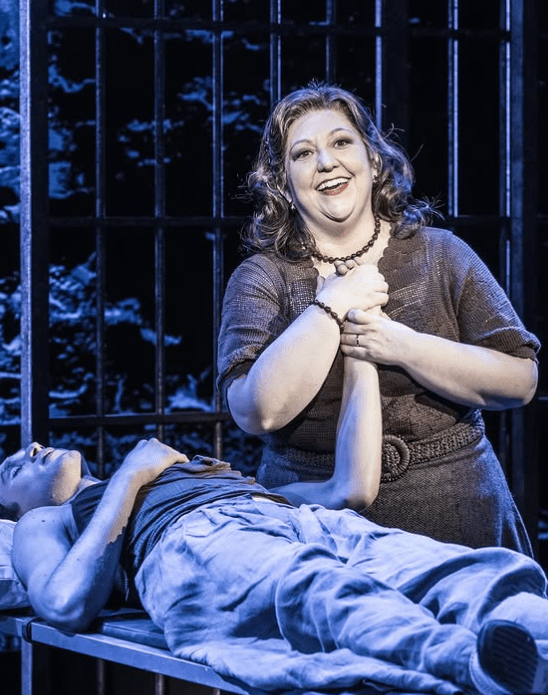
The set features a metallic grid that is raised up with a light shining straight down, creating cage-like shadows across the stage in way that is simple yet stylish. The back wall is fitted with prison bars, that often open up like stage curtains to allow Aurora through, whilst an overhead walkway provides an additional position for the Spider Woman to watch over Molina as he grapples with his moral dilemma (although this is occasionally masked by the aforementioned grid). Various set pieces are wheeled on – beds, hospital trolleys, a dance podium for Aurora’s act one closer Let’s Make Love – but they are few and far between, the sparsity adding to the impression that Molina and Valentin truly are surviving on the bare essentials.
It might simply be the Argentinian connection, but there are elements of Terrence McNally’s score that feels reminiscent of Lloyd-Webber’s Evita, each song adding emotional depth to the characters whilst carrying memorable melodies that perfectly blend the strict regiment of prison life with jazz age music hall numbers. Dear One, performed by imagined versions of Molina’s mother (Tori Scott) and Valentin’s wife Marta (Gabriela Garcia) is a beautiful inversion of the usual love songs, here both women singing about how little they care about their respective family members, as the prisoners try to convince themselves that life would be better if people ‘over the wall’ forgot about them. Throughout, Over the Wall remains an ongoing motif, a song reprised in four different ways, at one point comedic as prisoners sing about “big busted women”, later more moving as Valentin sings about his wife.
This production features one of the most poignant, believable love stories of any musical I have seen, born in a place where one would least expect it. The story does not feature any particularly dramatic twists or surprising turns, yet it is carried purely by the characters, and mainly by Pacheco who creates such a charming protagonist that you cannot help but root for him. This is the first major revival of Kiss of the Spider Woman since 1992, and it begs the question why it has taken this long. The plot may not appeal to everyone, but I would urge you to give it a go. There is something magical in Pacheco’s performance that will draw you in, and once you are stuck in his web, there’s no escape.
Tom Morley, April 2026
For more information on how I decide on star ratings, see here: Star ratings – Broken Legs Blog
Review Roundup:
Elemental Theatre: Kiss of the Spider Woman – 5* from ETC, who call this production “intelligent, affecting, and performed with breathtaking skill”
East Midlands Theatre: Kiss of the Spider Woman – 4* from EMT, who say this is “a production elevated by excellent performances, striking musicality and a central story that still has the power to unsettle as much as it moves”
WhatsOnStage: Kiss of the Spider Woman – And finally, 4* from WoS, who say that this production “favours sophistication over spectacle”, with a story that remains “rooted in character and emotional truth”









 Broken Legs Blog
Leave a comment