

“A vital message delivered at a vital point in history […] current and essential”
From Suzie Miller, the writer of the critically acclaimed “Prima Facie”, comes a new play which previously played at the National Theatre, and is here revived at Wyndham’s Theatre in the heart of London’s West End. “Inter Alia” tells the story of crown court Judge Jessica Parks, with a phenomenal performance from Rosamund Pike in the lead role. The title is a legal term meaning ‘among other things’, and here refers to the fact that Jessica must juggle her role as a judge, a mother, a wife and a woman in a life that is hectic, unforgiving and utterly exhausting. The play mirrors this – the action is relentless, Pike hardly pausing for breath as she races around the stage, grabbing various props and costumes from a set that contains a multitude of hidden doors and drawers, gabbling through endless speeches and anecdotes as the story flits about between her past and present. It makes for a play that feels draining and a little directionless, that is until events take a darker turn midway and the play transforms into an absorbing psychological drama that doesn’t shy away from difficult themes, proving to be incredibly harrowing in the process, telling a story that feels current and essential. In writing this review, I feel it is necessary to include some spoilers for the plot, but I will make sure they are clearly signposted – the first part of this review remains spoiler-free, the second half relatively spoiler heavy.

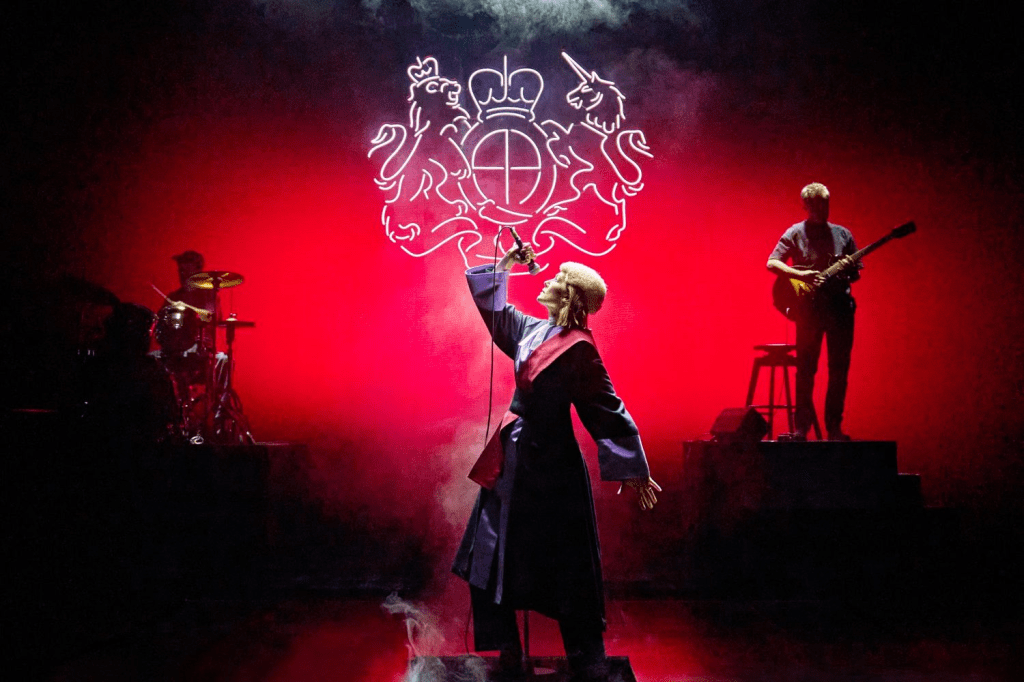
The play opens with Pike at work, presiding over various trials that include cases related to rape and domestic abuse. Her words are spoken into a microphone, echoing around the auditorium to give her an extra sense of authority, whilst inner thoughts are spoken away from the microphone, as are impressions of the various male barristers who seem to continually undermine her and lack the proper respect. It is a concept that takes some getting used to, the changes in volume a little hard to adjust to at first, but one that works relatively well, even if the concept is dropped later as the focus shifts from Jessica’s professional life to her personal life. The entire opening scene is underscored by music – drums and electric guitar – whilst bold words such as ‘QUEEN’, ‘POWER’ and ‘FEMINIST’ are beamed onto the wall behind her. It is a bit on the nose, but it adds a rockstar quality to the opening that is perhaps necessary for a play of this nature – clearly placing the working mother in a role that deserves to be celebrated, in the only way our culture knows how, by portraying them as a celebrity.
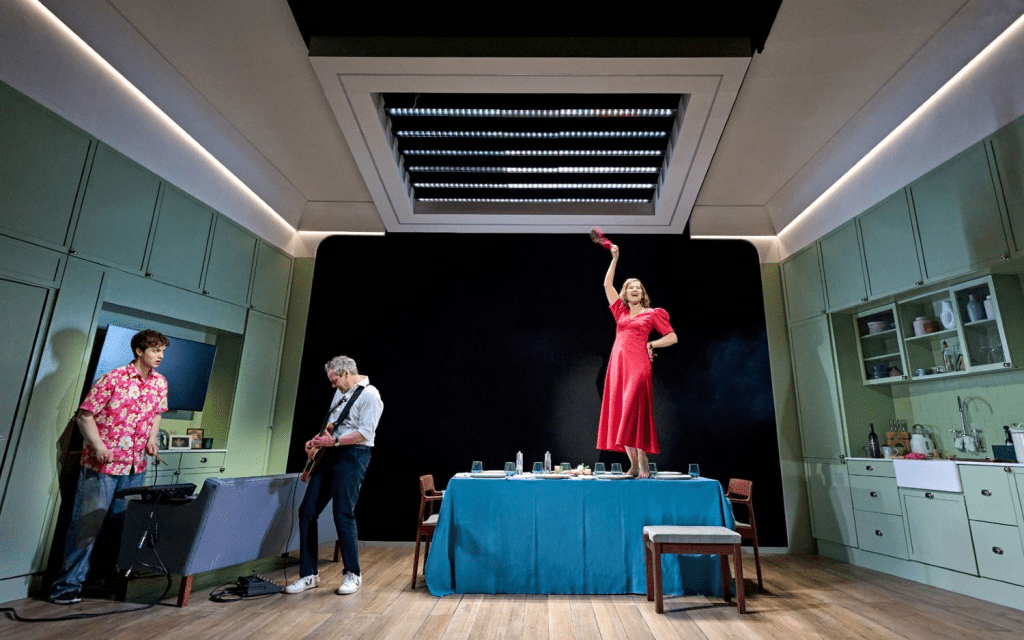
Jessica is distracted from her work by a phone call from her 18 year old son Harry (Cormac McAlinden), and it is here that Miriam Buether’s set design completely transforms – initially Harry can be seen in silhouette at the back of the stage, in a kitchen obscured from view by a heavy gauze. As Jessica finishes work and returns home, the gauze lifts, the entire set moves forward to fill the space at the front of the stage, and the family kitchen becomes our main setting for the majority of the play. The way that this set intrudes upon Jessica’s working life shows how easily the lines between personal and professional can be blurred, how difficult it is to separate one from the other. It is a theme that will be revisited continually throughout, and here Buether’s design allows us to starkly visualise this immediately.
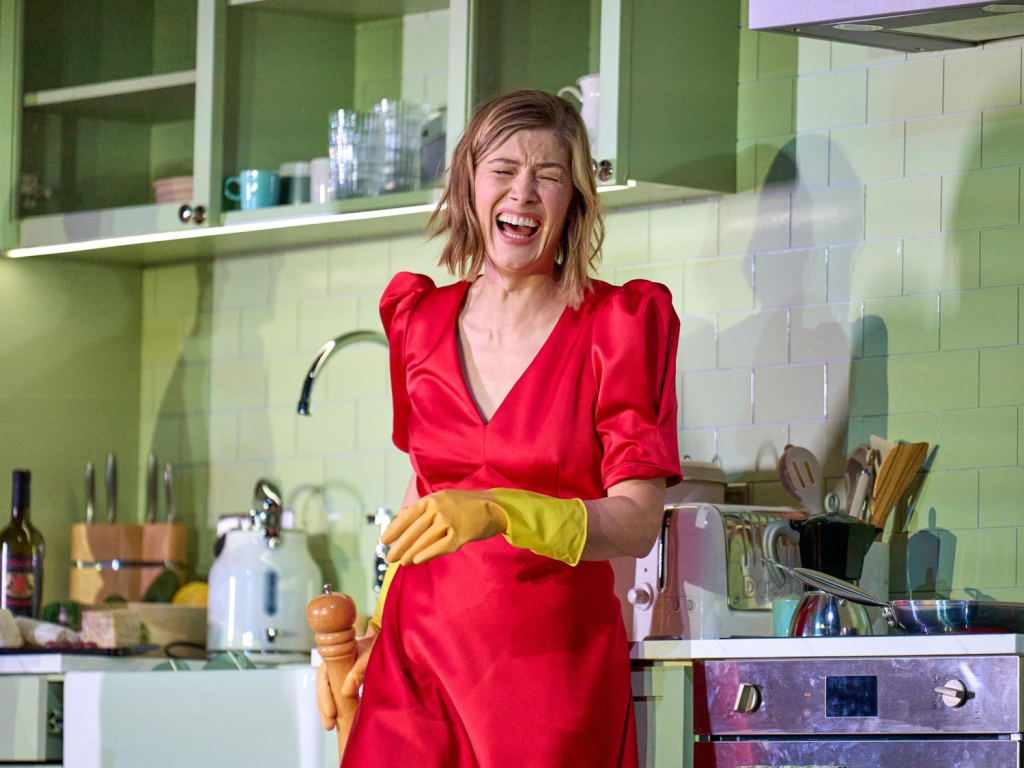
Despite being played as a single act with no interval, this is a play with two very clearly distinct halves, and the first half is definitely the weaker of the two, meandering through various anecdotes which seem a little disconnected and the importance of which only become apparent later on. We see how Jessica struggles to switch off from work, continually haunted by the horrific details she is forced to endure whilst in court. Jessica recalls how an innocent story involving a supply teacher when Harry was at infant school led her to believe he was being sexually abused, and the entire scene is re-enacted with a yellow jacket standing in for her young son, Pike delivering the words of both her past self and her boy. The yellow jacket becomes a continuing motif – we see it again and again throughout various snippets of her and Harry’s life together, sometimes as a prop, sometimes a larger version worn by McAlinden himself. One scene sees Jessica recount a time she caught 12 year old Harry on his computer, looking at something he clearly shouldn’t have been looking at. What follows is an awkward and often comical conversation about the dangers of pornography, complete with pepper grinders and cocktail sausages used as props to help her make her point, and yet with the appearance of a twelve year old actor, the entire comic angle is suddenly dropped, the realisation of the situation quickly dawning on the audience the moment an actual child is involved in the scene rather than an empty yellow jacket.
Also present (at least physically, if not always emotionally) is Jessica’s husband Michael (Jamie Glover), who is often reduced to the lazy stereotype of a husband who is largely incapable of looking after himself, thus making Jessica’s job even harder. As a criminal barrister, Michael clearly feels threatened by his wife, treating his own career as more important than his partner’s despite the fact that she holds a higher position than him in court. He is largely disconnected from his son, leaving Jessica to handle the emotional side of his upbringing. Throughout, Jessica is continually frustrated by her husband, yet never confronts him, choosing to bite her tongue for the hope of a quiet life. It is frustrating to watch as an audience member, and this is something that never gets resolved. Whilst it is, sadly, a fairly realistic interpretation of many modern day couples, it is not particularly inspiring for the working women that this play is so clearly aimed at. It is almost accepted that this is just the way the world works, and that we should just get on with it.
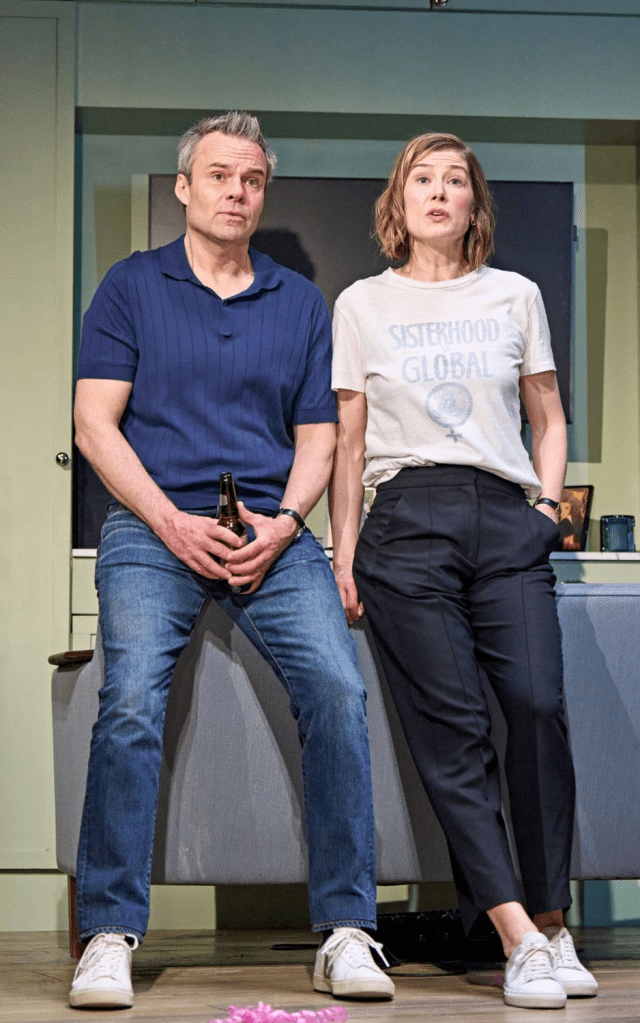
It is mirrored in the way in which Jessica mollycoddles her son, ironing his shirts and tucking him into his single bed (where the duvet is still adorned with footballs and rocket ships), despite Harry being, for all intents and purposes, a grown man. It seems her son is destined to repeat the example set by his father – that of a man who relies too much on the women in his life, who is completely unable to fend for himself. It is a theme that is so obvious as soon as you scratch below the surface, yet one that could be explicitly called out. Too much here is left unsaid, which, when handling such sensitive topics, leaves room for misinterpretation.
What follows includes some spoilers for the plot, so read on at your own discretion.

Things take a dark turn in the second half as Harry finds himself accused of raping a friend at a party. With this revelation, the groundwork leading up to this point is suddenly given purpose and feels necessary, yet one can’t help but wonder if those scenes would have played better had we known what the upcoming twist would be. It has to be said that McAlinden is on top form here. It is hard to live up to Pike’s performance, in what is essentially a one-woman play at times, and yet McAlinden more than holds his own, a young man who is struggling to come to terms with his actions, guilty and yet utterly unable to take responsibility.
Even when he eventually confesses, he tries to blame other aspects – his friends, online communities, the entire culture around relationships. Terms such as “the manosphere” are thrown around, which don’t feel particularly helpful and seem to simplify the situation too much – using buzzwords such as ‘manosphere’ can reduce the complexity of the social context, and result in people laying all the blame in one place, rather than the seeing the bigger picture (parents, social media, attention span), that is fairly richly explored here. What is even more interesting is Jessica’s reaction, torn between the memory of rapists from the many trials she has overseen, and the memory of her little boy, the twelve year old actor again present as McAlinden breaks down under the enormity of his guilt.
The final image, of a group of children playing chase around a playground, is completely haunting. This isn’t a colourful children’s playground, but rather one that is post-apocalyptic in style, trees that are nothing more than bare branches, and a roundabout that leans on one side. As children dash about between these dead and decaying structures, we see 12 year old Harry happily chasing after the girl he will one day rape. It leaves audience members with a lot to process as they exit the theatre.
Amidst a continuing debate regarding availability of pornography and banning social media for under 16s, this feels like an incredibly current piece of theatre. The marketing is clearly aimed at adults – parents and professionals – the posters featuring a very corporate-looking Pike alongside a title that is incomprehensible to the vast majority. And yet, surely the target audience for a play like this should be teenagers themselves? Yes, parents and carers and teachers can learn a lot from this story, but it is those at risk of perpetrating these crimes who need to be educated the most. And after all, what better way to humble a teenage boy than make him question what his own mother’s reaction would be should she stumble across his Snapchat messages or his browser history? A vital message delivered at a vital point in history.
Tom Morley, April 2026
Review Round-up:
The Guardian: Inter Alia – 4* from The Guardian, who say the play “sheds its nimbleness and wit as it grapples with the serious stuff in its later stages, meaning the pace slows even as the confrontations become more heightened”
WhatsOnStage: Inter Alia – Also 4* from WoS, who call this “a script which beautifully captures the singularity of motherhood – the beaming pride and protective fury, the pain of letting go, the seesaw of smugness and shame”
The Stage: Inter Alia – The Stage continue their tradition of giving shockingly low ratings, with a 2* review that calls this play “blunt-edged and formulaic” and “a clod-hopping feminism-lite drama”. It is, quite frankly, a poorly written review and not worth your time.












 Broken Legs Blog