

“Completely different […] fresh and exciting”
Taking place within The People’s Hall, an elegant, if partly dilapidated, grade II listed building, “Apple of Discord” tells the story of a battle between Greek gods and goddesses, as they all vie for the much-desired golden apple, promised to the fairest god of them all. Fully immersive, this piece invites the audience to explore the building at their own leisure, discovering different parts of the story, and helping to advance the narrative in their own ways. There is lots to enjoy here – spoken poems, escape-room-esque puzzles, songs and scenes – too much to cover in a single review, and too much to even experience in a single evening. This is a long evening of entertainment (over 3 hours), but there is plenty to keep one occupied, and more besides. When not observing the intense, intimate goings-on upstairs, you can enjoy cabaret-style performances down in the great hall, before various characters appear and whisk you off for more adventures. This is unlike anything I – and dare I say, most people in Nottingham – have experienced before.
The evening begins with Laurie Owen’s Atlas and Christine Hood’s Cassandra welcoming guests, clearly laying out the rules (don’t touch the actors, don’t climb on furniture!) and setting out the story, before we are led into the ancient building, where the wedding of Peleus (Reece George Soar) and Thetis (Clare Louise Moss) is about to take place. Taking our places as members of the wedding congregation, Soar gives a naturalistic wedding speech that helps to gently ease the audience in, whilst Moss’s speech is more poetic in nature, adding an ethereal quality to proceedings that will be revisited in later scenes.
All is going well until Amanda Mitchell’s Eris crashes the wedding with the offering of a mysterious golden apple, and mayhem ensues. For the audience, it is a little overwhelming – cast members dart about all over the place, and one is never sure where to look and what to focus on. We are introduced to a wide variety of characters in this scene, and for someone who is not too familiar with Greek gods, the story can be a bit difficult to follow in places. A clearer introduction to each character may have been more helpful, or a programme featuring pictures of each character that could have acted as a useful guide.
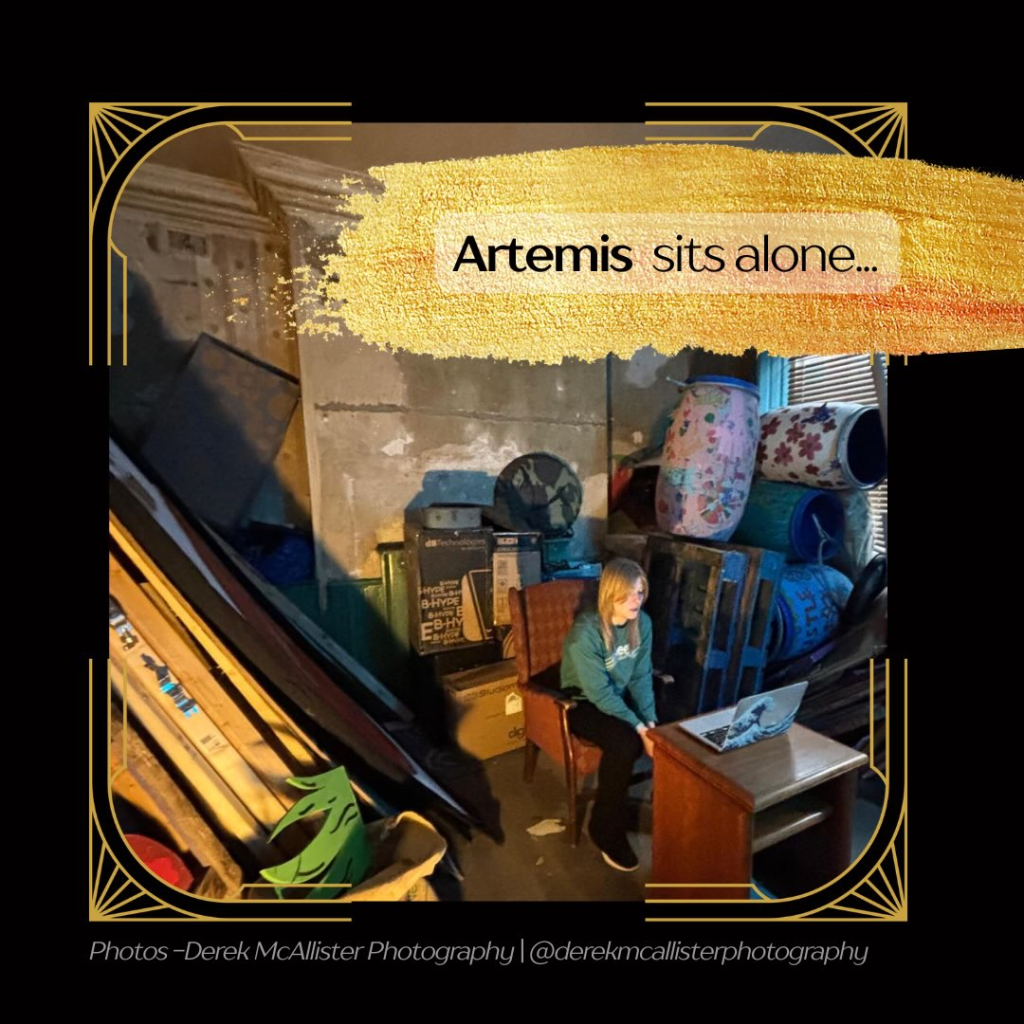
With the wedding ceremony suitably ruined, the Gods and Goddesses retreat to their quarters, and it is here that the audience are left to their own devices. There is a little bit of guidance – my companion and I were initially encouraged to visit Athena’s room – but later we found ourselves wandering a little aimlessly, searching for another scene to watch. Thankfully, not much searching is required – there is so much going on here that you very quickly randomly come across things, so I would encourage all theatre-goers to explore to their heart’s content!
Throughout the night, we experienced a range of different scenes – Athena (Emma Webber) and Poseidon (Ken Ogborn wielding a three-pronged piece of cutlery) engage in a fierce battle of wits, taking part in a board game in which they ask for the audience’s help, although the exact rules of the game are a little unclear and would have been better explained with some visual examples. Bickering husband and wife Zeus (Ben Macpherson) and Hera (Marilyn Ann Bird) present a more emotionally-charged scene, with language that borders on Shakespearean at times, whilst across the hall Joe Strickland’s Aphrodite and Sam Marshall’s Apollo (with the help of an unseen Echo) recite poetry to music – one particular standout moment seeing Strickland virtually performing a Greek God-infused rap when squaring up to Nicki Morley’s Artemis.
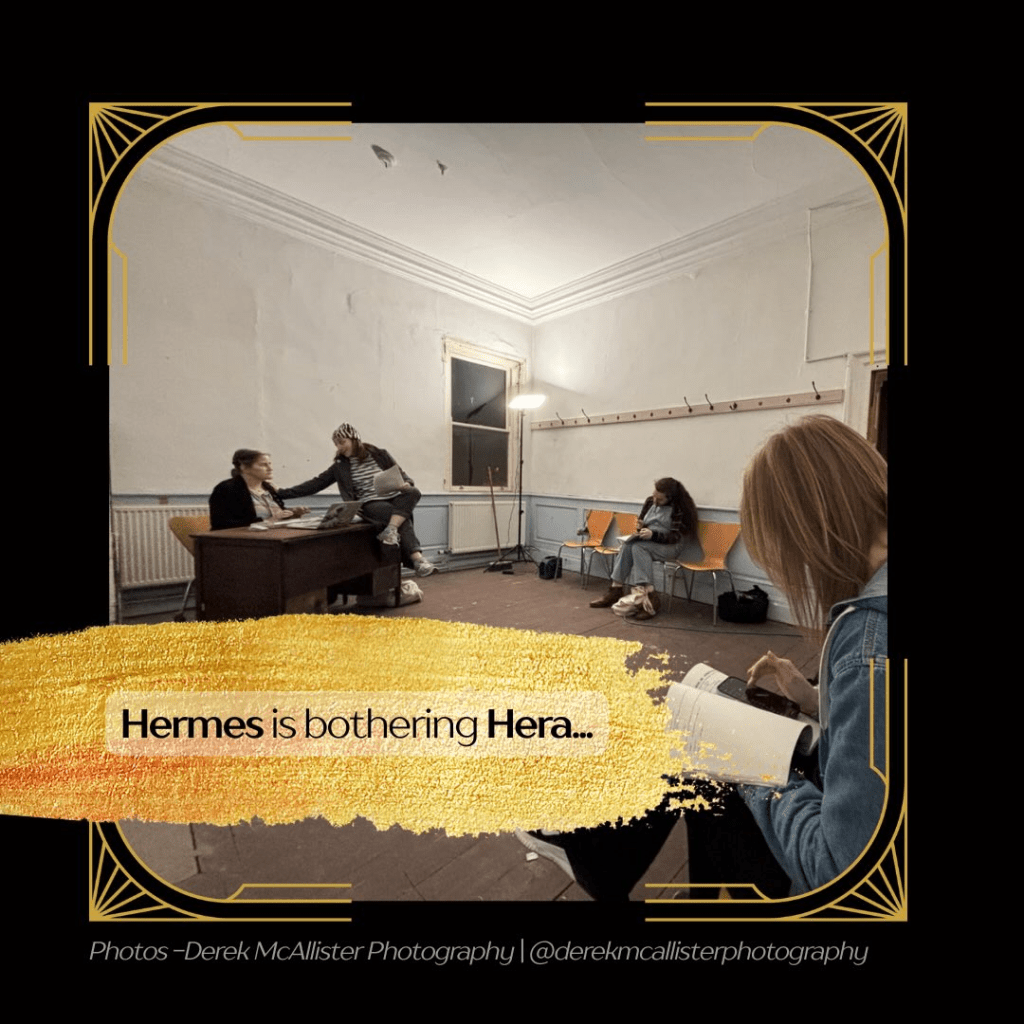
Other characters drop in-and-out of these rooms (these scenes are repeated throughout the night, so that audience members have several opportunities to see them) in an excellent feat of logistics that must have taken some very careful planning. Esther Warren’s Tiresias and Kat Engall’s Hermes easily slot into these scenes, before disappearing to the room next door to add to the drama and ‘discord’ there. It makes the world feel completely lived in and immersive. The actors remain in character throughout, and the evening is all the better for it.
Downstairs, the wedding reception continues despite the disruption to the marriage ceremony. Two tiers of ticketing sees some additional audience members welcomed at 8pm rather than 7pm, arriving for the reception but missing the main wedding sequence (how this works in terms of the plot is unclear to me, for it seems the initial wedding ceremony did a lot of the heavy lifting in terms of setting up the narrative, but presumably the late-comers are given a brief synopsis prior to entry). The reception takes the form of a cabaret set featuring multiple acts, a nice break from the intensity of some of the other scenes, allowing the audience to relax a little before throwing themselves into the next storyline. Here we see Dan Webber’s Aesop recite the Legend of Taylor the Swift (an epic poem featuring references to much of Taylor Swift’s back catalogue), and members of the Nottingham Shakespeare Company (Michelle-Louise Wright, Emma Carlton, Jack Dillon and Lachlan Charles) performing ‘Pyramus and Thisbe’ from Shakespeare’s “A Midsummer Night’s Dream”.
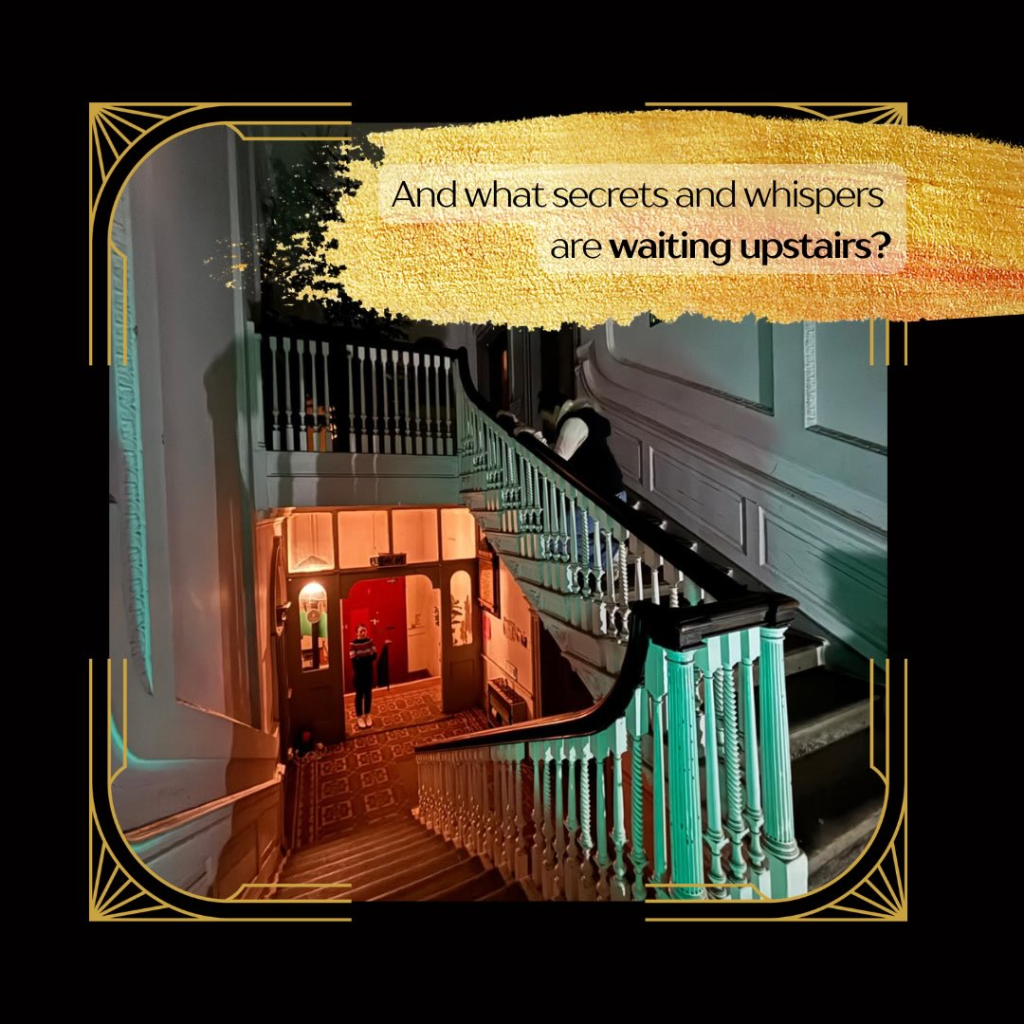
There is so much going on that it cannot possibly all be experienced in a single night. The cast list is so huge that only a small amount of actors are mentioned here – there were a significant number of characters that I simply had very little contact with during the evening, because of the various choices I made. At one point I noticed several audience members wandering round with marks on their foreheads, and I have no idea what that was about! The evening ends with a choice – two possible endings, and the audience can only choose one to watch, either by staying in the main hall or venturing upstairs to the “Mount of Apollo”.
This is an excellent, if somewhat over-stimulating, evening of entertainment. There are moments where the plot becomes a little incomprehensible, but the actors are incredibly watchable nonetheless, and the sheer range of theatrical styles on offer makes every room feel fresh and exciting. This will not be for everyone (particularly those who are not as keen on audience participation), but my main recommendation is to throw yourself into it and you will enjoy it even more – when Athena asks you to guide an audience member through a dark maze, you shout those instructions, and when Zeus tells you to dance, you dance! It is refreshing to see a local company try something completely different, and we can only hope for more theatre like this in future.
Tom Morley, March 2026





 Broken Legs Blog