

“The cost of war has never been more clearly laid out […] a production brimming with ideas”
Known for its rousing speeches and fierce portrayal of a ‘perfect warrior King’, the RSC bring “Henry V” to their stage at a time when wars are waging across both Eastern Europe and the Middle East, when we are bombarded with news stories of death and destruction most days and the realities of the brutality of warfare are often plain to see. It is therefore perhaps unsurprising that director Tamara Harvey chooses to make her King Henry a little more reserved, underplaying the well-known rousing speeches and instead focusing on the numerous casualties and severe losses, with the help of Annie-Lunnette Deakin-Foster’s movement direction which hammers home the dangers of battle and the loss of innocence. For all purposes, this feels like a much-simplified tale of war, yet the final scenes here introduce new themes and ideas that seemingly clash with the groundwork already laid, ending with a message that feels muddled and a little confusing.
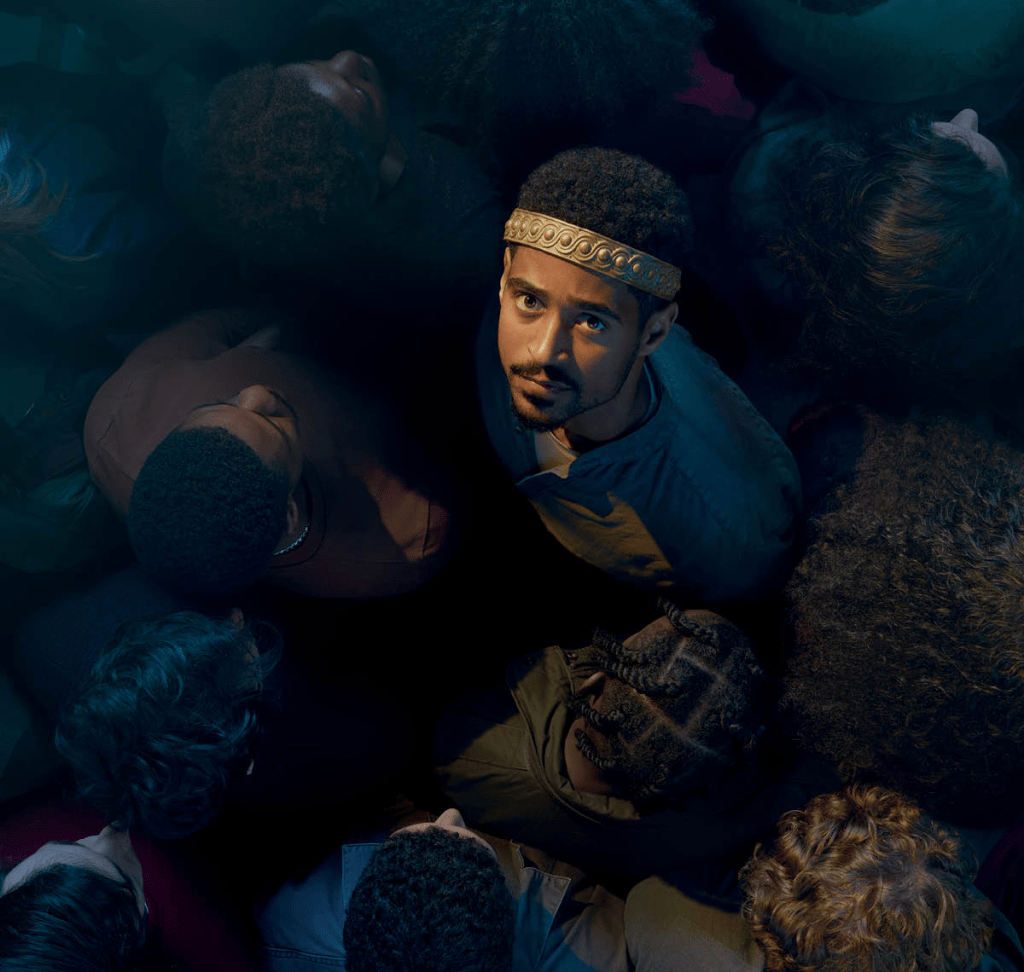
Alfred Enoch takes on the title role, returning to the RSC for the first time since his excellent turn as Pericles in 2024. There is a great amount of naivety to Enoch’s Henry, and the opening scene is a flashback from the end of Henry IV Part II, as the Prince watches his father (Valentine Hanson) die, and takes the crown for himself. Enoch then takes on the well-known prologue, here reworded slightly – where the original asks the audience to imagine future battles within the confines of a ‘wooden O’, here Henry asks himself to imagine his potential conquests within his newfound ‘coronet’. It is a change that might not sit well with everyone, but it goes a long way to helping us understand who this Henry is – a youthful wannabe who has fantasies of winning people’s love through war rather than politics. Henry is filled with optimism, rushing headlong into a war without thinking about the consequences (which may be reminiscent of a certain American president). He is often softly spoken, and there is a great deal of emphasis placed on his religion and family, sharing great chemistry with his younger sister, a gender-swapped Duchess of Gloucester (Sophie McIntosh adding a much-needed strong female character to the mix). We see him slowly mature, and it is here where Enoch excels in the role, yet his realisations about the savagery of war arrive too late to have much of an impact.
Despite Jamie Ballards’ Williams going a long way to show Henry the cost of his war, Henry continues to be blindsided by the potential victory. His “band of brothers” speech is delivered in a quintessentially British, gung-ho manner, often breaking the rhythm to find the humour in the language, affecting his voice with cheeky asides to the audience. It prevents the speech building as it should, robs it of its usual rousing nature, and whilst it is entirely in keeping with Enoch’s character, it provides this production with little momentum with which to launch into the battle of Agincourt. Everything Henry has learnt about life, from the death of Falstaff, his hanging of Bardolph, and his conversation with Williams, seems to not have had any effect on him.
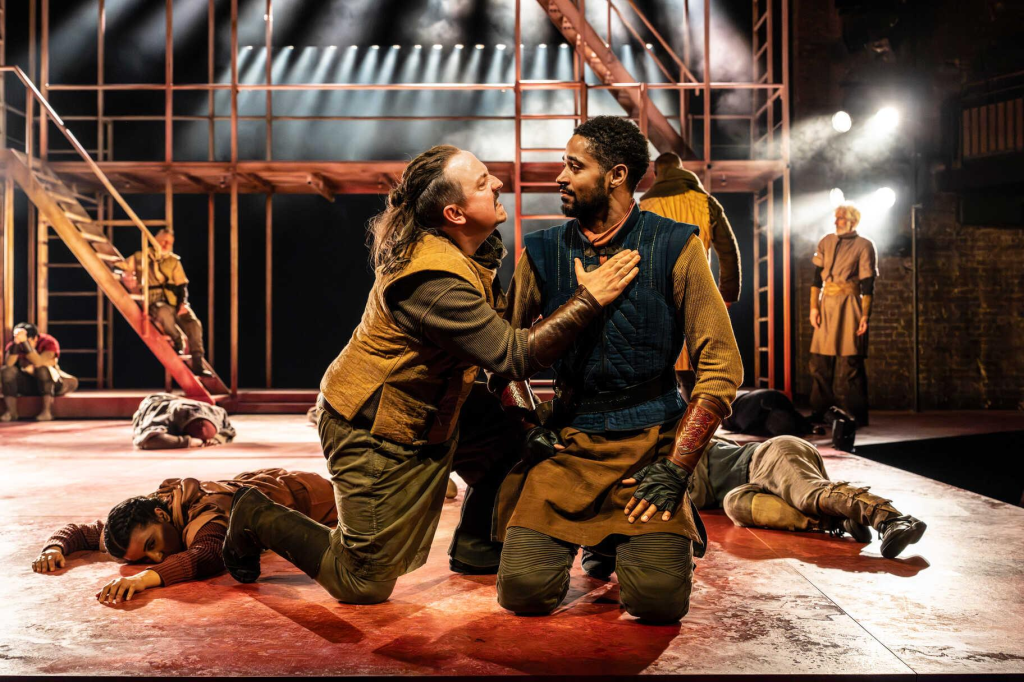
It is a front, of course. After the battle, upon hearing the number of the dead, Enoch’s Henry finally breaks down. The cost of war becomes too much for him, the responsibility he feels for the dead is clear to see. This is a production that goes a long way to emphasise the loss of innocence, most keenly felt in the role of Tanvi Virmani’s Girl, who steals some of the lines of the Chorus here, and becomes the focus of the main battle sequence. Lucy Osborne’s set design sees the stage filled with a large, rotating wooden scaffold, stained with blood at the base, that is used to its full potential during this sequence, as we follow Virmani’s journey through the battlefield, fighting off one soldier after another, being flung around the stage and across multiple levels of the scaffold. As the ensemble – and this is a huge ensemble, including 30 local 18-20 year olds added to swell these crowd scenes – begins to drop down dead one by one, leaving only Virmani standing, it is a stark reminder of the cost of war. It is the perfect set up for Henry’s eventual realisation, which is superbly executed but comes at the cost of earlier speeches (‘once more unto the breach’, ‘the feast of St Crispin’s day’) which suffer as a result.
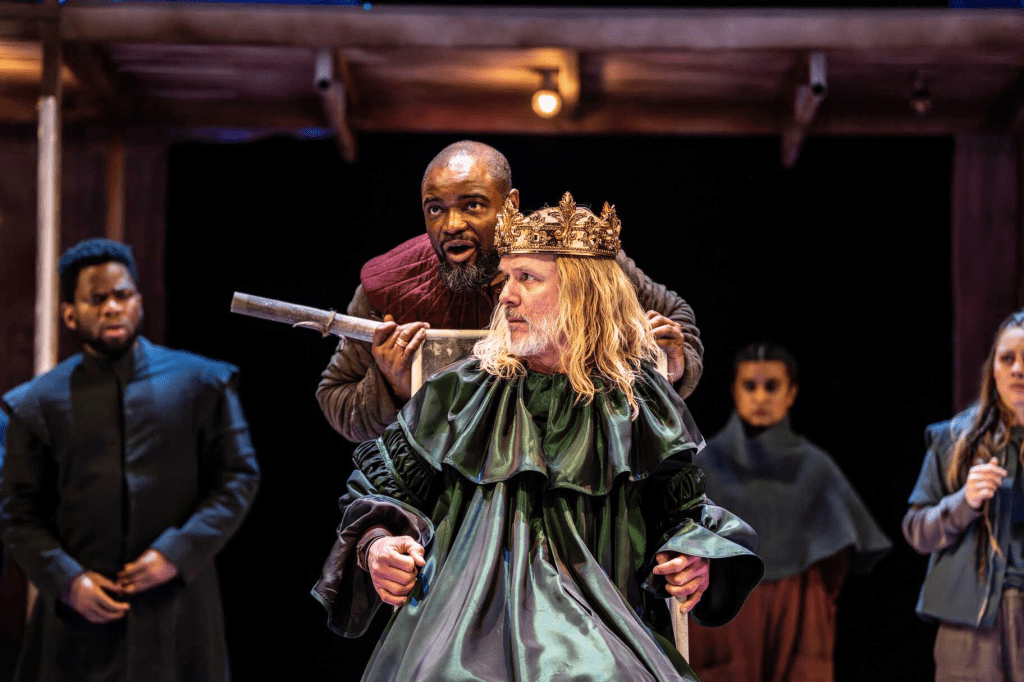
The play suffers further in that it doesn’t end with this realisation, but with Henry meeting with Ballard’s King and Catrin Aaron’s Queen of France to negotiate terms. Ballard’s King, despite being older than Henry, is much more immature, crumbling quickly in defeat, and relying on Aaron’s Queen for support, Aaron reminiscent of Lady Macbeth as she addresses Henry and confidently takes charge. After the war, Henry must find a new way to govern, and he does so by deciding to wed Princess Katherine (Natalie Kimmerling). This move goes a long way to show how Henry has changed as a ruler, yet it is not played here as a particularly positive thing. Instead, Enoch’s Henry comes across as fairly predatory (something not even hinted at in earlier scenes), with Kimmerling shying away from him and clearly being made to feel uncomfortable by Henry’s confessed love. It is an interpretation that is, unfortunately, all too easy to relate to in 2026, but one that feels at odds with the rest of the narrative. Just when we want to celebrate Henry finally maturing, he is turned into a much more seedy villain, leaving the audience confused as to what the message is meant to be here. It is an aspect of the character that is introduced too late to be properly explored, and makes one wonder if the play would have had more of an impact had it ended immediately after the battle of Agincourt without this extended epilogue.
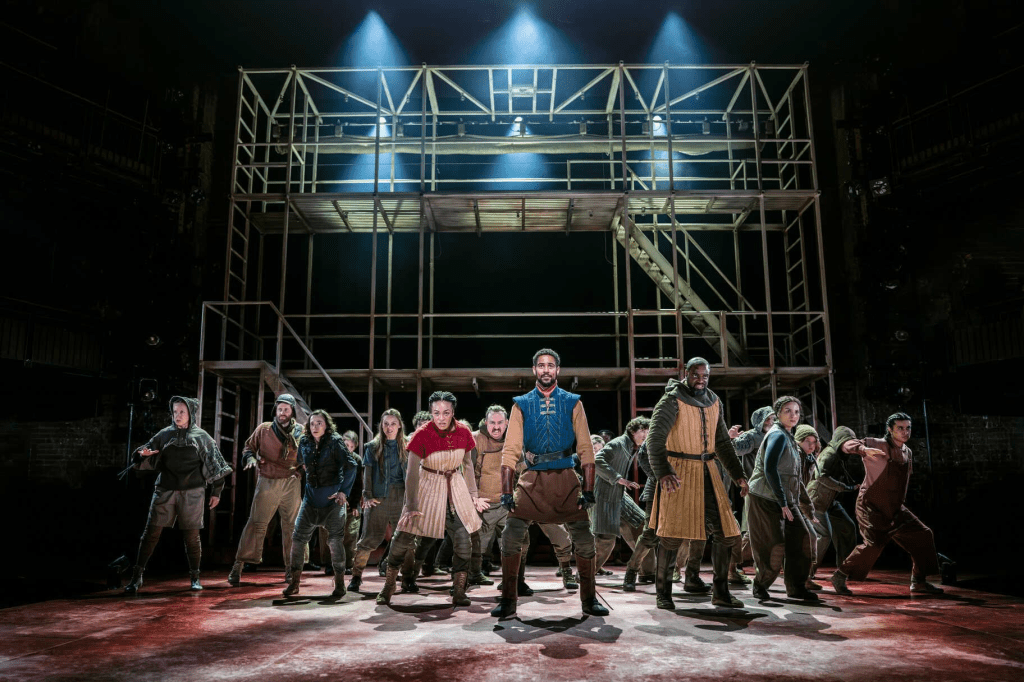
Osborne’s costume design is mostly in keeping with the time period, tabards and tunics, yet for some reason some characters appear wearing trainers and jackets, which can be quite distracting – in the case of Michael Elcock’s Dauphin, I found myself watching his feet more than paying attention to his actual speeches. It is a weird mix-match of costume where the purpose is never quite clear. Jamie Salisbury’s composition is suitably warlike and aggressive, loud drum beats that are matched by ferocious choreography, yet unmatched by Enoch’s calm delivery. The play leans heavily into the comedy, with the help of Paul Hunter’s Pistol, and yet his inclusion during some of these choreographed moments seems to again dispel any growing tension.
This is a production brimming with ideas, that could have been better realised if some ideas were stripped back a little. In the past, I have appreciated the simplicity of Harvey’s direction, and that is often the case here – the focus is very much on character and story rather than extravagant set changes – but it instead feels thematically complicated. Enoch’s Henry is an interesting interpretation, but one that can feel lacking amidst the exciting musical and choreographic choices. The cost of war has never been more clearly laid out, a stark message that is important to convey in 2026, but a message that is clouded by too many other aspects.
Tom Morley, March 2026
For more information on how I decide on star ratings, see here: Star ratings – Broken Legs Blog
Review round-up:
The Guardian: Henry V – A 3-star review from The Guardian, who say this is “ultimately, […] a faithful celebration of Henry’s nationalism, with a few off-notes”, questioning whether this is a “missed opportunity”
All That Dazzles: Henry V – 4* for ATD, who say “thanks to Enoch’s captivating central performance, it is a mesmerising show to watch”
The Stage: Henry V – A meagre 2* from The Stage, who call this an “unfocused take on Shakespeare’s study of pride and patriotism”



 Broken Legs Blog