

“An intriguing watch but one that is utterly bizarre”
Last year’s Rupert Goold-directed “Hamlet” (which I previously reviewed here) is given a makeover for a UK tour by Sophie Drake, who retains much of the original, but is forced to make necessary changes due to the limitations of a touring set. I spoke previously about my issues with the setting of this Shakespearean tragedy, which replaces the hallowed halls of Elsinore Castle with the upper decks of the Titanic, and it is safe to say that the setting works no better here. The play is beset with too many problems that it must then try to solve, too many barriers that result in shoe-horned explanations or non-sensical scene transitions. In Stratford-upon-Avon, what the play lost in clarity it made up for in spectacle, but the tour even loses that to some degree – the platform on which the action takes place remains static, and the surrounding water is recreated thanks to some clever (if slightly nauseating) video design courtesy of Akhila Krishnan, rather than using an actual swimming pool. Drake finds clever ways of incorporating these elements into a touring production, but it leaves everything feeling slightly lacking.
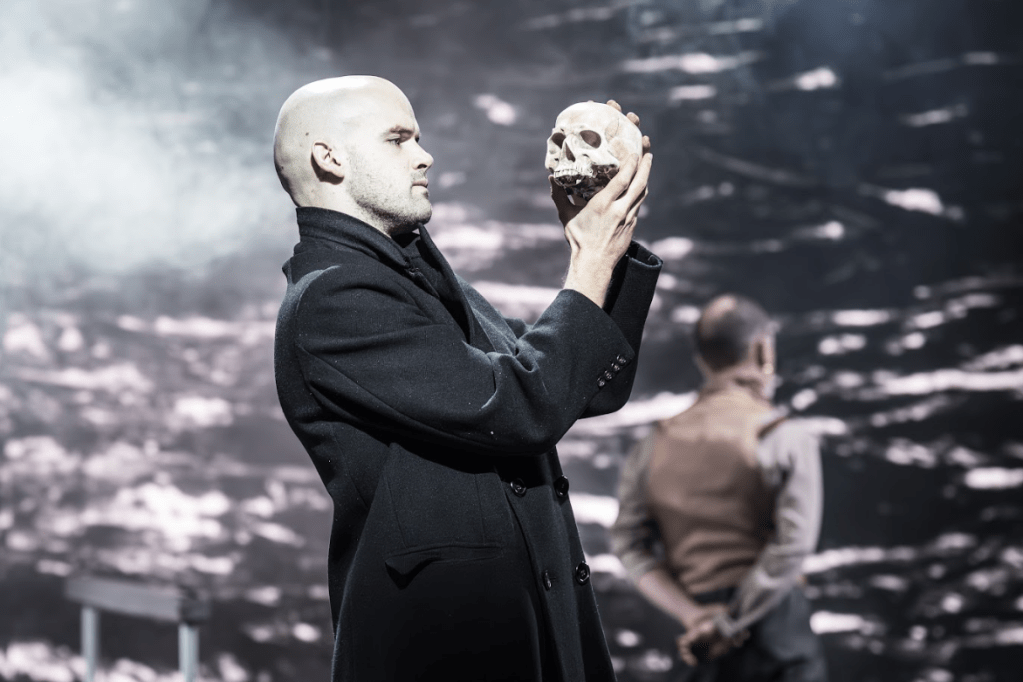
We have a new Hamlet at the helm courtesy of Ralph Davis, who presents a very angry, moody Prince that works well given the context but doesn’t particularly endear him to the audience. Davis lurches from one famous quote to the next, putting too much emphasis on certain well-known phrases that detract from the character. His soliloquys are overly dramatic, lacking nuance in places, and many of his scenes are simply reduced to shouting matches by the end. There are glimpses of promise here – his scene with Georgia-Mae Myers’ Ophelia in which Hamlet tells her to “get thee to a nunnery” begins on a calmer note, making the sweet Prince feel a little more dangerous, but it isn’t long before Davis is slinging out the lines at full volume once again. It can make the show feel exhausting, and that’s without the endless back-and-forth of the actors as they throw themselves around the stage amidst the sinking ship.
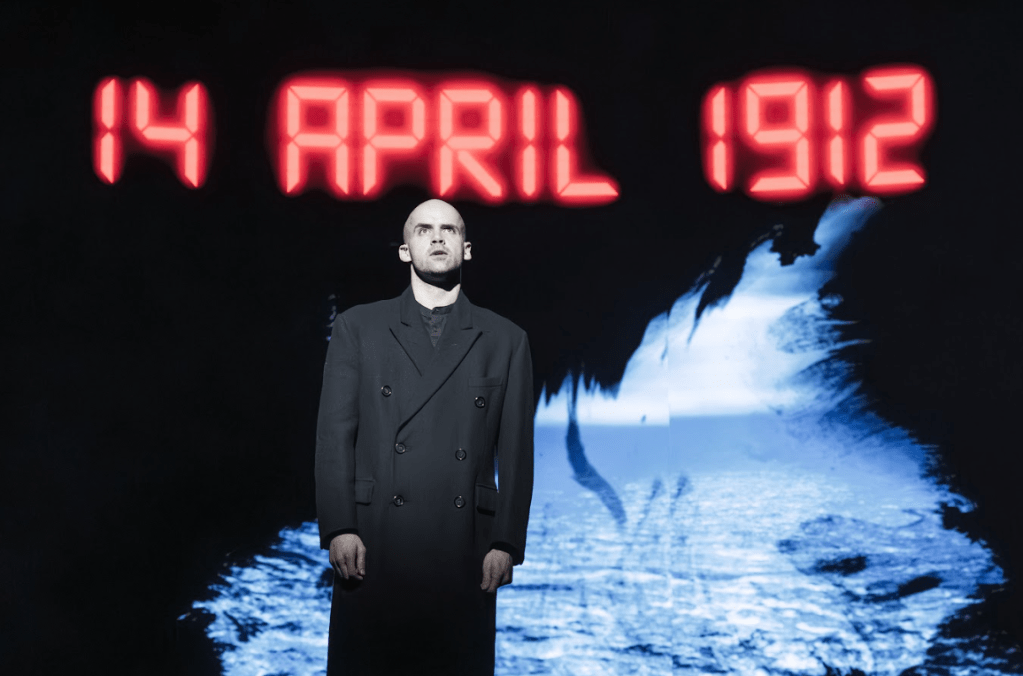
The entire play takes place over the course of one evening, meaning that Hamlet’s descent into madness is very sudden, and it feels completely disingenuous here. Davis leans into certain tics, both physical and vocal, as a way of portraying this sudden madness, although these aren’t present in his opening scenes, and only begin shortly after he communicates with the ghost of his father (Ian Hughes). Using this as a triggering event for Hamlet’s declining mental state is a good idea, but it is the fact that it happens so quickly that makes it hard to comprehend. A large digital clock informs us exactly how much time has passed between scenes, and Hamlet goes from moody teenager to completely barking mad in about half an hour. It is, frankly, unbelievable, and results in a lot of Shakespeare’s language losing impact.
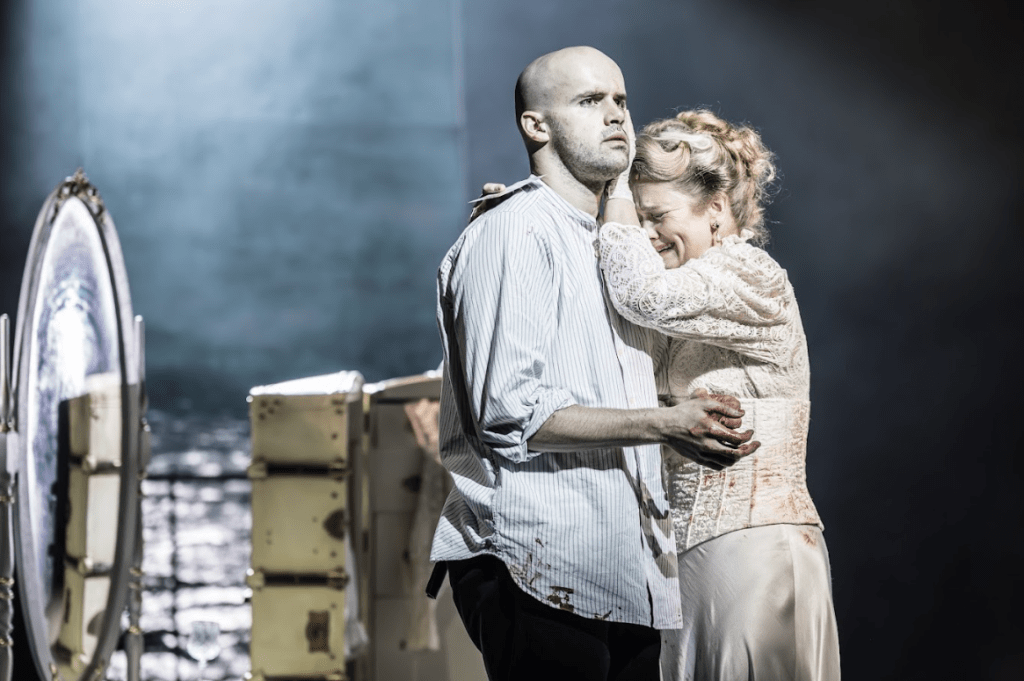
Ophelia doesn’t fare much better. Myers presents an Ophelia that knows her own mind, and clearly believes she can save Hamlet, physically trying to pull him back from the brink of madness, desperate to recall the man she used to know. It is an interesting interpretation, although her scenes are all too brief, and the second act seemingly doesn’t know how to handle her grief, with Myers mimicking Hamlet’s tics in a way that is almost played for comic value. When she dies – and her drowning is probably one of the most natural causes of death thanks to the Titanic setting, although it does result in Gertrude’s “willow aslant a brook” speech being necessarily butchered – her dead body is seemingly dragged from the sea, to be wrapped in a blanket and then unceremoniously dumped over the side again, just one example of the narrative gymnastics that this production must undergo to make the plot work.
As Claudius, Raymond Coulthard gives a very natural performance, a King who seems to be trying his best to cope with the situation, but quickly reveals his true nature in later scenes opposite Benjamin Westerby’s Laertes. This production leans heavily into the romance between Claudius and Gertrude (Poppy Miller), who both appear to dearly care for each other, helping to add some meaningful motivation to their actions. The scene between Davis and Miller immediately after Polonius’ death forms the emotional heart of the play, and the mother and son’s confrontation is very enjoyable to watch, if a little uncomfortable.

Perhaps the most surprising standout is Julia Kass as Guildenstern, who has better chemistry with Davis than Myers, and adds an extra level of intrigue to their scenes together, the line “you did love me once” hinting at some additional unseen backstory. Kass steals some lines from Rosencrantz (Jamie Sayers, who is often reduced to a mere spare part), and Horatio’s final announcement even swaps the famous phrase around to declare that “Guildenstern and Rosencrantz are dead”. Moving Hamlet’s “to be or not to be” speech to post-Mousetrap is a stroke of genius, putting extra emphasis on Hamlet’s isolation, the speech arriving in the wake of a slap in the face from Gertrude, and a ferocious argument with Guildenstern. Colin Ryan’s Horatio is likeable enough, yet a little forgettable, and his supposed friendship with Hamlet is not easy to buy into. Ryan is rather innocent and optimistic throughout, in sharp contrast to Davis.
Es Devlin’s set design sees the actors on one of the steepest rakes I have ever seen, and those in the stalls may have a stiff neck by the final curtain. Hannes Langolf’s movement direction allows the cast to recreate the listing of the ship without the need for moveable scenery, and the final scene sees parts of the decking ripped away, leaving a hole for cast members to drop through as they meet their demise. It is a clever way of attempting to recreate the final scene as played in Stratford, but it is by no means perfect. Evie Gurney’s costume design remains excellent however, period accurate costumes helping to add a touch of class to proceedings.

Overall, this is an adaptation too far, a setting that just doesn’t work in any sense. For those who are Shakespeare purists, you’d be better off giving this a miss. For those who enjoy seeing updated versions or Shakespeare transposed to different settings, this is an intriguing watch but one that is utterly bizarre. I consider myself the perfect target audience for this production (I love seeing Shakespeare reimagined in different ways, as demonstrated by my rave review of last year’s Radiohead-inspired Hamlet Hail To The Thief) and yet I just could not buy into this at all. Just when you think things can’t get any worse, “The Murder of Gonzago” is played as a Japanese Noh Theatre-inspired montage, which is fine but has no place being on the Titanic. This production will likely alienate fans of “Hamlet”, but also risks alienating those that are new to Shakespeare, and for a touring RSC production, I think that is the true tragedy.
Tom Morley, March 2026
For more information on how I decide on star ratings, see here: Star ratings – Broken Legs Blog
Review Round-up:
Elemental Theatre: Hamlet RSC 2026 Tour – ETC’s 3* review calls this “undeniably interesting” but “occasionally frustrating”
The Reviews Hub: Hamlet – The Reviews Hub clearly have a very different opinion, with a 100% ‘essential viewing’ rating, saying “this is a production well worth seeing for its staging alone, and is an impressive addition to the Shakespeare canon”
Kev Castle Theatre Reviews: Hamlet – Kev Castle also disagrees with my view, saying this “presentation is absolutely stunning, incredible and non stop entertainment”











 Broken Legs Blog