
“Chaotic, in-your-face […] Cartwright’s script is pure poetry”
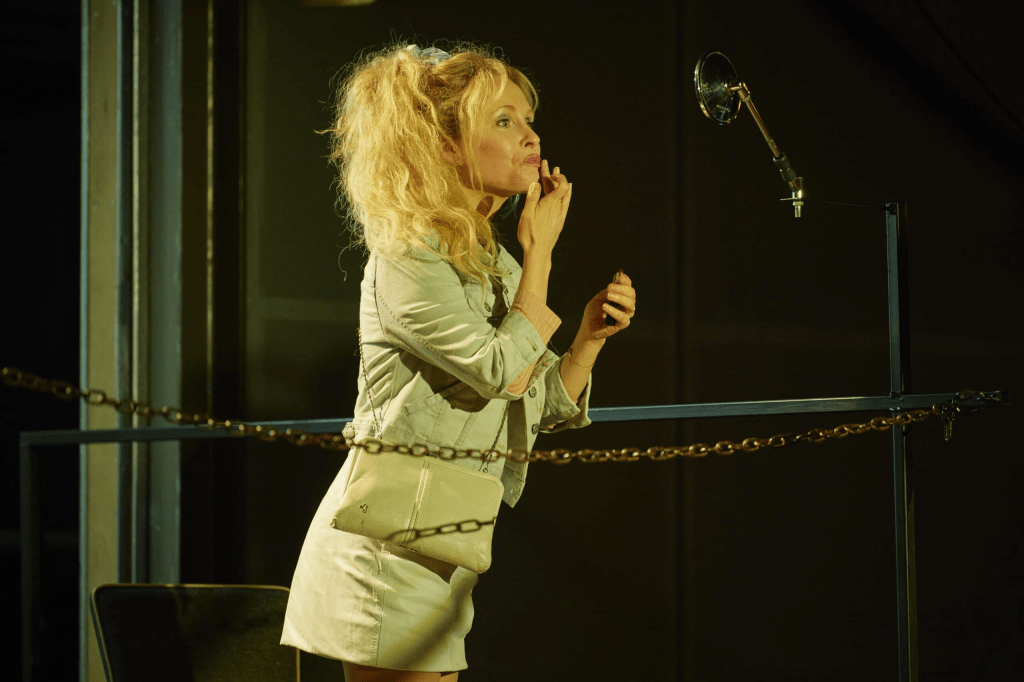
From the moment the audience enters the Royal Exchange, they are entirely absorbed into the world of ‘Road’. The entire building has been cleverly redesigned to allow audience members to explore Jim Cartwright’s 1980s-set play at their own pace, before taking their seats in the auditorium. A trip to the pub sees Shobna Gulati’s Brenda and Dean Michael Gregory’s Barry playing darts. Further down the corridor, you can find Eddie’s dad (Dana Haqjoo) watching the boxing on TV. Lucy Beaumont’s Louise is doing her makeup, preparing for a night out, whilst my theatre companion and I found ourselves pursued by Lucie Shorthouse’s Chantal, asking us to lend her a lighter or buy her a shandy. It is chaotic, in-your-face and completely unlike any theatre I’ve ever experienced before. And it all happens before the show has even begun.
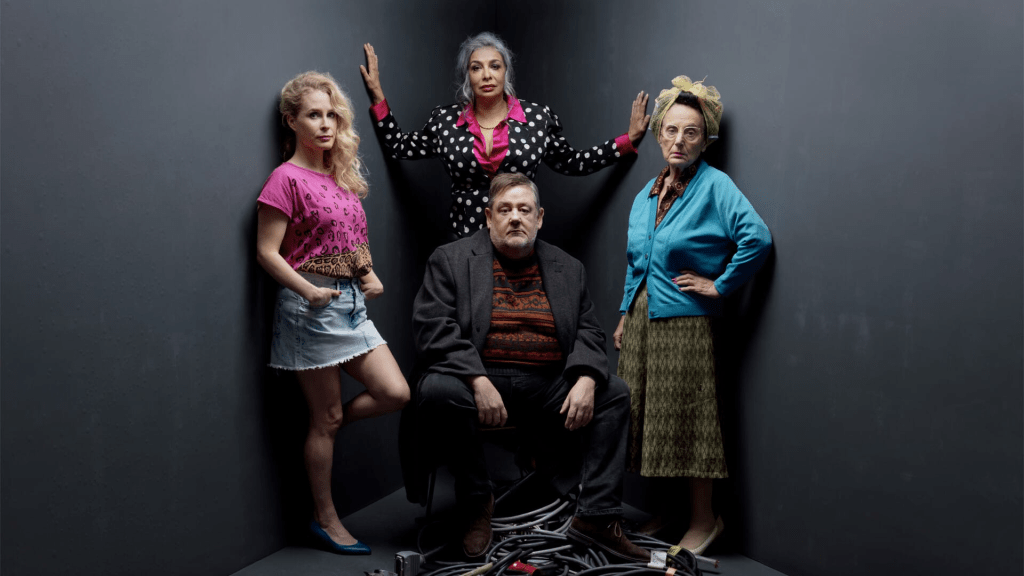
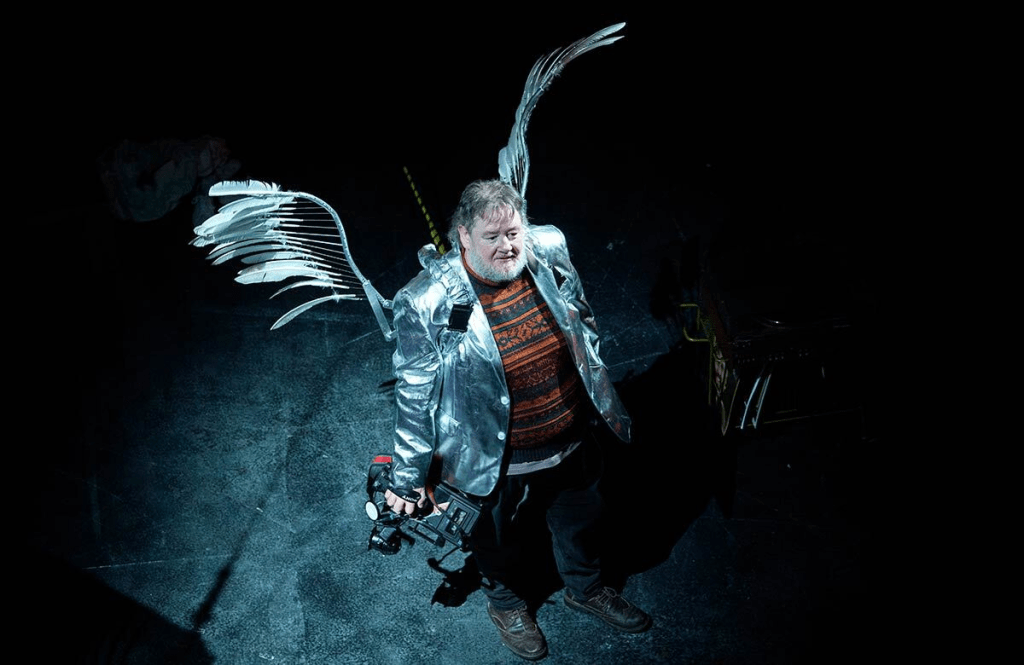
Once the audience have taken their seats in the Royal Exchange’s in-the-round Module Theatre, our tour guide for the evening, Johnny Vegas’s Scullery, appears, miming along to Somewhere Over The Rainbow. It is Scullery who enjoys the most interaction with the audience – although the fourth wall is never up for long with any of the cast – casually finding ways to invite different audience members into his world. It is never clear whether Scullery is the homeless layabout he seems to be, or something more ethereal and omnipotent. Occasionally, his speeches hint at a greater knowledge and understanding, offering high concept ideas and explanations for why the Road is the way it is. At other times, his monologues are simply brash and vulgar, vicious catcalls aimed at young girls and grotesque sexual innuendo. When one of the characters dies towards the end of Act One, Scullery appears dressed as an angel – his purpose is not just as a guide for the audience, but as someone who genuinely cares for the characters on the Road. Someone has to care about them – no one else does, they have been left to rot. Anyone expecting cheap, comic thrills from stalwarts such as Vegas, Beaumont and Lesley Joseph are in for a shock – this is one of the most depressing things you will see at the theatre, and the play is all the better for it.
Leslie Travers’ stage design sees TV screens hanging around our heads, trailing wires and flying bits of furniture. Gulati begins the play in an armchair suspended above the stage, the naturalism of the script clashing with the abstract design in a way that makes us take note of every small detail. The street sign (which simply says the word ROAD) hangs centre stage, revolving throughout the play and often casting interesting shadows on the myriad of characters below. The Royal Exchange is a wonderful mish-mash of ornate building design and modern fixtures and technology. The set design mimics this – it means that the props and scenery scattered throughout the rest of the building don’t feel out of place amidst the rest of the setting. It is genius, melding the authentic 80s feel with the necessary modernness of card readers and ticket scanners.
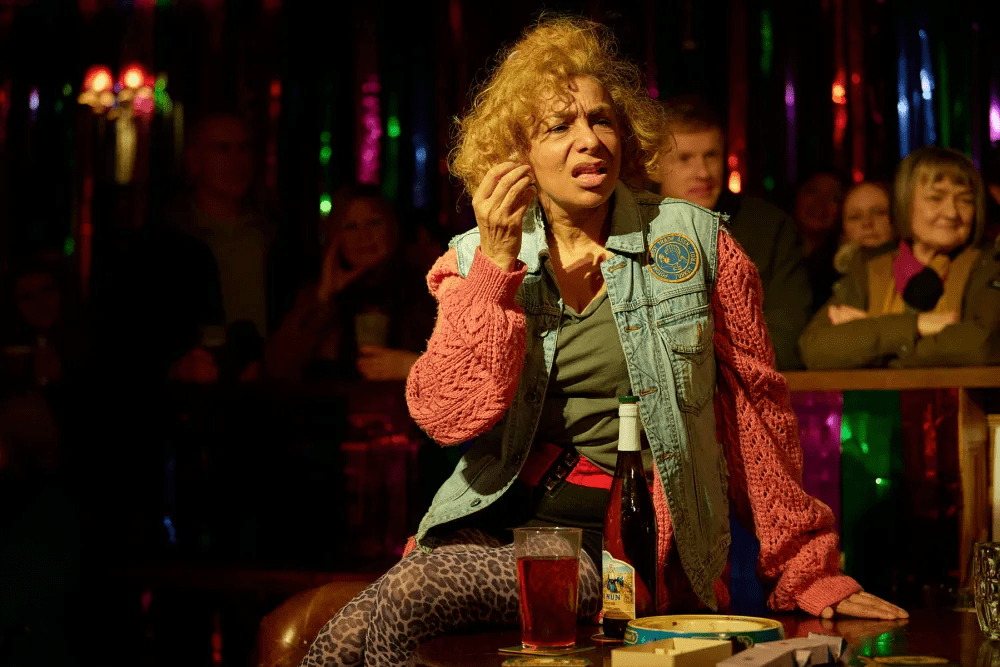
“Road” does not tell a straightforward story, but rather a collection of stories, all taking place over the course of one night, with many of the actors taking on multiple roles. Under Selina Cartmell’s direction, the height of comedy is reached thanks to Gulati, who appears as Helen, a young woman trying to seduce a soldier without much luck, and Marion, whose attempted romantic liaison with Brian (Haqjoo) is interrupted by the arrival of Brian’s daughter (Shorthouse). Elsewhere, Beaumont appears as a frightened housewife awaiting her husband’s return from the pub in a particularly moving scene, whilst Kyle Rowe portrays Skin Lad, a skinhead described by the other characters as a ‘f***ing nutter’ but there is more to him than meets the eye – after a particularly physical monologue that sees Rowe single-handedly re-enacting a fight he’s had, he reveals to the audience that he is trying to escape from his anger by exploring Buddhist techniques. There are no simple stereotypes here, and it is what makes the play ever so engaging.
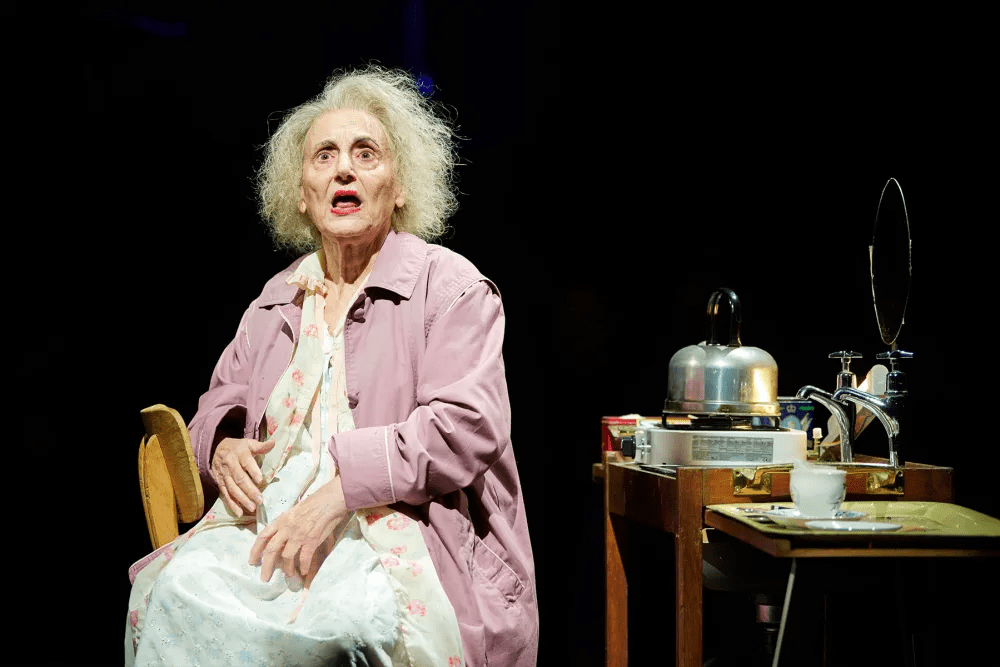
Perhaps one of the most moving moments of the night comes courtesy of Joseph, who plays elderly lady Molly, a woman who lives on her own and quietly sings to herself whilst putting on makeup – “a bit of red, a bit more red”. It is funny but also incredibly sad – a woman desperately trying to cling to her past, someone who has always depended on her good looks now left with very little else. Elsewhere, Tom Courtenay appears via TV screens to deliver Jerry’s monologue, a gentleman lost in his memories, recalling the nights when he used to go dancing and flirt with girls. They are both part of a forgotten generation, and it is a wonderful commentary for what happens to the older population once they stop being useful to society. The amount of people across the country who have simply been forgotten is staggering. The play may be set in the 80s, but the themes are just as relevant today.
The interval sees the stage turn into an 80s disco, with audience members encouraged to get up on stage and have a boogie, before Joseph drags us all out of our seats for a scene set in the fish and chip shop erected in the foyer. Before long characters appear on balconies above us, or climb telegraph poles to deliver speeches. Standing shoulder-to-shoulder with the actors obviously makes the show feel more immersive, but also adds to the claustrophobia of the Road – this is a place that no one ever escapes from; once you’re here there’s no getting out.
Not everything works quite as well as one would hope – many of the characters feel similar after a while, staggering across the stage drunk whilst launching childish insults at each other, which can become a little tiresome. Courtenay’s inclusion is a joy, particularly as he appeared in the first production of “Road” 40 years ago, but it feels a little out-of-place – perhaps if just one of the other monologues had also been delivered by video-link it would have felt a bit more cohesive. Each of the monologues ends with Vegas pointing a video camera at the actor so that their final words are beamed to the TV monitors – but the camera is little more than a prop, and the videos that play are pre-recorded, with the actors miming their final words instead. It is an odd choice, and incredibly obvious given that the sound-quality of the final line is different. It robs the actors of finishing their monologues authentically, which is a shame given the superb acting on display.
The music choices throughout are excellent, most of them featuring optimistic lyrics, yet slow melodies that make everything just that little bit more depressing. This is mostly felt during the final scene, as Brink (Jake Dunn) and Eddie (Rowe) bring Carol (Laura Elsworthy) and Louise (Beaumont) home after a night out, where, after downing a bottle of wine, they put on Otis Redding’s Try A Little Tenderness. Tingying Dong’s sound design is extraordinary here, the music gradually transitioning from the central record player to slowly fill the room, becoming overwhelmingly loud by the end, as the four characters all begin to break down, realising how hopeless their lives have become. It is a suitably downbeat ending to what is a barrage of misery, but it is done with such style and wit that it is incredibly enjoyable nonetheless.
This show is highly recommended purely for the experience of something unlike anything else being offered in theatre. Cartwright’s script is pure poetry – there is so much to like here, and so many interesting themes and stories that will give you plenty to chew over on your way home. Any laughter elicited by the actors is sure to be tinged with a hint of sadness. It shows that, wherever you look, you will find beauty, and everyone in our country has a story that deserves to be told.
Tom Morley, February 2026
Review Round-up:
The Guardian: Road – 4 stars from The Guardian, who call the show “exuberant, abrasive and giddily theatrical”
The Reviews Hub: Road – A 5 star review that describe the play as “an unflinching examination of a community many people would prefer to ignore”
Elemental Theatre: Road – 5 stars from ETC who say “its dark humour lands like a defence mechanism, and its political resonance feels chillingly contemporary”






 Broken Legs Blog
Leave a comment