

“Light-hearted, breezy […] some excellent comedic moments”
The true story of Florence Foster Jenkins, the American socialite dubbed “the world’s worst singer”, is one filled with sadness and mental illness, Jenkins finding herself mocked by the musical elite as she desperately tries to fit in amongst them. Having seen “Glorious!”, a play based on the life of Florence, one would be forgiven for not realising this level of nuance. “Glorious!” forgoes any depth of character, any exploration of Florence’s mental state and resilience, and instead favours an average comedy with lacklustre jokes and over-the-top interpretations. It is redeemed by the fact that the relationship between Florence (Wendi Peters) and her accompanist Cosmé (Matthew James Morrison) is incredibly endearing and helps to drive the plot, as their friendship blossoms and Cosmé feels compelled to fight in Florence’s corner instead of joining the masses in ridiculing her.
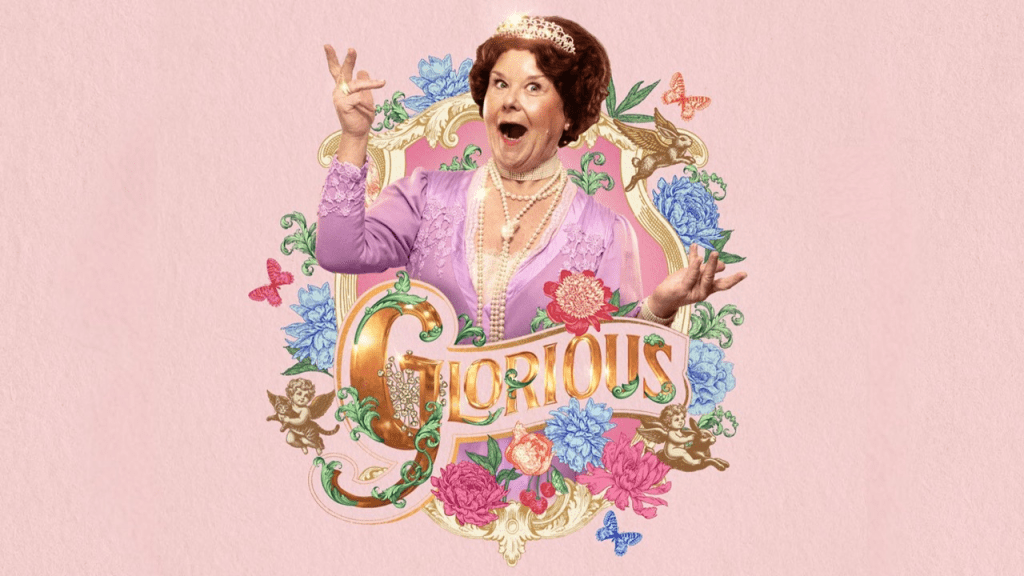
Florence is portrayed here as completely oblivious as to the level of her ability. We see her happily mouthing along to her own recordings, brazenly attempting ridiculous vocal warm-ups and proudly recalling various comments from critics, most of which are obvious back-handed compliments such as “I’ve never heard anyone sing like that before”, which draws a few laughs from the audience. Peters plays Florence with immense gusto, and the play is all the better for it – she is a whirlwind on the stage, larger than life and full of energy. She delivers her lines in an exaggerated, upper-class American accent, possibly staying true to the real-life Florence, but the melodrama this inflicts on the character becomes a little tiresome after a while. Where she is most successful is in the quieter moments that sees Florence open up to Morrison’s Cosmé, although Peter Quilter’s script doesn’t afford her enough of this. There are extra levels to Peters’ performance, but they are too hidden by a script that is far more interested in lame jokes than anything of real substance. The second act allows us an all-too-brief insight into Florence’s sadness as she almost crumbles in the face of criticism, but she is quickly brought back to her enthusiastic self by some simple words of encouragement from Cosmé.
Morrison’s Cosmé excels in his understated reactions to Florence’s performances, subtle facial expressions and glances at the audience adding to the hilarity. Cosmé is a quiet, reserved man, a pianist who is determined that the spotlight should rest on the singer rather than the musician. He is instantly likeable, delivering a monologue direct to the audience that gracefully sets up the scene although feels a tad unnecessary, given that the plot isn’t particularly hard to follow. The second act tries to add a little extra to his character by suggesting that he is a closeted homosexual, although this plot thread is never truly explored, and seems to be introduced merely for the purposes of a bit of extra comedy. The main problem with this play is that there is so much to the two main characters that remains unexplored, and instead we have to endure bland joke after bland joke which does very little to retain the audience’s interest.
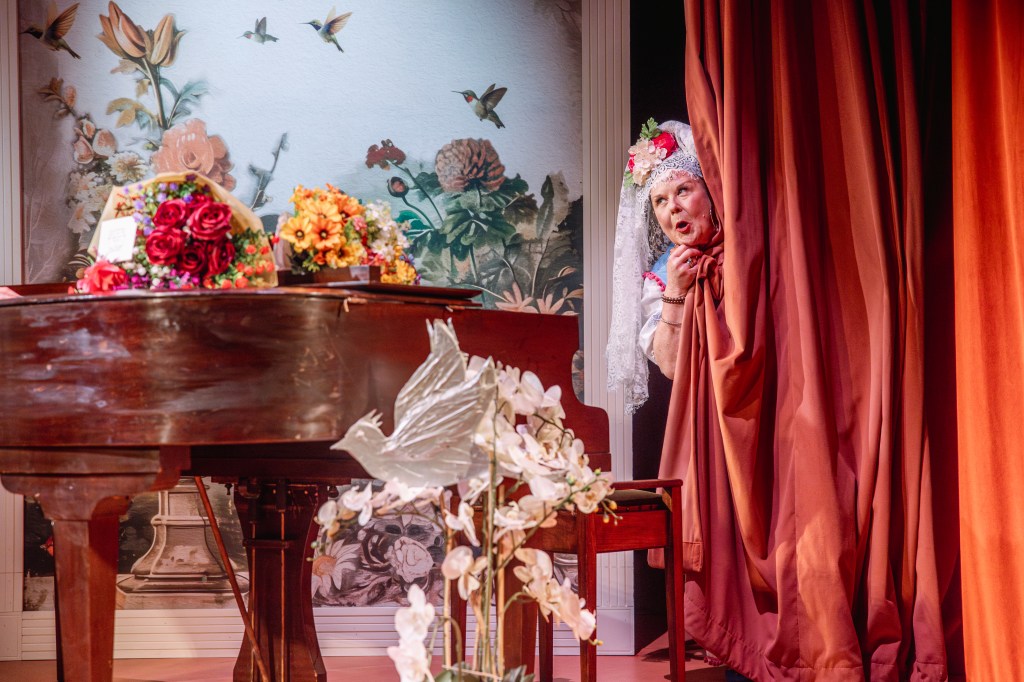
Peters’ delivers some great comedy moments as Florence performs some truly terrible vocal gymnastics, but there are only so many times bad singing can be regarded as funny. The opening of the second act steps this up a notch with the inclusion of ridiculous costume and props, but later, when Florence takes to the stage at Carnegie Hall for her first (and last) public appearance, a lot of the visual gags are stripped away and the result is something that we’ve already seen several times before in this production. The final scene offers us a glimpse of what Florence actually sounds like in her own head – but instead of being treated to a superb vocal performance by Peters herself, the production instead chooses to play a backing track which Peters obviously mimes along to, robbing these final moments of something that could have proved rather moving.
Mark Goggins’ sound design throughout is far too quiet – one moment sees Morrison attempting to quiet the noise of a crowd, but the noise of the crowd is hardly overbearing. There are several moments throughout when Morrison plays the piano, but even the piano is so hushed that these moments are not quite as impressive as they should be. The first scene inexplicably sees the piano situated at the back of the stage, behind an arm chair, which seems like an odd choice given that most of the action revolves around Cosmé sat at the piano whilst Florence sings at him.
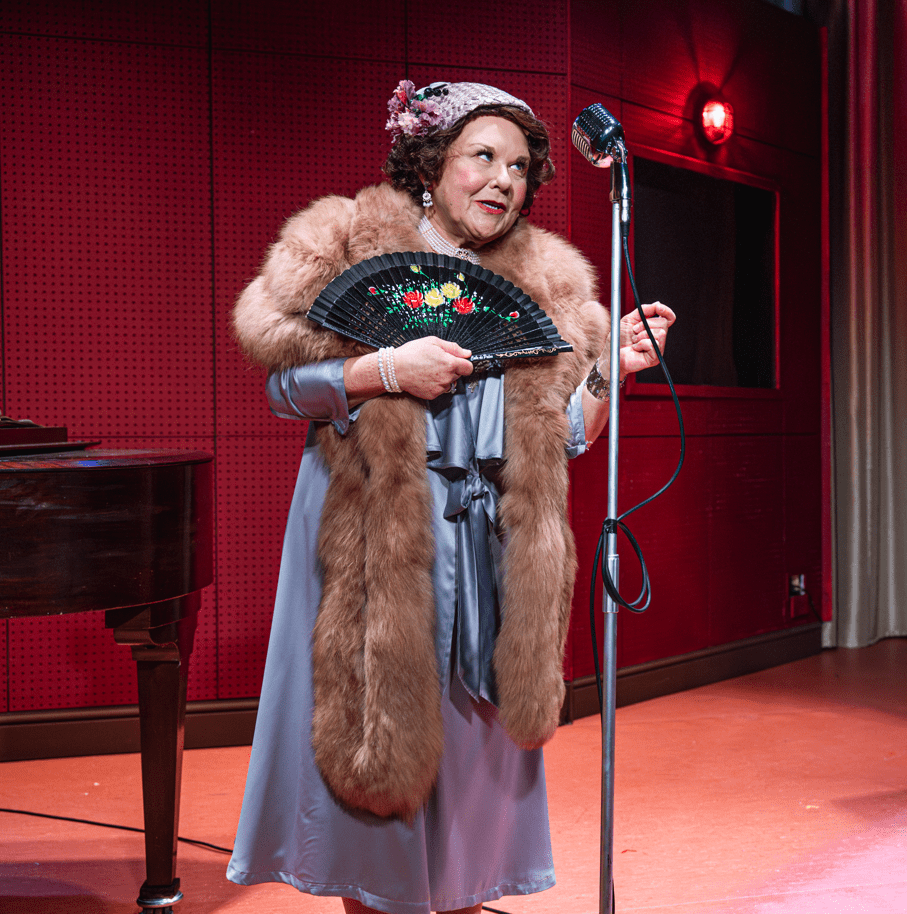
Peters and Morrison are joined by Sioned Jones as fellow socialite Dorothy, who adds very little to the plot, and Caroline Gruber as housekeeper Maria (a joke about Maria being Italian is, frankly, exhausting) and Mrs Verrinder Gedge, who criticises Florence’s performance and adds a little drama to the second act. At an hour and a half, the show is fairly short but still feels like it struggles to find enough plot to warrant such a runtime.
Ingrid Hu’s set design is simple and mostly effective, bringing to life upper-class 1940s America with various pieces of artwork and glamourous furniture suitable for the period. It is all mirrored by the immaculate costumes which add a level of sophistication to the production. At times the stage can feel a little empty – the final scene sees Dorothy complaining that the stage is so full of flowers she can’t find space for her bouquet, but in reality the stage is fairly bare, with a few flower arrangements here and there, although it is something that can be forgiven in a touring production.
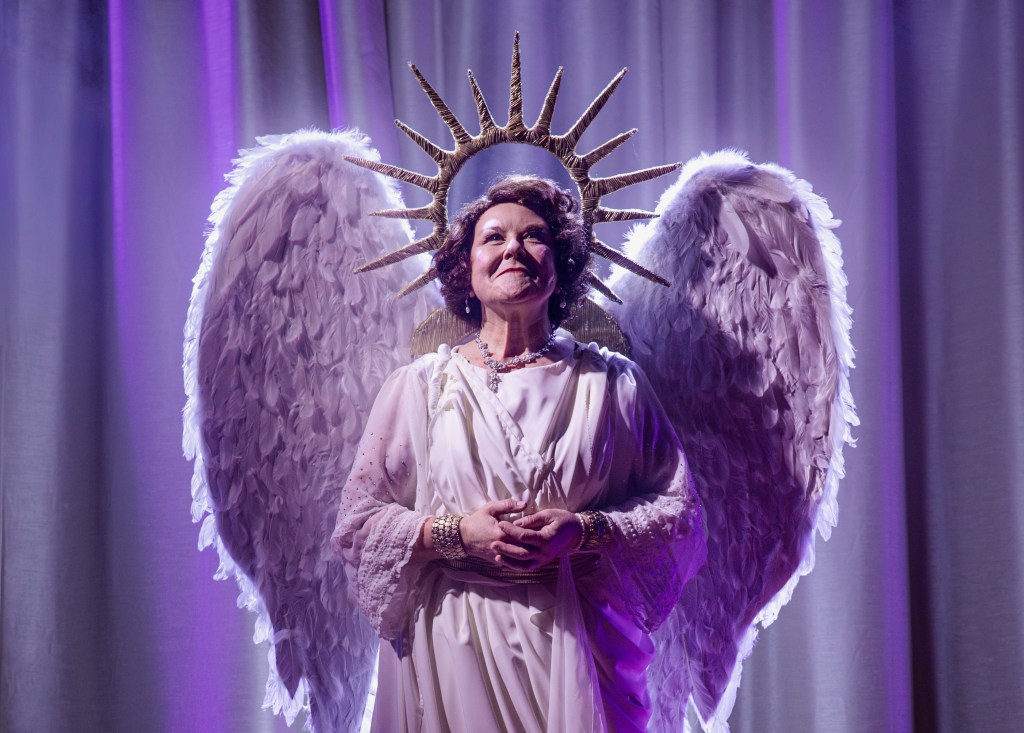
This is a light-hearted, breezy show that doesn’t demand too much attention and is likely to delight those looking for an easy-going, fluffy night of theatre. There are some excellent comedic moments in here, although they are few and far between, and if you are looking for a laugh, you will probably come away feeling satisfied if not overly enthusiastic. A fun night of theatre that, given the potential, feels like a missed opportunity.
Tom Morley, February 2026
For more information on how I decide on star ratings, see here: Star ratings – Broken Legs Blog
Review Round-up:
All That Dazzles: Glorious – 3 stars from ATD, who says that “Wendi Peters […] plays this part with skill. It takes talent to go from pantomime-esque comedy to sheer vulnerability within minutes”
London Born and Bred: Glorious! – 4 stars from London Born and Bred, who call this a “feel-good comedy that proves following your dreams is everything”
View from the Gods: Glorious! – Also 4 stars from View from the Gods, who say this play has “all the right notes in the wrong order. Solidly recommended.”













 Broken Legs Blog