

“Heart-breaking yet full of joy”
Telling the true story of Nottingham-born actress Phoebe Frances Brown, “The Glad Game” takes its name from the story Pollyanna, where the main character refers to her life philosophy as The Glad Game, which revolves around trying to maintain a positive and optimistic outlook. Throughout the play, Phoebe searches for things that she can be glad for – often failing to come up with something in the moment, struggling to find the words. It is understandable. Phoebe has been diagnosed with incurable cancer, a brain tumour that slowly begins to rob her of the things she enjoys; mainly, being on the stage. As her brain starts to fail her, she struggles to remember lines, she shakes uncontrollably with seizures, and her ambitions start to crumble before her eyes.

Responsible for telling us this sad yet hopeful tale is Jen White, who brings this solo play to life with vibrant energy, finding humour within the tragedy. Under the direction of Kathryn Edwards, White wastes no time in welcoming the audience into Phoebe’s world, where hilarity and trauma sit side-by-side. Moments play out as though they were straight from a sitcom – a pneumatic drill in a hospital, a small café with a microphone-wielding owner, things that feel entirely bizarre yet utterly truthful. These comic moments are interspersed with necessarily hard-hitting scenes, as we follow Phoebe from her initial headaches to tests, diagnosis, denial and eventual acceptance. It is a difficult watch, and can at times feel like a barrage of misery – Brown’s own words are overwhelmingly bleak at times, and White delivers them with total sincerity, never making light of Phoebe’s illness, yet still making us smile in the darkest of situations.
Where White shines the brightest is in her physical comedy. Scenes are separated with snippets of music, and White immediately responds with cringe-worthy, joyous dance moves, mouthing along to the lyrics. White has a knack for turning the saddest moments into comedy genius – after her initial diagnosis, Phoebe sits eating noodles, before miming along to All by myself, growing in confidence as the song continues until the noodles are set aside and the chopsticks stand in from drumsticks. It is these flashes of joy and happiness that help to make Phoebe feel like a character we can invest in – someone real and relatable that finds herself in the most horrible of situations.
Along the way, we are introduced to various characters from Phoebe’s life, the text providing clear descriptions of them that help us to distinguish between the various friends – the one with the crystals, the one who likes the outdoors, the one who always brings crisps. Occasionally, White offers impressions of the outlandish characters that Phoebe comes into contact with; the heavy smoker that she shares a gym class with, the squeaky voiced friend who fails to understand the meaning of the word ‘malignant’. The impressions are genius but over too quickly, and it is a shame that we do not see more of them. Other characters are brought to life via voiceovers (some provided by actors, others provided by real-life Phoebe’s family) but the voiceovers are sometimes a little out-of-place and overused. Jonathan Blackwell’s sound design is effective in providing White with a break between monologues, but could do with being slightly louder.
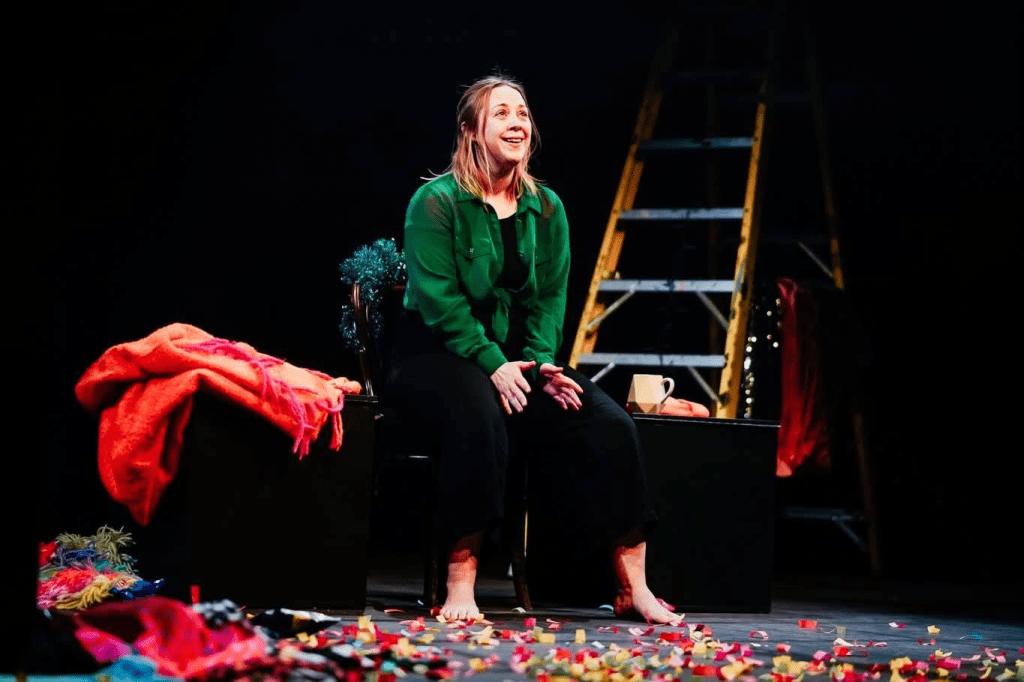
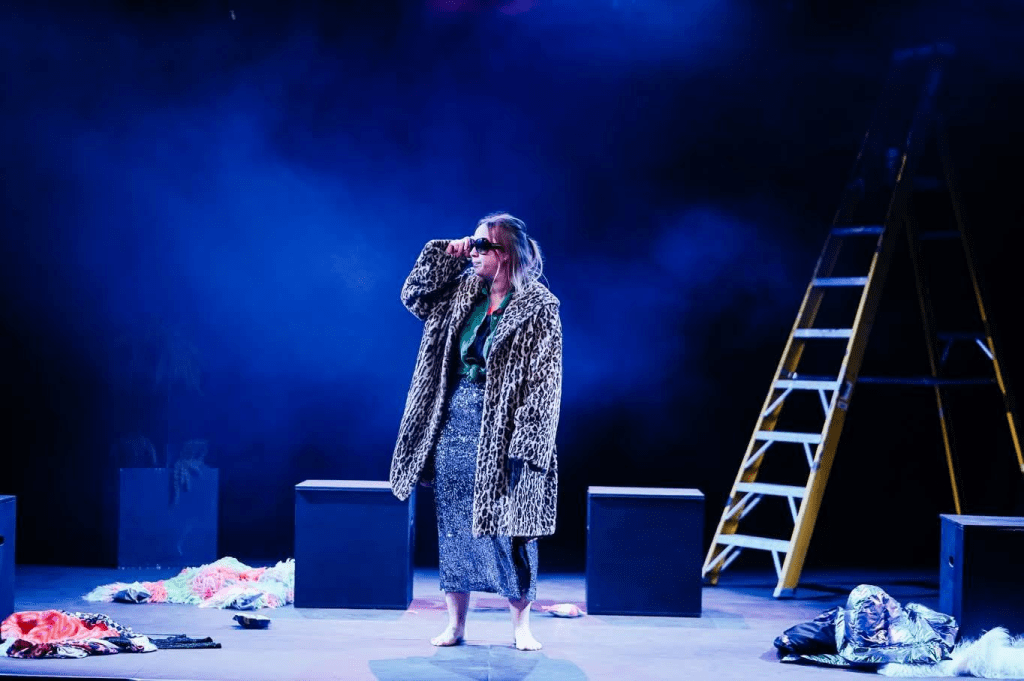
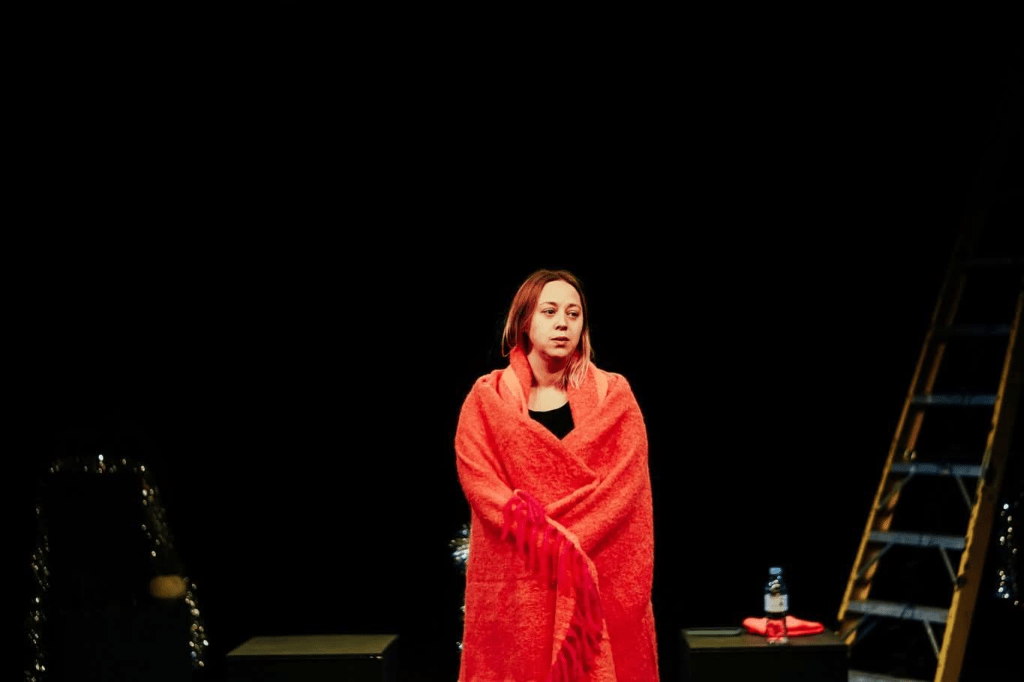
The set begins quite bare and gradually becomes more cluttered, Phoebe filling the stage with various belongings, covering every surface with clothes, tinsel, fairy lights, confetti and numerous bags of crisps. It creates a wonderful mish-mash of Phoebe’s life. It makes the stage feel homely, less clinical. It leans into the theme of hope that runs throughout the play. David Billen’s lighting design is a work of art, making the space feel claustrophobic at certain points, trapping White in a box of light, then opening up to turn the entire room into a disco. One moment that will stay with me sees the lights spinning around the room during a New Year’s Eve party, before slowing down and then reversing as Phoebe begins to have a seizure. It is a subtle change, yet conveys the story incredibly cleverly.
It is clearly an honour for the Lace Market Theatre to bring Brown’s story to their stage, and allow her work to live on. Brown sadly passed away in 2022, the year following the premiere of this play at Nottingham Playhouse in 2021. With the blessing of Brown’s family, this feels like a truly special moment for the long-running amateur theatre group, who end the show with footage of Phoebe as a child, dancing around the room, playing different characters and doing what she loves best. The script does not quite reach the emotional highs it might strive for, and there is too much reliance on swearing in place of comedy for my personal liking, but it succeeds in ending on a note of hope, finding something to be glad about amidst the seriousness of ‘real life’. Any person attempting a solo show should be commended, but White makes it look easy. Anyone familiar with White’s work (and I have been lucky enough to share a stage with her on multiple occasions) will not be surprised by that. Here she excels in showing Phoebe’s frustration, anger, sadness – but it is in those quieter moments, the glimpses of the woman Phoebe was before the cancer, when she truly shines. Heart-breaking yet full of joy.
Tom Morley, February 2026
Review Round-up:
East Midlands Theatre: The Glad Game – 5* from EMT who call this an “impressive storytelling feat” and commend Kathryn Edwards on her “adroitly excellent directorial debut”
Kev Castle Theatre Reviews: The Glad Game – Kev Castle’s review calls this the “quickest 80 minutes in theatre” and “a truly thought provoking piece […] with great warmth”











 Broken Legs Blog