

“Breath-taking to watch […] a superb spectacle”
Purpose-built for the worldwide premiere of this production, the brand new Troubadour Canary Wharf Theatre plays host to “The Hunger Games”, based on Suzanne Collins’ best-selling novels and hit film series, that tells the tale of a dystopian future society where children are forced to compete in a battle to the death. Adapted for the stage by Conor McPherson, this theatrical extravaganza features a host of special effects, choreographed fight sequences and dance interludes, yet amidst all this is a story focused on humanity and power, which occasionally gets lost amidst all the spectacle.
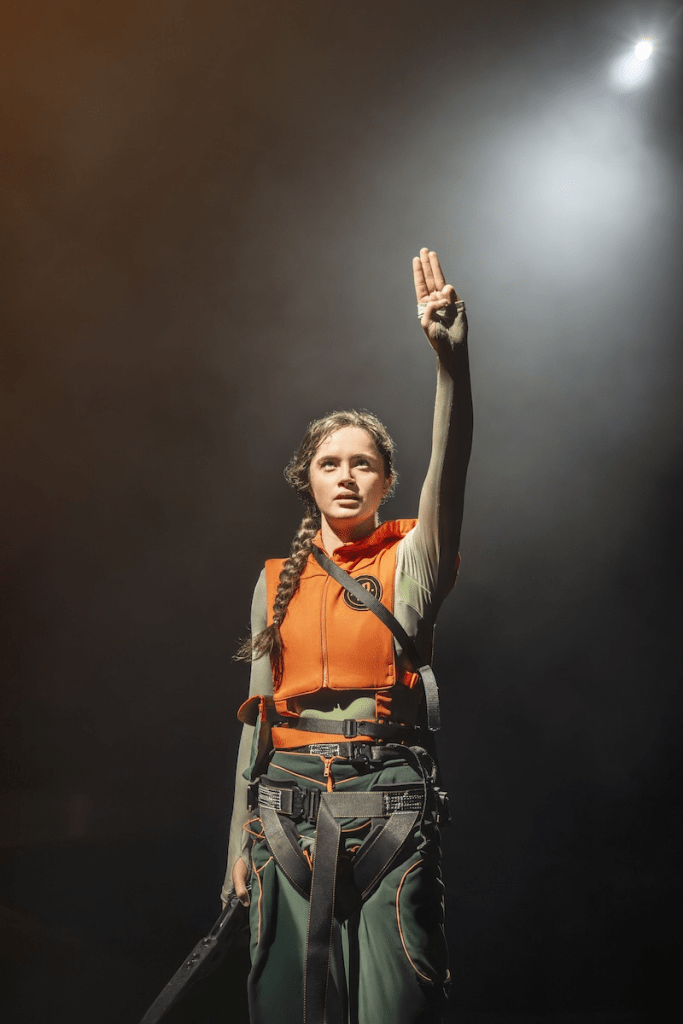
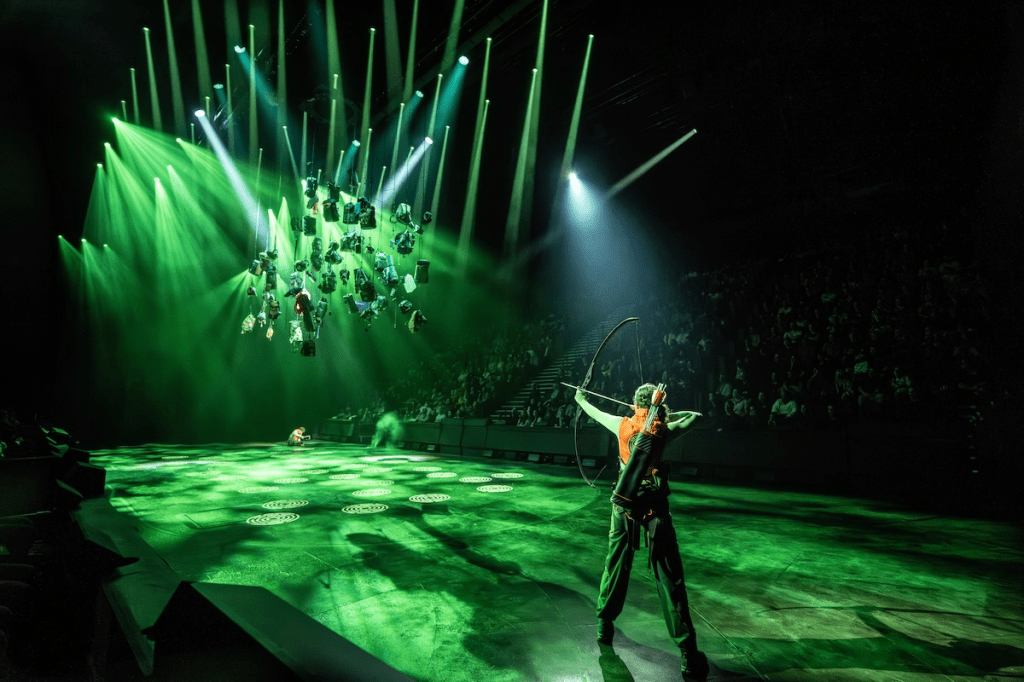
Guiding us through this story is Mia Carragher’s Katniss Everdeen, who volunteers for the games in order to protect her sister Primrose (Sophia Ally). Occasionally Carragher will break the fourth wall, to offer additional narrative that helps to fill in some expository gaps, whilst also allowing us better insight into how she is feeling and thinking, which helps us connect to her motivations more, particularly in the middle of the high-octane games themselves which take up the majority of the second act. It is a careful balancing act between hitting emotional beats and hitting the other actors, as Carragher throws herself into an incredible physical performance that sees her climbing rope ladders, tip-toeing across lighting rigs and performing high wire stunts. It is certainly a marvel to behold, and even more impressive that she manages all of these stunts whilst also remaining in character as a very young, overwhelmed Katniss, less sure of herself and more standoffish than the role originated by Jennifer Lawrence on screen. It hammers home the injustice of the games – these are just children, and they are being forced to fight for the entertainment of the social elite.
The play begins in Katniss’s home of District 12, a poor region focused on coal mining, and as such the show starts on a calmer and quieter note. It is a simple life that Katniss leads, and she stalks through the vast auditorium, hunting squirrels and enjoying some quiet flirtation with best friend Gale (Tristan Waterson). All too soon, the arrival of the representatives from the Capitol arrive, for the draw of names for The Hunger Games. The plot points are delivered thick and fast, perhaps necessary in a show that only lasts a little over 2 and a half hours, but the plot can feel laboured and daunting to the uninitiated. We are not given enough time to buy into Katniss’s relationships with Gale and Primrose, before she has volunteered in her sister’s place and is being whisked away to the Capitol. What should be moments of heightened tension as Primrose’s name is called out instead fall flat – it is impossible for us to care too much for these characters that we have barely spent any time with.
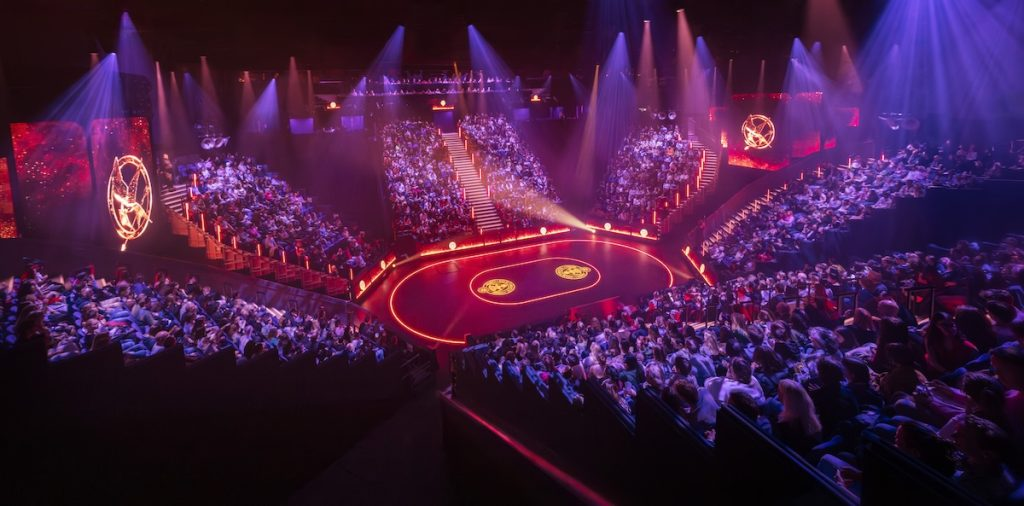
As we are pulled away from District 12, and into the lively, futuristic world of the Capitol, the stage is filled with bright costumes (Moi Tran), garish video design (Tal Rosner) and loud music (Ian Dickinson) as Katniss gets caught up in a media storm that is keen to learn all about the newest competitors in the upcoming Hunger Games. Yet it feels impossible for the ensemble (which is still fairly large at just under 30 cast members) to fill the vast space of the Troubadour Theatre, which is set out as an arena, with the stage in the centre and audience on all sides. As such, regardless of how loud the music is and how bright the lights are, everything feels a little dead, a bit too surface-level. The world clearly feels claustrophobic to Katniss, but it doesn’t for us – we are too removed from the action. This is particularly noticeable when Katniss arrives for the parade as the ‘Girl on Fire’, and sound effects of the crowd cheering and whooping have to make up for the lack of audience reaction.
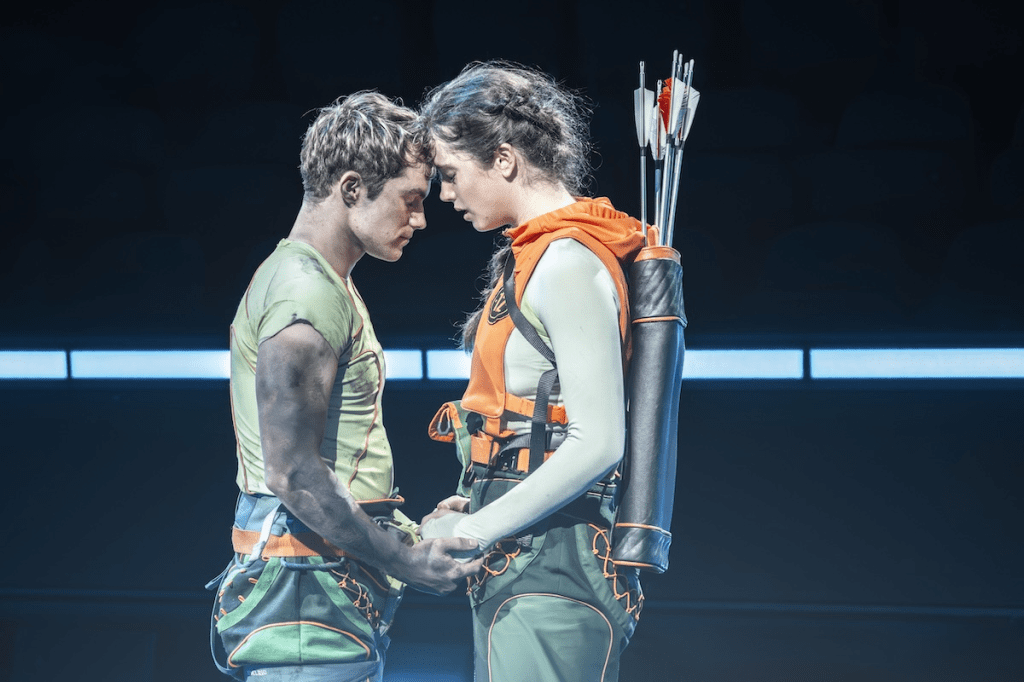
District 12’s other competitor is baker’s boy Peeta Mellark (Euan Garrett), who tries to get the Capitol elite on his side by proclaiming his romantic feelings for Katniss during a pre-Games interview. It is difficult to tell whether he is being genuine or not, which is the entire point – we are seeing this from Katniss’s perspective after all, and are never privy to Peeta’s true intentions. The scene following the interview is an emotional high point of the play, as Katniss attacks Peeta for what she believes is a disingenuous revelation. It helps us buy into their relationship more – there is some extra backstory about Peeta catching Katniss stealing a loaf of bread, but it feels unnecessary. This scene lays bare the nature of their relationship, and helps us understand their chemistry moving forward. By the time Katniss and Peeta cross paths during the second act, the tension between the two is simmering, and the audience are on tenterhooks waiting to see how this romantic conundrum is going to resolve.
The seating in the Troubadour Theatre is designed to move, allowing the stage to transform from an in-the-round configuration to a cat walk, opening up to provide more space to the actors for entrances and exits, and then closing in again to bring the audience in closer for more emotional moments. This can be effective (a particular moment involving Aiya Agustin’s Rue in act two is emphasised by the fact that the audience is slowly drawn in closer to her), but is over-used, sometimes feeling like an unnecessary gimmick. Thankfully the movement of the seats is smooth enough that it doesn’t distract from the action on stage (although the motors are occasionally a bit squeaky!).
Katniss and Peeta are trained by previous Games winner Haymitch (Joshua Lacey) and managed by upper class socialite Effie (Tamsin Carroll). Despite being interesting characters in their own right, Lacey and Carroll are not given enough stage time to make too much of an impression, feeling reduced to simple stereotypes and virtually disappearing for most of the second act. Nathan Ives-Moiba’s fashionista Cinna fares even worse here, a walking cliché that is nothing more than a plot device. Where the play excels is in Stavros Demetraki’s Caesar Flickerman, a talk show host with bright blue hair and eye-roll-inducing jokes, who succeeds in winning the audience over with his cheesy asides. When the Games get going in the second act, Flickerman is ever-present, providing voice-over and offering glimpses of audience reactions to the happenings within the Games. He also pays Waterson’s Gale a visit, which provides an interesting snippet of life back in District 12, although this side plot with Gale and Primrose is left hanging, which is probably to be expected given that this is a dramatisation of the first book in a trilogy.
The first act ends with the Games about the begin, and as soon as the second act starts we are straight into it, with a mad dash for items from the Cornucopia of goodies seeing several children brutally murdered immediately – although this is very clearly staged violence, with no blood, and entirely suitable for the teenage audience that the show is aimed at. What follows is a whirlwind of an act that sees a mix of stage combat (Kev McCurdy) and interpretive dance (Charlotte Bloom) coupled with some superb special effects (Chris Fisher) – at one point, the stage fills with smoke and the central part of the floor raises up to give the sense that Katniss is on an island. Later, the lighting rig lowers and Katniss jumps up to it, climbing it as though it were a tree. And Peeta’s camouflage on the forest floor allows for a fun jump scare that keeps the audience on their toes. It is a lot of fun to watch, and definitely the stronger half of the play, although aside from Katniss, Peeta and Rue, the rest of the competitors are given very little characterisation and all sort of blend into one after a while.
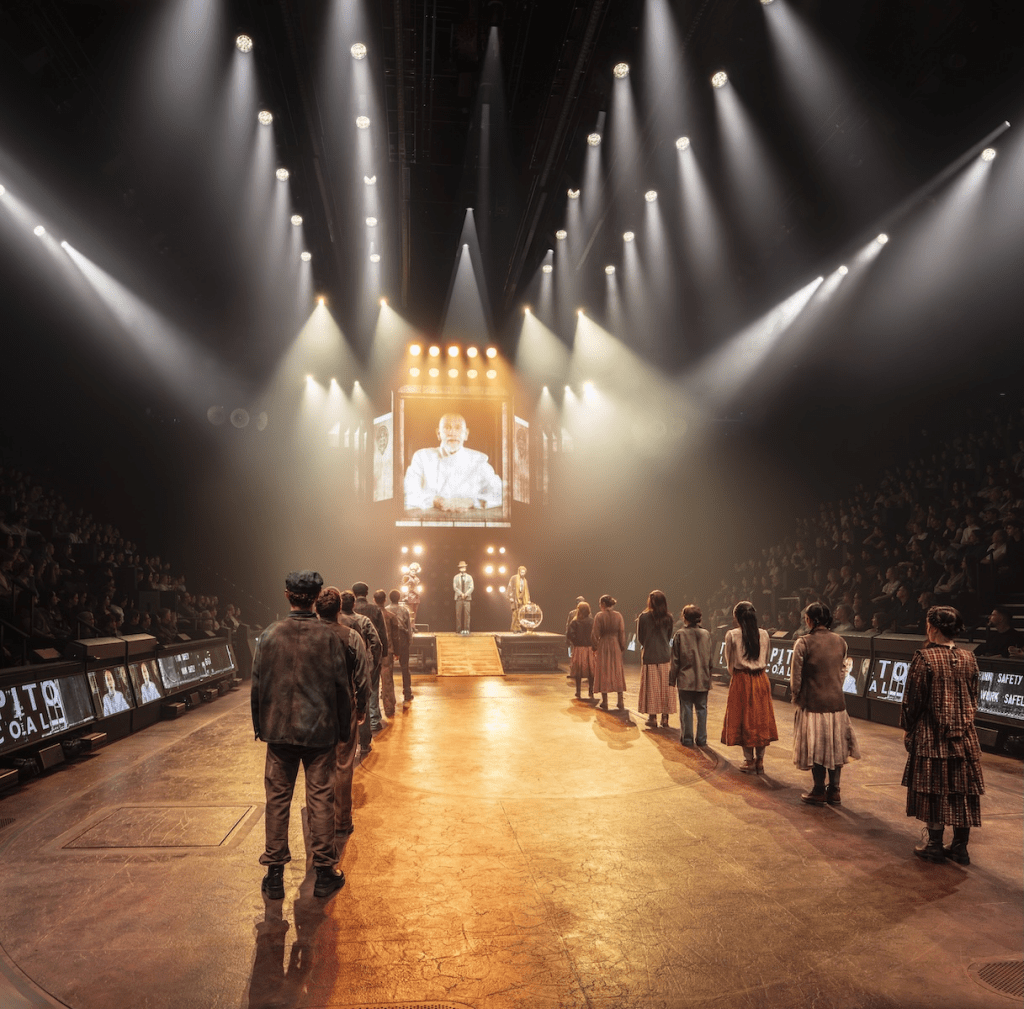
Perhaps the most baffling inclusion in this production is John Malkovitch as President Snow, who appears on screen to commence the games, and later to provide instructions to his lacky Tiberius Maul (Felix Garcia Guyer). Yet Malkovitch’s performance is stilted and too removed from the action – at times he almost appears bored whilst reading from an autocue. The fact that Snow is presented as a video rather than an onstage actor makes absolutely no sense. To have Snow confront Katniss in person would provide a stellar finale – but instead, Snow remains onscreen, and his “outrage” at Katniss having outfoxed him completely misses the mark. Granted, having Snow as a video allows for someone of John Malkovitch’s calibre to take part in proceedings, but the question we have to ask is if it is even necessary – after all, I doubt Malkovitch’s inclusion is really helping the play to sell that many more tickets.
The fact that this sort of story can be brought to the stage is a feat in itself. Director Matthew Dunster has seemingly done the impossible, bringing to life a huge range of characters and a wild array of locations, whilst set designer Miriam Buether leans into a minimalist theme, leaving lots to the audience’s imaginations. There are moments that are breath-taking to watch, and some sleight-of-hand escapades that will leave you in awe of what you have just witnessed. Where this show is lacking is in its plotting and characters. The tension should ramp up throughout the first act, yet it feels a bit too dragged out, too pedestrian in places. It doesn’t grip you immediately, and the subsequent rollercoaster ride feels like you are being dragged along ten paces behind, rather than sat at the front with your hands in the air. It is a superb spectacle, make no mistake. But scratch beneath the surface of that spectacle, and you may find a chasm that will leave you feeling a little bit empty.
Tom Morley, January 2026







 Broken Legs Blog