
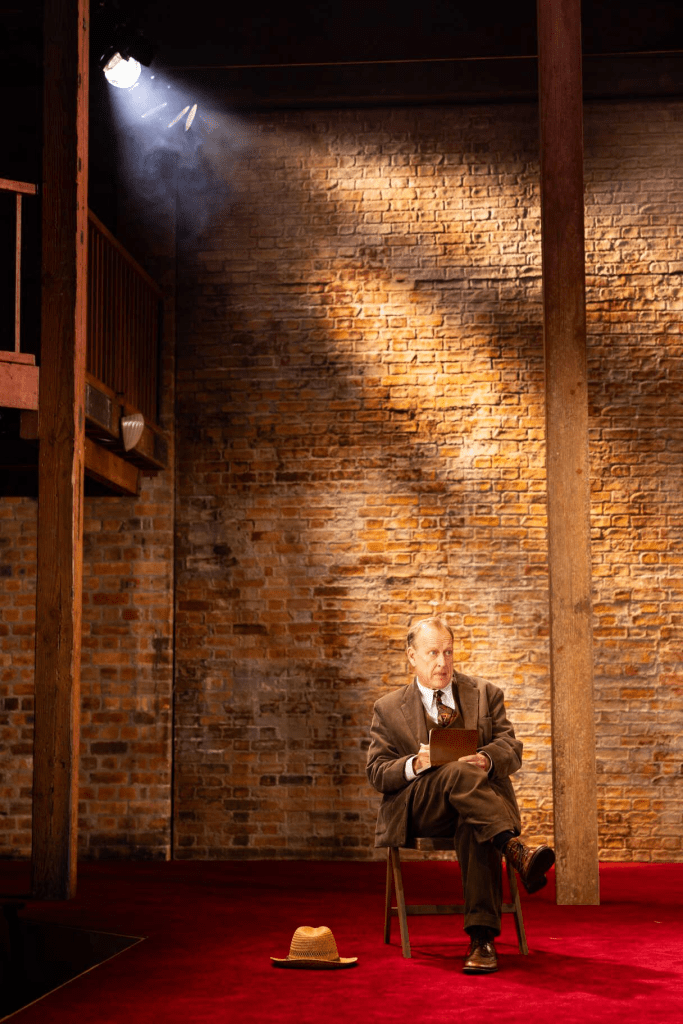
Part 2 of the RSC’s “The Forsyte Saga” picks up 20 years after the end of Part 1. We are now in the 1920s, and change is in the air, obvious immediately from the changes in Anna Yates’ set design, which sees the claustrophobic, regal red curtained backdrop removed, the back of the stage now stripped completely bare, leaving us with a feeling of freshness and freedom that is reminiscent of post-war Britain. Lighting has been updated to more “modern” electric lighting, with new fixtures attached around the theatre that gives the space a golden glow. We’re in the jazz age now.

Flora Spencer-Longhurst’s Fleur continues to act as our narrator, but the narration takes on a different tone this time, as her character is now integral to the story, and she offers no fourth-wall breaking ruminations on any scenes where her character is not present. Whereas Fleur was omniscient in the opening part, she is now in the dark about certain matters, and the parts delivered to the audience act more as soliloquys rather than narration. The play begins with certain actors passing on their part 1 characters to new actors – Jo Forsyte now taken on by Nigel Hastings and June Forsyte by Emma Amos. It is a quick transition, although necessary for those that have seen part 1, to make immediately clear who is who. The actors for Irene (Fiona Hampton) and Soames (Joseph Millson) aren’t changed, however, and one can see why this decision was made (Irene and Soames are integral characters in both parts, after all), but it does beg the question as to why some characters are purposely recast and others aren’t.
The rift in the Forsyte family is still raging, although new hope for reconciliation appears as Soames’ daughter Fleur encounters Irene’s son Jon (Andy Rush), and vow to be together despite their parents trying their hardest to keep them apart. The scenes of Fleur and Jon meeting mirror that of Irene and Phil meeting in Part 1, although this is a very different relationship, and there is definitely more of a romantic feel here, particularly in act one, at odds with Irene and Phil’s more seedy encounters. This romance will take a different turn in act two, and the audience are never sure whether to root for Fleur or not – the innocence of her character is slowly stripped away over the course of the play, and the influence of her foreboding father becomes ever more evident. Some of her lines spoken to Jon in the latter half of this play are reminiscent of Soames’ views in Part 1. Fleur is a Forsyte through and through, clinging on to a sense of importance and ownership that has no place in the 1920s.
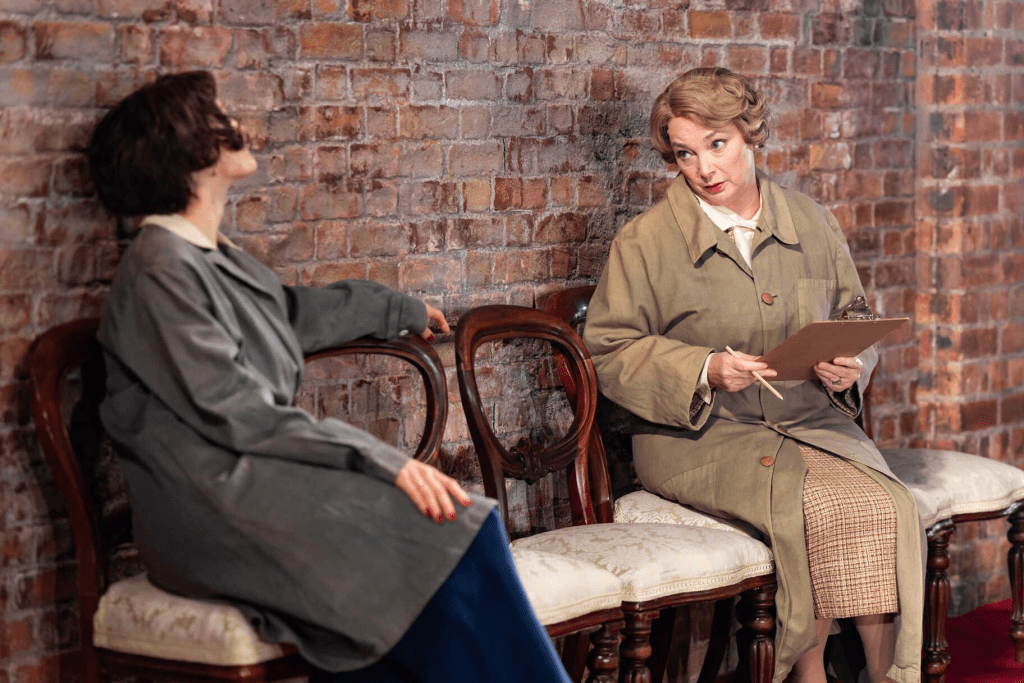
The introduction of Jamie Wilkes’ Michael Mont means we have a love triangle on our hands, and Mont introduces some much-needed comedy to proceedings, with an excellent scene that sees Michael take Fleur punting, without much success. Tomek Pieczora’s incidental music is wonderful here, and continues to shine throughout, whilst Max Pappenheim’s sound design helps to create a plethora of different soundscapes, from busy train stations to lush meadows. It is Alex Musgrave’s lighting that shines the brightest however, more naturalistic than part one and creating some truly beautiful visuals throughout. When Jon and Fleur meet in the forest clearing on the Forsyte estate, the wooden pillars of the Swan Theatre are lit upwards, creating the sense that we are surrounded by trees, making the space feel warmer. It is magical, and casts the couple in a romantic light, that is quickly shattered when they are forced to return to reality.
The ending to this five hour epic story is not as perfect as one might hope, but that is by no means a negative. John Galsworthy’s story is filled with realistic, flawed characters, and it is these flaws that deny us a happy, or even satisfying, ending. There are moments where we glimpse a potential ‘happy ever after’ for these characters, but it is snatched away from us by the sheer selfishness that is the Forsyte way. It is real, but it can also be devastating.

This is an enthralling show, and Part 2 lives up to the expectations set by Part 1. Whether Part 2 can be enjoyed in isolation is difficult to say. Any important plot points from Part 1 are eventually covered, as Michael and Jon learn the truth about their family history, although they are not explained upfront, and there might be a little confusion for newcomers in the early scenes. Seeing Part 1 first would definitely enhance your enjoyment here, and I would recommend seeing both parts together for the full experience. A complex story that feels both of its time, and yet still incredibly prescient.
For more information on how I decide on star ratings, see here: Star ratings – Broken Legs Blog
Tom Morley, December 2025
Review Round-up:
Theatre and Tonic: The Forsyte Saga Parts 1 and 2 – Four stars from T&T, who call this “a timeless saga of love and longing, expertly crafted for the stage“
The Telegraph – The Forsyte Saga, RSC, review – Five stars from The Telegraph, who encourage readers to “get to Stratford-upon-Avon to see this superb take on Galsworthy’s sprawling study of the upper-middle class”
LondonTheatre1 – The Forsyte Saga Parts 1 & 2 – Five stars from LondonTheatre1, who call this “the theatrical event of 2025 and […] easily at the top of my list of memorable productions I have seen this year”









 Broken Legs Blog
Leave a comment