
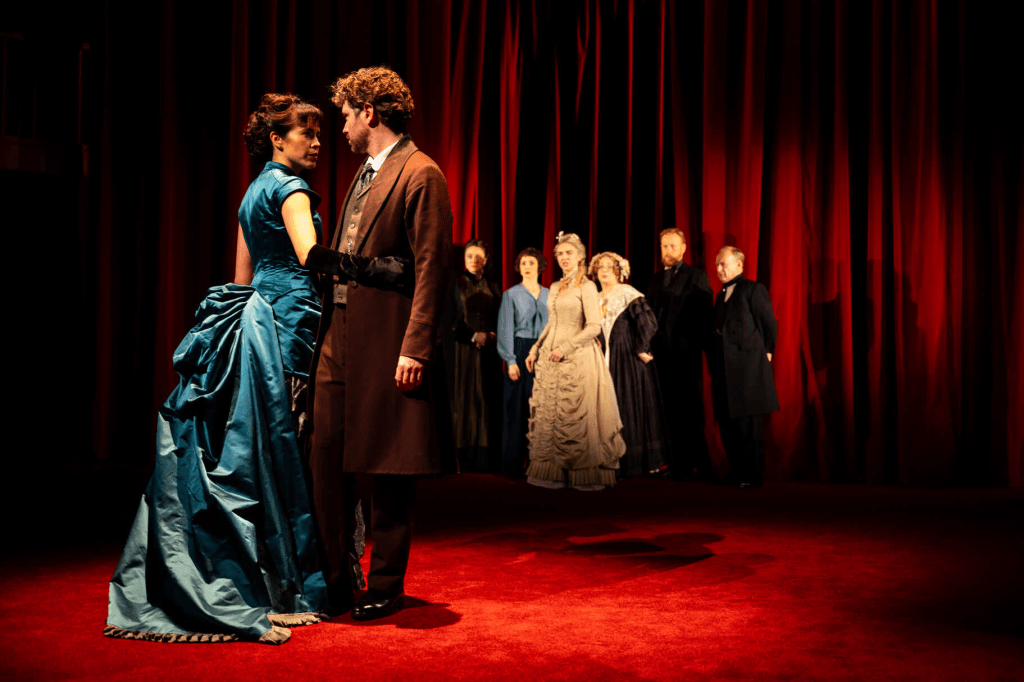
An adaptation of John Galsworthy’s series of novels, “The Forsyte Saga” tells the epic tale of an aristocratic family at the turn of the 20th Century, filled with secrets, hidden desires and forbidden love. Split over two parts, Part One revolves around Irene (Fiona Hampton) and Soames (Joseph Millson), an unhappily married couple struggling to come to terms with their increasing estrangement from each other. Adapted by Shaun McKenna and Lin Coghlan, this play takes six of the original nine novels and condenses them into a five hour piece (each part running around two and a half hours), chopping and changing some storylines to give focus to themes around property and ownership, as the Forsytes start to lose their grip on the social ladder whilst the world changes around them.

This is ‘Upstairs, Downstairs’ without the downstairs, as the focus here is very much on the upper classes, and the importance of appearances and social rankings. This can make the characters appear standoffish and difficult for the audience to warm to. Indeed, Irene and Soames are both complex characters who are not particularly endearing in the opening act, although we warm to Hampton’s Irene in act two, mainly due to various hardships that she is forced to endure.
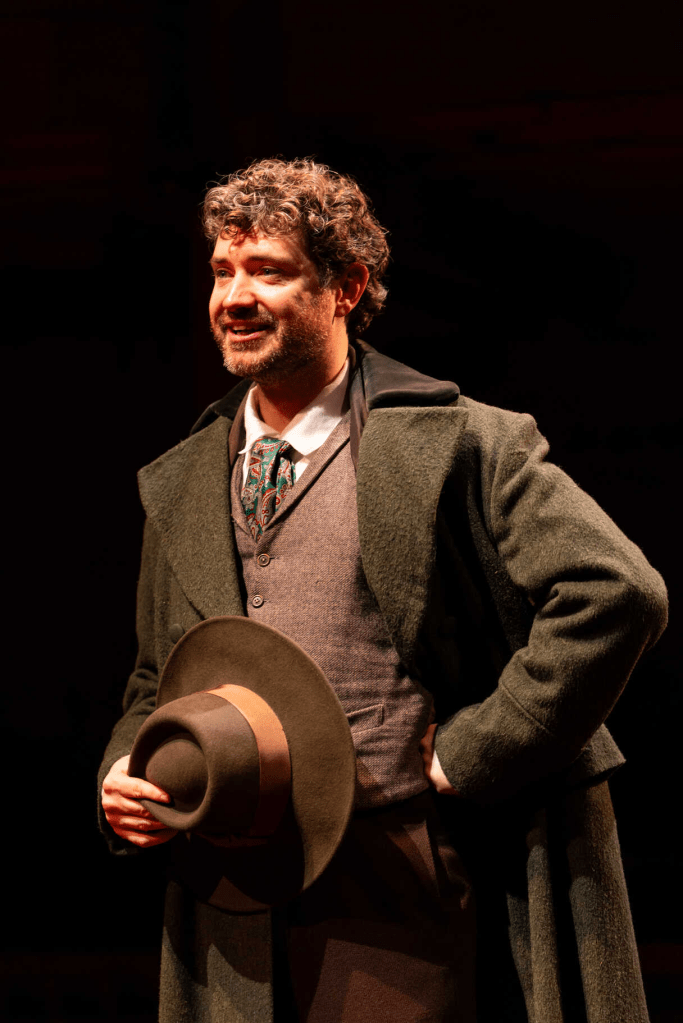
The character we relate to most is Andy Rush’s Phil Bosinney, a self-employed architect who becomes engaged to Soames’ cousin June (Florence Roberts) and appears much more hardworking than the rest of the Forsytes (but this is mainly because the Forsyte family business is never particularly elaborated on). Unfortunately, Phil’s treatment of June sours our appreciation of his character, and despite Rush’s rugged, boyish demeanour, his moral compass calls into question whether this is a character we should like or not.
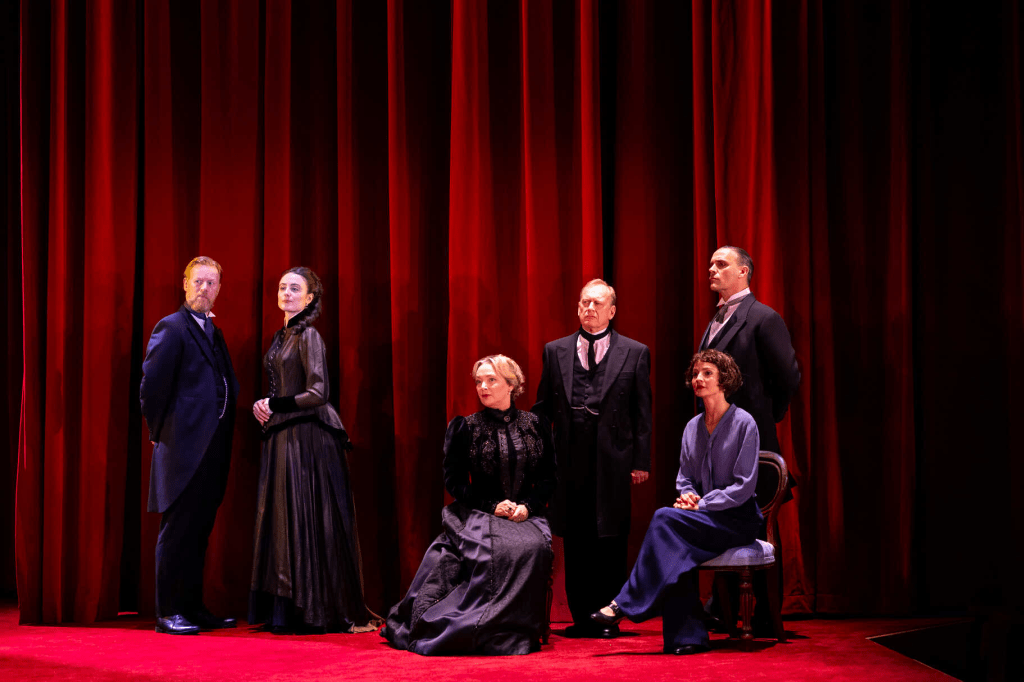
But this is one of the main appeals of the play. It isn’t simply black or white, good or bad – there are no out and out villains here, and no obvious heroes either. Every character harbours a secret that makes them more interesting and morally grey. It makes for some fascinating personality clashes. These clashes are also used to make a comment on the politics of the time – one scene sees June clash with her uncle James (Nigel Hastings) over the intricacies of the Boer war and the slow decline of the British Empire. This decline is mirrored in the strained relations between the Forsyte family, as an event occurring at the end of act one sets the scene for a tremendous rift in the family that will be felt for generations to come, and will have interesting repercussions in Part 2.
A story such as this warrants a large cast of characters, and director Josh Roche employs use of multi-role, although this can cause confusion at times, particularly in the case of Michael Lumsden, who portrays Swithin Forsyte and Jolyon Forsyte without even changing costumes. Both brothers are very similar characters, and as such Lumsden struggles to make them distinct – audience members could be forgiven for thinking they were two different characters. In act two, which moves the action on several years, Swithin is swiftly killed off (in a throwaway line about him having “passed away last year”), which calls into question whether it was even necessary to include the character in the first place. Emma Amos as both Emily Forsyte and Juley Forsyte struggles less in this department, but this is due to the stark differences between both characters, Emily portrayed as Soames’ distant, cold mother and Juley as a gossipy old aunt.
As Fleur, Flora Spencer-Longhurst acts as our narrator, before taking centre stage in act two. She tells us upfront that she will be Soames’ daughter one day, although she is particularly coy about the identity of her mother, something that will keep us guessing throughout Part 1. The narration is used to cut some corners initially, allowing for quick introductions to the characters, and making clear everyone’s relationships. There is also a family tree included in the programme to help matters along, but it includes some spoilers for those who don’t know the story, and I would advise not studying it in any detail until after you have seen both Parts 1 and 2. The narration adds a poetic quality to the piece, helping us to imagine certain scenes without the need for any set, although it is perhaps a little overused, at times telling us things that are obvious from the way characters react. For instance, we don’t need Fleur to tell us that Irene can’t stand to be touched by her husband – that much is obvious from what we are seeing on the stage. The narration is a little too intrusive at times. How Fleur knows everything she is telling us is also left ambiguous – anyone expecting this to be cleared up in Part 2 will be left disappointed.
Anna Yates’ set design is sparse – perhaps a necessity in a play that includes over 100 scenes. Instead, the stage is populated simply by the actors and a few chairs, allowing each scene to smoothly run into the next so that the pace of the piece never drops. Alex Musgrave’s lighting design helps in this department, creating atmosphere and adding variety to the piece, but it is a little harsh at times, not always matching the nature of the rest of the play. One scene sees Irene and Soames on opposite sides of a locked door, and this is created by a block of bright white light separating them. It feels too modern, not in keeping with the time of the piece, and drags us out of our immersion – later scenes, set in a police station and in the local morgue, fare better in this respect, the lighting reminiscent of the setting and not too abstract.
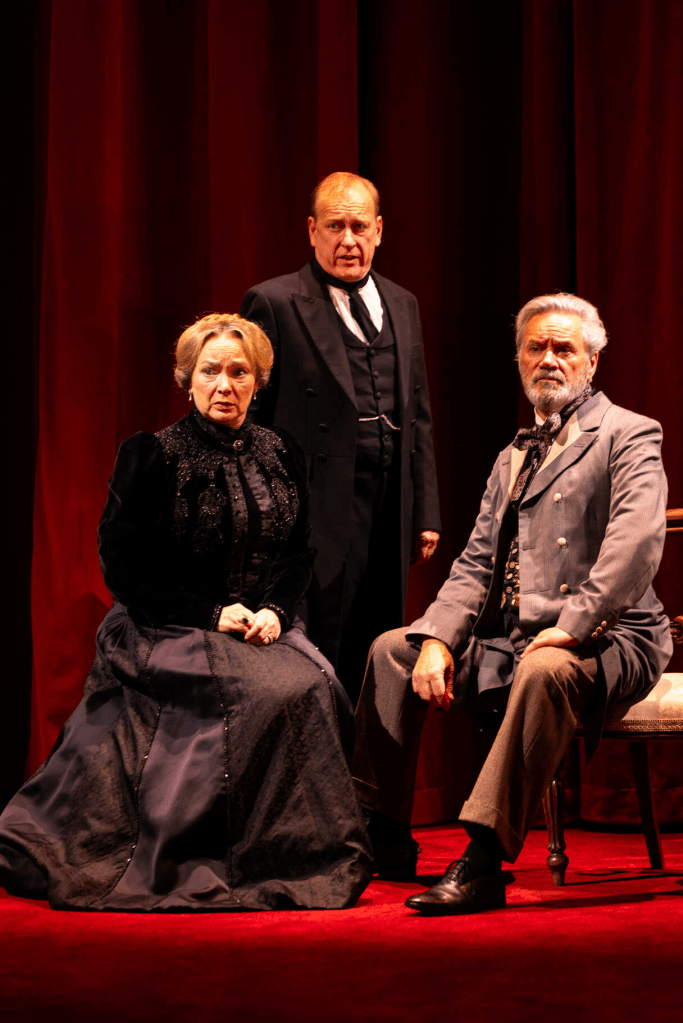
This play is an interesting exploration of marriage rights and class values at the end of the Victorian era. The characters are realistic, and their reactions not entirely predictable – the story involves twists and turns that keep the audience on the edge of their seat, constantly guessing at what is to come and always being surprised. The vast cast of characters may feel a little overwhelming to begin with, but act two culls the numbers a little, focusing on Irene, Soames and Jamie Wilkes’ Jo Forsyte, as the relationship between the three of them grows ever more fraught and dangerous. The play ends with a teaser for what is to come in Part 2, but anyone seeing Part 1 in isolation will be mostly satisfied by the conclusion here. Although the characters of Irene, Soames and Jo appear in Part 2, the focus is very much on the next generation of characters, and their story is mostly wrapped up in Part 1. Absorbing, engaging and epic.
For my review of Part 2 of “The Forsyte Saga”, see here.
For more information on how I decide on star ratings, see here: Star ratings – Broken Legs Blog
Tom Morley, December 2025
My usual ‘Review Round-up’ will be included at the end of my Part 2 review.





 Broken Legs Blog
Leave a comment