
Upon hearing that the RSC are producing a stage version of Roald Dahl’s “The BFG”, your first question might be ‘how are they going to do that?’ The answer, of course, is with style, flair and a touch of magic. The result is an enchanting evening of theatre, with children and adults alike marvelling at the superb stagecraft on display – there are moments here that feel almost cinematic. And yet it is Dahl’s story that shines the brightest amidst this feast for the eyes – Tom Wells’ adaptation is full of character and charm, held together by child actor Martha Bailey Vine as Sophie (who shares the role with two other actors, Elsie Laslett and Ellemie Shivers). Vine is an absolute joy, the beating heart of this production, grabbing the audience’s attention immediately and then ably guiding them through a story that could feel complicated or convoluted in less capable hands.

The story begins in Sophie’s orphanage, depicted as a dollshouse on stage opening up and then being replaced with life-sized actors. It is a convention used throughout, to great effect, a mix of both humans and puppets allowing us to see things from a human perspective, before hitting the zoom-out button to see things from the giants’ perspective. It means that, when the BFG arrives, he is sometimes portrayed as a larger-than-life puppet, manned by four puppeteers (Ben Thompson, Shaun McCourt, Elisa de Grey and Onioluwa Taiwo) and sometimes by John Leader, who interacts with a doll-sized Sophie puppet, controlled by Ailsa Dalling and Aki Nakagawa.
Leader is full of childlike wonder, his gentle giant is slightly naive yet incredibly playful. There is an unsurety in Leader’s movements that means we can picture him as big and clumsy even though the actor isn’t. His character beautifully contrasts against Vine’s Sophie, who is an actor older than her years, sensible and smart, yet it is in the flashes of childish reactions that she becomes even more endearing – particularly her excitement at crafting a dream potion later in the play. For two actors that only ever share the stage with their puppet counterparts, Leader and Vine have excellent chemistry, their relationship transforming across the course of the show from one of fear and nervousness, to close friends. It is utterly believable, and testament to Daniel Evans’ direction that we can buy in to this friendship so completely, despite the fantastical setting.

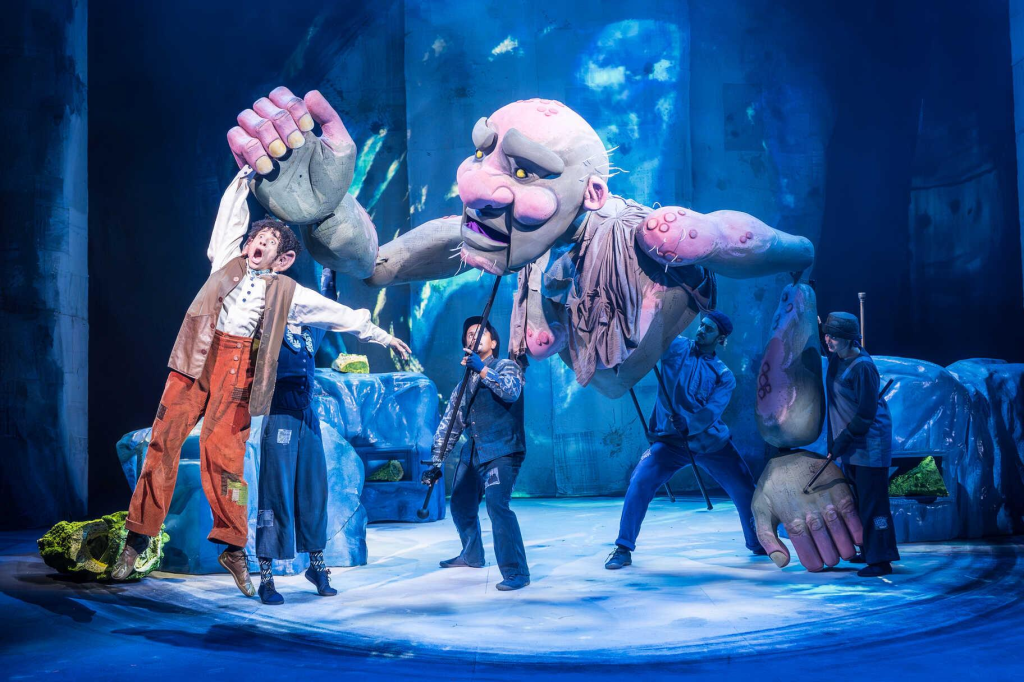
The BFG is forced to kidnap Sophie after she sees him trying to blow dreams at “human beans”, and takes her to giant land. It is here that we learn that, for a giant, the BFG is actually quite small, especially compared to the ferocious Bloodbottler, whose puppet (controlled by Fred Davis, Corey Mitchell, Parkey Abeyratne and Sonya Cullingford) fills the entire stage, towering over Leader’s BFG and the puppet Sophie. Before long, we “zoom out” again, Bloodbottler portrayed by Richard Riddell whilst the BFG becomes a small puppet, and Sophie an even smaller one. It sounds confusing, but it isn’t. The transitions are smooth and clear, all supported by Oleta Haffner’s composition, which adds an extra layer of wonder to proceedings.
The second act of the play is a little more plot driven, as Sophie embarks on a mission to save her best friend Kimberley (Uma Patel), and it is here that the story really leans into the comedy, making full use of Helena Lymbery’s action-fuelled Queen, and her butler-turned-co-pilot Tibbs (Sargon Yelda), who take two characters that could feel forgettable amidst the giants and spectacle, and turn them into fan-favourites. However, the height of the comic stakes belongs to Philip Labey and Luke Sumner’s Captain Smith and Captain Frith, who share an excellent ongoing joke about moustaches, bringing a branch of comedy that will be adored by children and adults alike. When they appear as puppets later in the play, the comedy is heightened further.
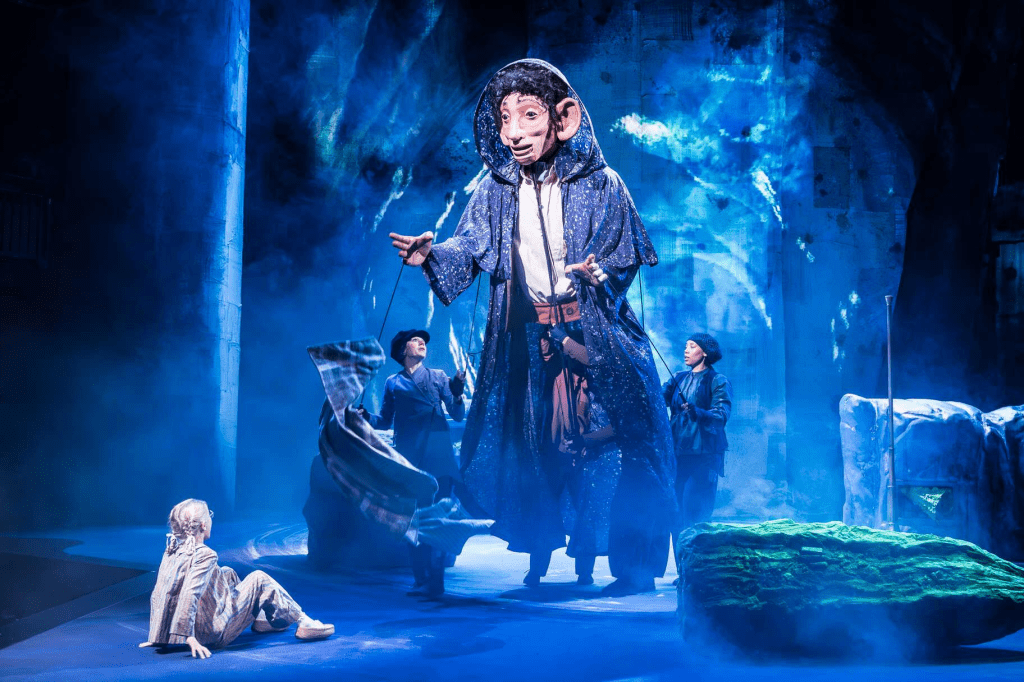
The puppetry, in case I haven’t made clear by now, is second-to-none. Under the direction of Toby Olié, each puppet brings with it such character, and moves in a way that feels realistic, even though we can clearly see the puppeteers controlling it. The puppets are supported by the voices of the actors, who add a little extra ad-libbing to react to the movements of the puppet onstage, increasing the believability. But there is extra magic to this production – dreams fly around the audience, in touching distance above our heads, giant sneezes spray us with water, and the entire show ends in an extravaganza that sees the auditorium filled with confetti and bubbles.
It is hard to find any negatives with this production. Some movement sequences, choreographed by Ira Mandela Siobhan, feel a little too long, accompanied by music but no vocals, almost giving the impression that this is a musical missing its lyrics. But it is easy to overlook these slight niggles when this is a play that continually impresses and outdoes itself throughout. If you plan to see any show this Christmas, make sure it is this one. Whizzpoppingly scrumdiddlyumptious!
Tom Morley, December 2025

Review Round-up:
Theatre and Tonic: The BFG at Royal Shakespeare Theatre – Kicking off our mixed bag of reviews is Theatre & Tonic who give the show 5 stars, saying it “sparks your imagination, leaves you in awe and has an enormous amount of heart”
WhatsOnStage: The BFG at the RSC – Four stars from WoS, who say it is a “glorious show, fun for all the family” yet “misses […] the pure glee of Dahl”
MickeyJoTheatre: The BFG at the RSC is just OK – 3 stars from MickeyJoTheatre, who provides a perhaps unfair comparison to Matilda the Musical, saying he “expected something just a little more magical”





 Broken Legs Blog
Leave a comment