
This blog post was written for East Midlands Theatre
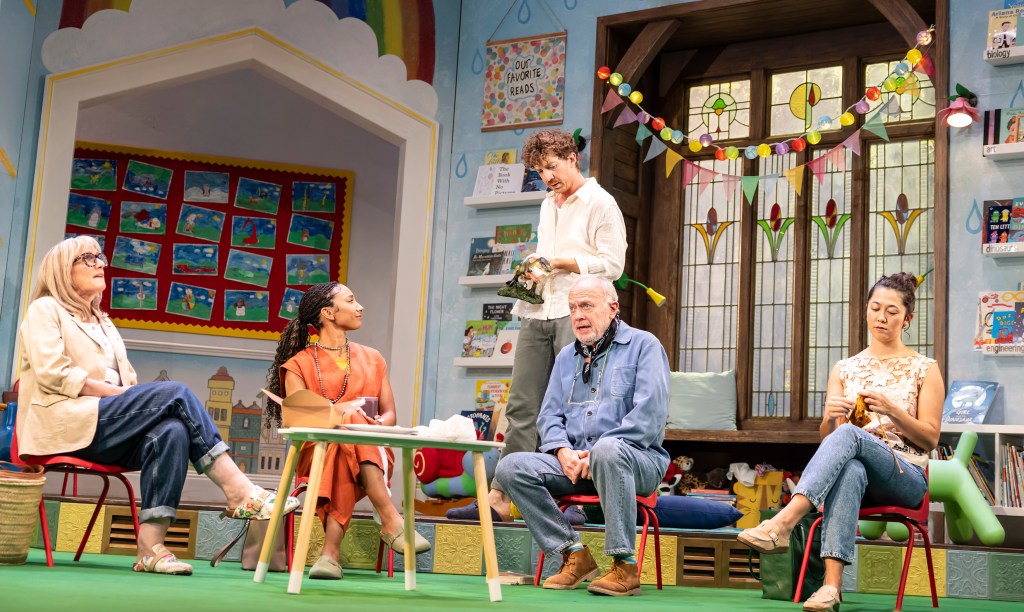
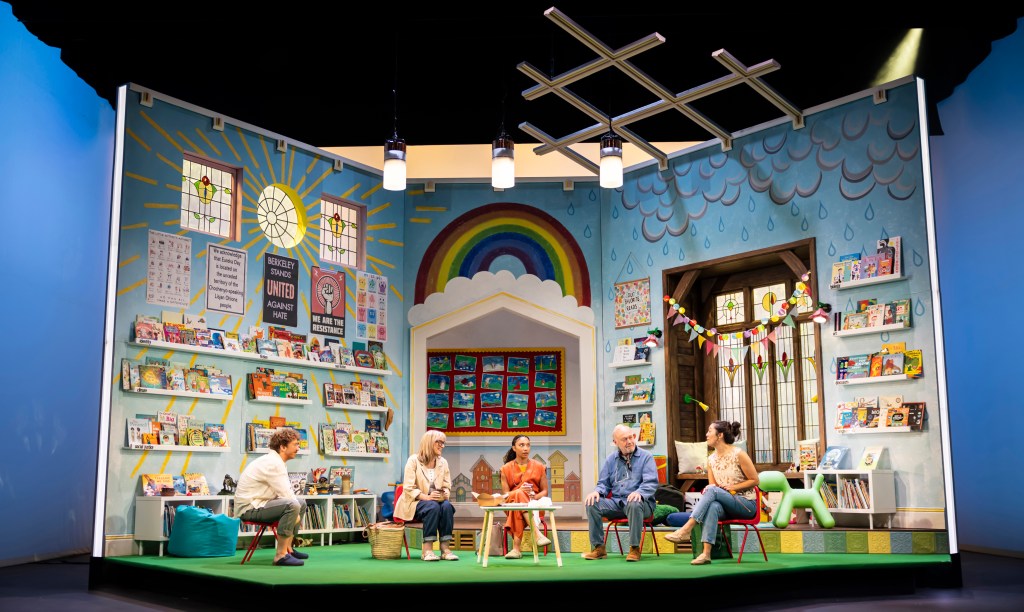
Set in sunny San Francisco, “Eureka Day” bursts onto the Nottingham Playhouse stage with energy, confidence and colour, Eleanor Field’s set filled with rainbows, cartoons and mindfulness quotes as we find ourselves in the playroom of the Eureka Day private school, where the majority of the play takes place. The crux of the story revolves around the school PTA, a group of 5 parents who band together to discuss various non-issues such as which nationalities to include in the school registration form, and which can be listed as “Other”. The Playhouse bills this production as a comedy – and there are several incredibly funny moments, but as the story continues, Jonathan Spector’s play ventures into more meaningful territory, dropping the laughs to tell a story with far more depth and character than one could have ever expected from its opening moments.

For anyone who’s ever been involved in corporate conversations, there will be lots to enjoy here. The comedy of the early scenes comes from the fact that everyone is trying to be nice to each other, afraid of stepping on each other’s toes and making every effort to make all PTA members “feel heard”. The chair of the PTA is Don (Jonathan Coy), an older member who tries every trick in the book to get his fellow board members to reach agreement. Cue numerous whiteboards, action plans and heaps of buzzwords. Don is evidently well-meaning, but his generosity means that he sits on the fence too much, resulting in every PTA meeting becoming long and drawn out as he allows everyone to have their say, resulting in multiple tangents and very few decisions. Coy’s exasperation is plain to see, and yet he is powerless to do anything about it – the very nature of the PTA’s democracy means that he can never seem to move the conversation on. There are many parallels that can be drawn between this and politics in general, particularly in a climate where civil servants are being asked to roll back D&I initiatives.
The play takes a turn when a child is diagnosed with mumps, and the PTA have to make difficult decisions about whether to keep the school open or not given that a significant proportion of pupils are unvaccinated. Jenna Russell’s Suzanne is particularly outspoken against vaccination, whilst Adele James’ Carina opposes her argument, and Kirsty Rider’s Meiko flip-flops from one side to the other. The argument is nuanced and eye-opening, and feels incredibly relevant especially in the wake of the Covid pandemic (although the play is very specifically set in 2018). Audiences are likely to empathise with James’ Carina, who is hardly able to control her reactions, multiple eye-rolls and scowls drawing laughs from the audience. Yet it is Russell’s Suzanne who potentially makes the most moving argument, despite us initially dismissing her as someone who has strayed too far down the path of conspiracy theories. Russell delivers a speech in the latter half of the play with such passion and emotion that audiences find themselves completely changing their opinion of her, as Spector’s script transforms her from a bland, artisan-pastry-eating environmental activist to a more rounded, three-dimensional character. It makes the argument around vaccination ever more convoluted, and will certainly leave audiences with something to think about. The play is in no way ‘anti-vax’, but it offers an explanation as to why some people may feel this way about vaccination, rather than simply reducing them to stereotypical nutjobs.
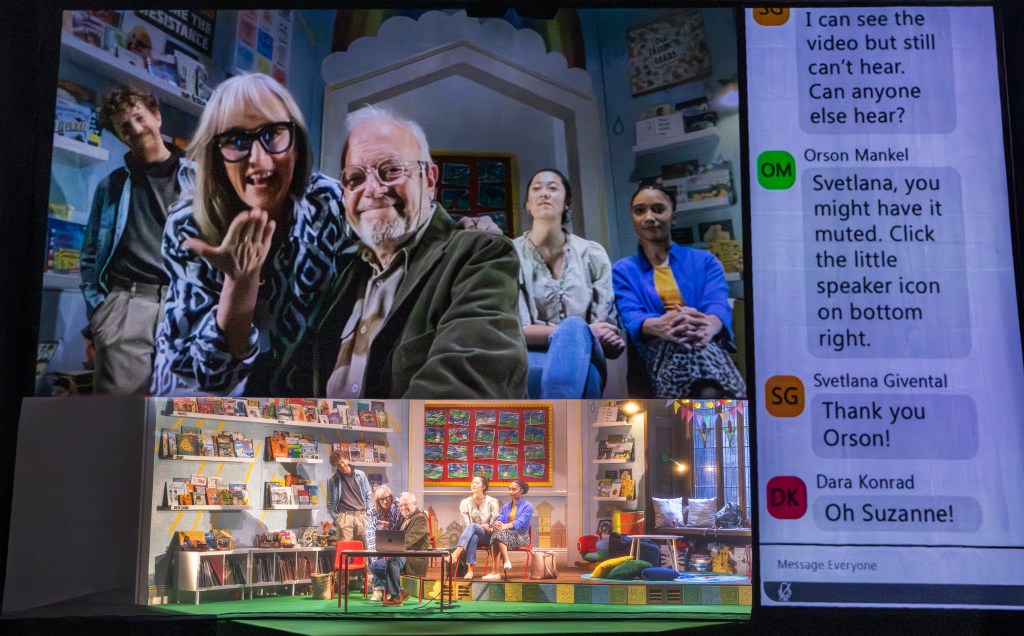
One of the highlights of the show, without doubt, is an online Zoom call, as Don contacts other parents to inform them of the school’s closure in the face of the mumps epidemic. Director James Grieve splits the stage into three segments, which allows us a view of the PTA in their classroom, a view of the computer screen and, most importantly, a view of the chat, as various other parents make their opinions clear through quick text messages. It is an ingenious format, and one utterly unique in theatre. Some obvious jokes are made – people struggling to unmute speakers, random filters appearing on the webcam and one parent who seemingly communicates just using thumbs up emojis. Were this play performed in the immediate aftermath of Covid and the infamous Jackie Weaver Parish Council meeting, it could all feel a little tired, but there is just enough distance between us and the pandemic that it makes for an incredibly funny and well-observed scene. The scene becomes increasingly difficult to follow, our attention torn between the action on the stage and the action in the chat, and it does mean that some particularly important plot points involving Matt Gavan’s Eli are missed due to the audience being distracted by the fast-moving chat bar. But that’s the point of the scene – it is reminiscent of a world in which technology doesn’t allow us to stop and think and absorb, where we are continually bombarded with differing opinions and comments that make every conversation feel exhausting.
There are a few too many ideas and themes that means not everything works quite as well as it could. Gavan’s Eli and his wife are trying a ‘polygamous marriage’, which results in him having an open affair with Rider’s Meiko, but the idea is never really given much space to develop into anything particularly interesting, and feels like an overhang from an initial draft of the script that could have been lost to focus on the meat of the plot. The rest of the plot feels fairly tight, however, and the play finishes with a perfect punchline that leaves the audience begging for a sequel.
This play is a success due to its believable, relatable characters, that instantly draw you in and make you feel invested. Whether you’re erupting into laughter, gasping with shock, or on the verge of tears, there is something here for everyone to enjoy. At 1 hour 45 with no interval, the play moves along at a brisk pace, although the heavy topics that are discussed in the second half suggests that perhaps a break in the middle would not go amiss. An enjoyable, thought-provoking evening of theatre.
Tom Morley, October 2025
For more information on how I decide on star ratings, see here: Star ratings – Broken Legs Blog
Review Round-up:
Jack Stage UK: Eureka Day Review – 4* from Jack Stage, who says the “play excels in its ability to satirize a distressing socio-political era of our recent history, albeit indirectly through the mumps vaccine”
Elemental Theatre: Eureka Day – Also 4* from ETC, who say “while Eureka Day is billed as a comedy, it feels more like a thought-provoking social/political drama with some brilliant comedy elements”
WhatsOnStage – Eureka Day – Reviewers are clearly all on the same page here, with WoS also awarding 4*, who call the play “whip-smart, intelligent and incisive”






 Broken Legs Blog
Leave a comment