

Bringing an original Morse tale to the stage, the majority of “House of Ghosts” is appropriately set in a theatre, amidst a production of Hamlet, where disaster strikes after the actress portraying Ophelia (Eliza Teale as Rebecca) drops down dead. Tom Chambers’ Morse is immediately on the case, emerging from the audience, bringing the house lights up and preventing any of the other actors from contaminating the crime scene. What follows is a fast-paced murder mystery, as we race from location to location, and Morse gets ever closer to uncovering the secret behind Rebecca’s fate. Little does he know that in doing so, he may have to dig up some skeletons from his own past too…
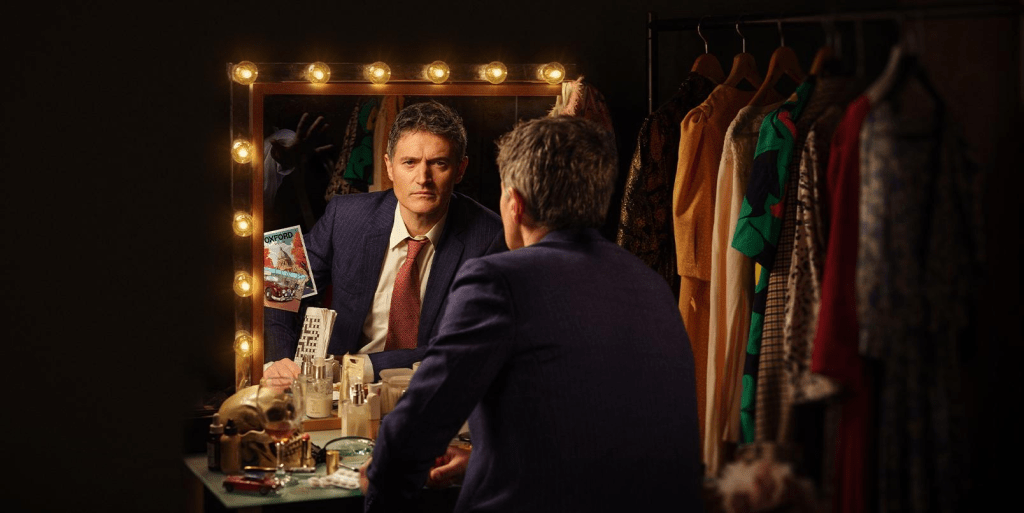
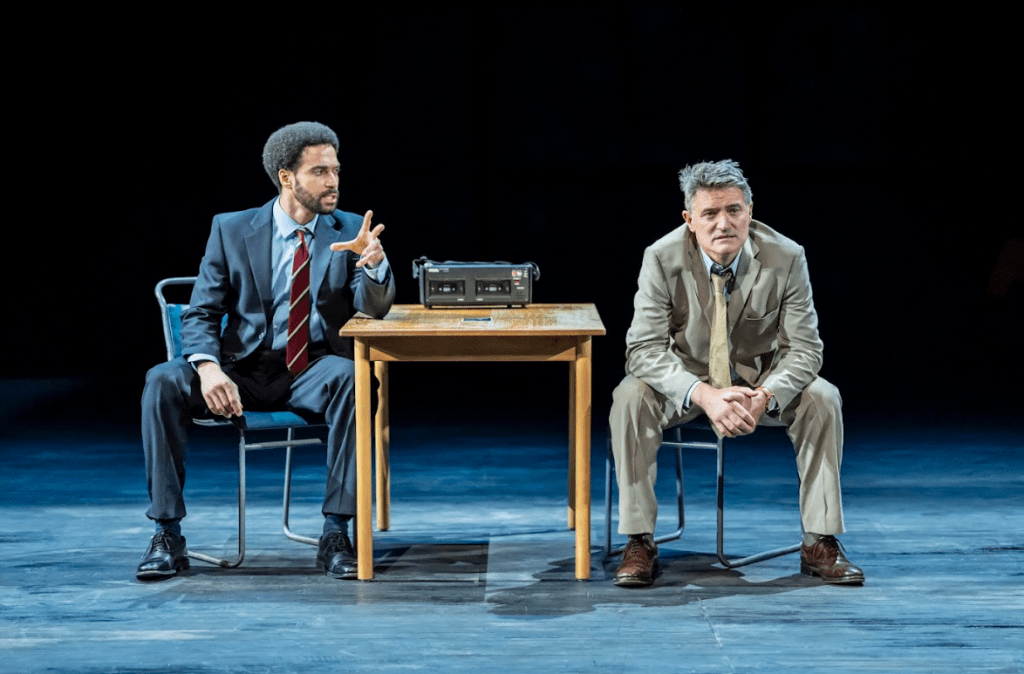
Writer Alma Cullen, who also penned several episodes of the ITV Morse series, crafts an original story featuring the famous detective and his trusty sidekick Lewis (Tachia Newell). The relationship and camaraderie between Chambers and Newell is one of the highlights of the piece, and the influences of Colin Dexter’s original novels is plain to see. Chambers presents a more youthful Morse than we are used to, slightly more temperamental and quick to anger, perhaps a closer imitation of the Morse from the novels rather than the TV series. Still, he retains Morse’s wit and cynicism, and his gentle teasing of Lewis makes for some light-hearted comedic moments between the sleuthing. The stakes of the tale are also in keeping with original Morse dramas – there are no car chases or gunfights here, Cullen instead relies on the intricacies of solving crimes to help ramp up the tension.
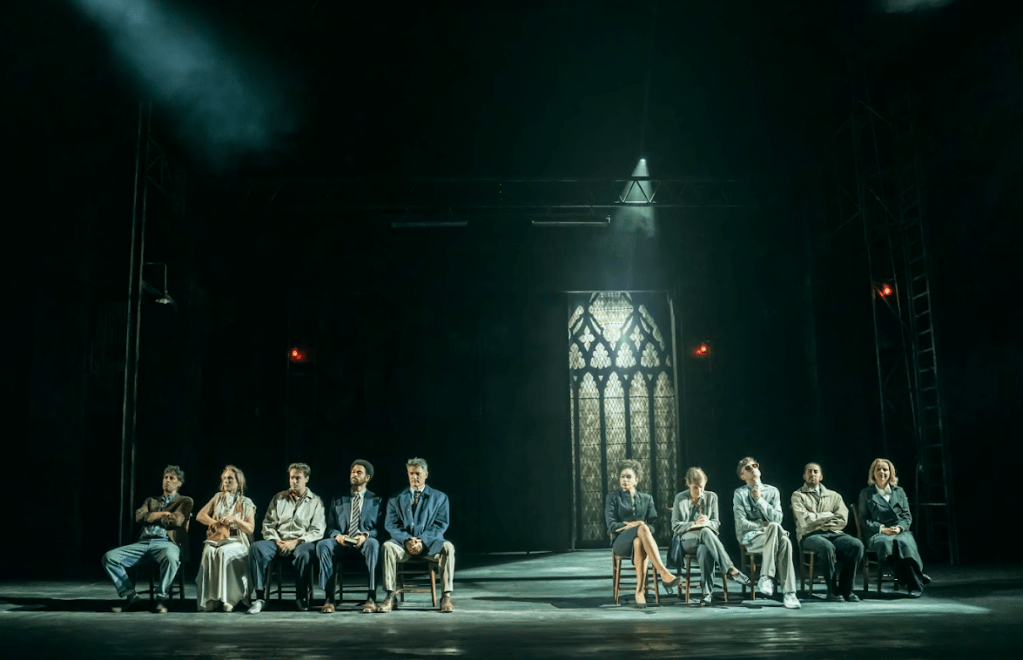
Morse and Lewis are surrounded by a series of kooky suspects, in particular Robert Mountford’s intimidating director Lawrence, and Charlotte Randle’s theatre luvvie Verity. Both characters share a history with Morse himself, having been at university with him, and an old photo from their days as students becomes integral to the plot as the play nears its conclusion. Thrown in for good measure are Spin Glancy’s Justin, who seems constantly on the verge of a mental breakdown, and James Gladdon’s Freddy, perhaps one of the more likeable suspects who is sadly not afforded more stage time. Each of the characters are distinct, but the story becomes a little more confusing as more and more characters are discussed without being seen – we are treated to an in-depth discussion about Rebecca’s mother, and many references are made about local actor-turned-priest Paul, who doesn’t show up until the second act (and is also portrayed by Mountford, showcasing a very different side to his acting talents). It becomes difficult to keep track of who is who, and the plot moves along so quickly that certain revelations are not given sufficient time to stick the landing before we are whisked into the next scene.
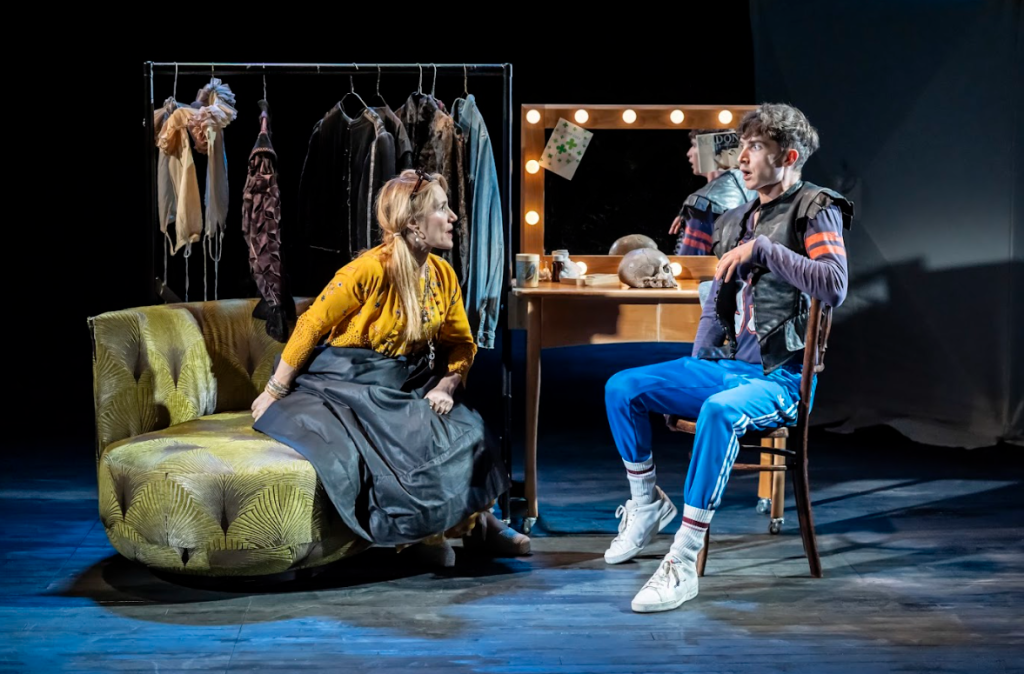
As well as plot moving quickly, the set is also full of swift transitions that can make ones head spin if you are not paying close attention. Colin Richmond’s design brings to life an obvious theatre set (the scenery for the Hamlet production is very clearly 2-dimensional), which is ingeniously flipped to show us the backstage area. From here we are treated to a whirlwind of settings, from lecture theatres to churches to pubs to the police station. Each scene is created with a few small pieces of set, and in some cases simple cloth backdrops, but it all moves so quickly that it ends up feeling rather unpolished. The wings are in plain sight throughout, with upcoming set pieces clearly visible, which adds to the messiness.
Transitions are accompanied by Beth Duke’s sound design, which helps to soften the endless transitions, but at times is unnecessarily loud. It is the actors, under the direction of Anthony Banks, who help steer us through the convoluted plot, making some of the more exposition-heavy scenes easier to digest. There is not a lot of subtlety to the character development, but perhaps this is necessary to provide a quick set-up for the murder mystery, and the play zips along with a runtime of just over 2 hours.
The play draws on the usual Morse themes of both focusing on the murder mystery and Morse’s home life, exploring a burgeoning relationship with Teresa Banham’s Ellen, a history lecturer who is acting as advisor to Lawrence for the production of Hamlet. The play excels at bringing Ellen into the story, weaving her and Morse into the plot in a way that doesn’t feel shoe-horned, but despite this, the question is still raised as to whether this needs to be a story about Morse at all, or whether it could have just been a drama featuring an original detective, given that the story is not based on any of Dexter’s novels.
The play will appeal to those that are fans of the murder mystery genre, with a twist at the end that is foreshadowed in a way that doesn’t make the conclusion obvious, but doesn’t feel like it comes from nowhere either. All the strands of the plot are drawn together in a mostly satisfying way, although it is a little more complicated than it needs to be. An enjoyable night at the theatre, but sadly not one that is likely to stick long in the memory.
Tom Morley, September 2025
Review Round-up:
East Midlands Theatre: Review: Inspector Morse: House of Ghosts – 4 stars from EMT, who say that “If you’re a Morse fan […] you’ll adore the tropes explored here”
Curtain Call Reviews: Inspector Morse – House of Ghosts – From earlier in the tour, this 4 star review commends Chambers’ ability to “put his own stamp on [the role of Morse] and portray the slightly curmudgeonly character with a lighter air about him“
Elemental Theatre: Inspector Morse: House of Ghosts – Only 2 stars from ETC, who say the “staging is overburdened by constant location changes” whilst also criticising a subplot surrounding Justin’s sexuality as being “clumsy, unnecessary, and alienating”








 Broken Legs Blog