
This blog post was written for East Midlands Theatre
How much of our lives do we actually remember? And of the memories that we do retain, how often are they accurate? These are the questions posed in “Lost Atoms”, the latest production from physical theatre company ‘Frantic Assembly’. The play focuses on the love story of Jess (Hannah Sinclair Robinson) and Robbie (Joe Layton), who meet in a coffee shop, and reconnect a few days later by chance at a train station. From there, we drop in on various instances (or memories) of their relationship together, reliving the first meeting with in-laws, the first holiday, the moment Robbie asks Jess to move in. It’s all fairly mundane, there’s nothing particularly surprising here – but gradually the story becomes more confused, and the audience are forced to question whether our narrators are reliable, or whether their memory of events has been clouded by emotions and slowly twisted into something different.

As Jess, Robinson rattles through dialogue at an incredible speed, bringing a chaotic energy to the stage, that is counter-balanced by Layton’s calm, measured Robbie. Jess wears her heart on her sleeve, and is more willing to open up, usually in a tirade peppered with a little too much swearing, whilst Robbie is more reserved, cautious, perhaps even afraid of letting his emotions show. This is the first hint we get that the two characters are perhaps not well-suited to each other at all. We’re all aware that opposites attract, but Jess and Robbie are so polar opposite, it seems obvious that their relationship is doomed from the get-go. Whilst Robinson and Layton bounce off each other as actors, their characters lack a certain chemistry, there’s no spark that encourages the audience to ruthlessly root for them throughout. Their clash of personalities makes for interesting, if at times frustrating, viewing, but it also makes it hard to care. The cracks start to show from their very first meeting (Robbie leaves without warning, and his reason for leaving is never properly elaborated on), and from there their relationship is like watching a car crash in slow motion.
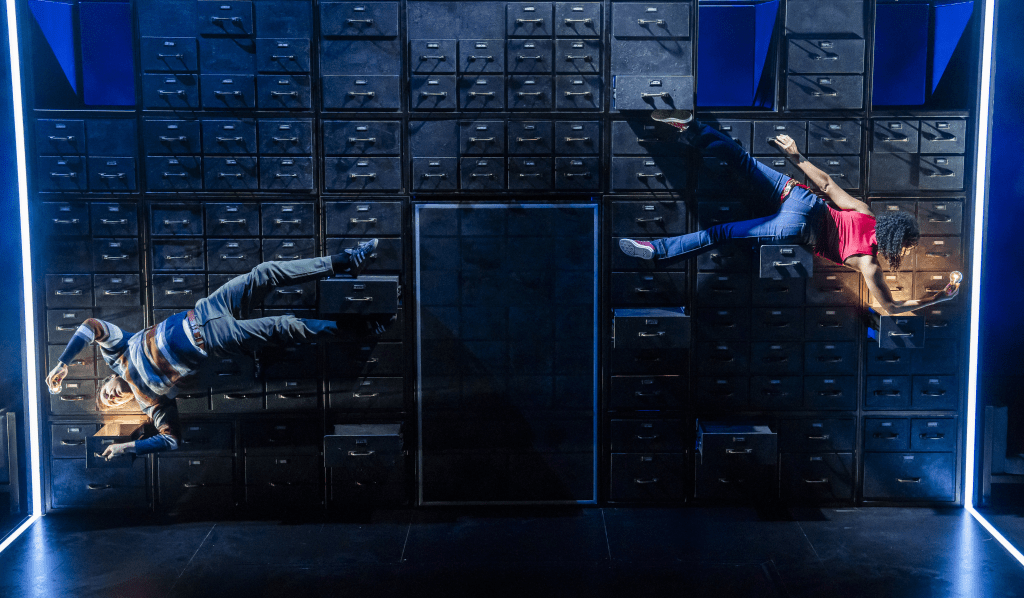
But this story, from writer Anna Jordan, offers nothing new. Audiences will have seen love stories play out like this a million times over – Robbie’s repressed grief for his deceased mother, Jess’s frustrations at her overbearing parents – and the text struggles to offer any sort of commentary that feels fresh or new. Where the play does stand out is in Andrzej Goulding’s stunning set design and Scott Graham’s impressive direction. Throughout, Jess and Robbie are surrounded by stacks of filing cabinets. Each drawer holds a different memory – items, photos, sometimes flashes of light or sound. At times the actors use the drawers as ladders, to reach memories that are higher up. They pull the drawers out to become chairs, or stools, or beds – the choreography here is superb, and the physical ability of Robinson and Layton, as they effortlessly haul themselves around the space, is a marvel to behold. The transitions that take us from memory to memory are seamless, movements are precise and everything has an ethereal energy that makes us question the true reality of the story we are seeing. It is all wonderfully supported by Simisola Majekodunmi’s lighting, which fizzes and crackles as memories start to crack.
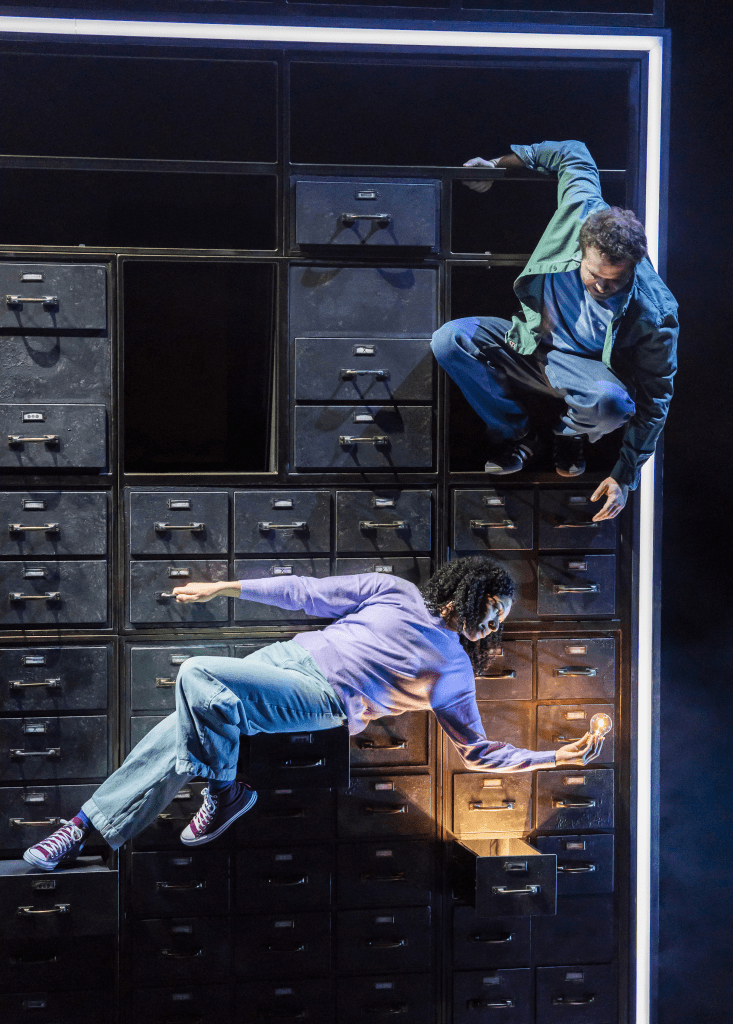
Certain scenes are re-played, with slight differences as memories are re-evaluated. At one point early on in the play, Jess stops the action to remind Robbie that “you asked me about my book”. The scene restarts, and this time Robbie asks “what are you reading?” Later, the characters disagree over the setting of a scene – was it a kebab shop, or a greasy spoon? Cue both characters acting out the same scene in two different places simultaneously. It is a fascinating concept that is never explored to a proper extent. These clashing memories are ultimately inconsequential – it doesn’t matter if the conversation took place in a kebab shop or a greasy spoon, the contents of the conversation are the same. The idea of revisiting or revising scenes is dropped in the second act, and the story becomes more linear. This idea culminates in a final scene in which Jess and Robbie argue over each other’s reactions to a particularly traumatic event. Robbie says that he comforted Jess; Jess says he was standoffish. Yet the scene is never acted out for us, we never get to experience both essences of reality as we did in the early moments of the play. It feels like a wasted opportunity.
This is a piece that strives for emotional highs, but never quite hits them. As Jess and Robbie’s relationship starts to turn upside down, so do the actors – attached to harnesses, the entire scene flips 90 degrees, and everything becomes a little disconcerting. The production is stylistic and absorbing, but the story is routine and bland. A promising start never fully delivers. This is a series of missed opportunities wrapped up in a cleverly choreographed and beautifully presented piece of theatre.
Tom Morley, September 2025
Review Round-up:
WhatsOnStage: Frantic Assembly’s Lost Atoms at Curve and on tour – review – 4 stars from WoS, who describe the show as “lyrically beautiful with much wit, pathos and a stunning soundscape”
Elemental Theatre: Lost Atoms – Frantic Assembly Review – 3 stars from ETC, who say the show is “performed with craft and anchored by two exceptional actors”










 Broken Legs Blog
Leave a comment