

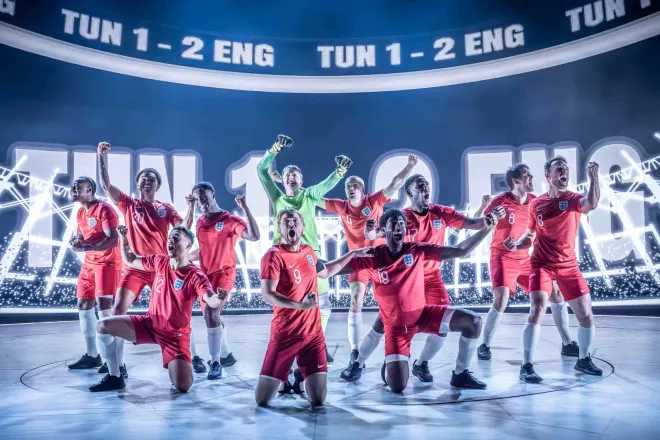
Beginning its UK tour in James Graham’s home city of Nottingham, his latest play “Dear England” explores the seemingly impossible task faced by England manager Gareth Southgate (David Sturzaker) – to turn around the men’s football team after a shocking defeat against Iceland in Euro 2016. Taking on the role of manager is a thankless task, and Southgate, continually plagued with guilt over his penalty failure against Germany in ’96, seems doomed to fail, with many lacking faith or respect in him. The play focuses on Southgate’s unusual approach, which draws criticism from players, coaches and fans alike, although anyone with a basic knowledge of the England team’s history will know that, within two years, England were in the semi-finals of the World Cup, and Southgate was a hero in the eyes of many.

As Southgate, Sturzaker is charismatic, charming and incredibly likeable. All footie fans know we love an underdog, and this production wastes no time in placing Southgate firmly in this role, beginning with a recreation of the ’96 penalty which seemed destined to be his legacy. Upon taking on the role of manager, Southgate brings in psychologist Pippa Grange (Samantha Womack), in order to help the players and coaches combat the pressures placed upon them by fans and the media. The players are initially reluctant to engage in this new style of training, and Southgate faces resistance from his coaches too – George Rainsford’s sweary Mike Webster would rather focus on the data (at one point giving a fascinating insight into the correlation between the speed of penalty takers and their success), whilst Ian Bartholomew’s Steve Holland seems keen to get the players out on the pitch and put them through their paces physically. Southgate argues that the players need to train their mental attitude as well as their physical prowess, and he is right – his change of tactics helps to bring the players together both on and off the pitch and spells success for the team.
The play is less about the intricacies of the game, and more about the emotional aspects that go along with such a competitive sport. One of the joys of this production is seeing the group of players, who initially come across as immature, argumentative and fame-hungry, slowly grow into more respectable adults, as they learn the power that the sport has given them continues off the pitch. Marcus Rashford (Jayden Hanley) begins campaigning for children’s school meals, whilst Bukayo Saka (Jass Beki) stands up against the racist abuse he receives from fans after missing a penalty. It is during these moments that Graham’s writing excels, as it always has – the football team is simply a backdrop to tell stories about humanity and politics. Yes, there is plenty for football fans to enjoy (including a superb imitation of Gary Linekar from Ian Kirkby), but even if you are not a fan of the beautiful game, this is a play that will speak to many people on many levels, and can be enjoyed by all.

Throughout, Southgate continually pushes the idea of stories – drilling into the players that, in order to reach a championship final, they need to focus on the building blocks that will allow them to get there, paying attention to the beginning and middle of their stories rather than simply focusing on the end. This production is certainly crammed full of different stories, and it is here where the storyline can feel a little confused and directionless. Over the course of two and a half hours, we are introduced to so many characters that it is hard to focus on a particular arc – we have Harry Kane (Oscar Gough) questioning whether he deserves to be team captain, Eric Dier (Tom Lane) worrying that fans will simply see his appointment to the squad as nepotism given that his parents work for FIFA, and Dele Alli (Liam Prince-Donnelly) struggling to come to terms with being dropped from the team before Euro 2020. Thrown in for good measure are cameos from Prime Ministers Theresa May, Boris Johnson and Liz Truss, as well as commentary around football hooliganism, rising racial tensions and the increasing popularity of women’s football, with Courtney George taking on the role of Lioness manager Sarina Wiegman. Graham certainly has a lot to say in this production, but it results in a plot that feels sprawling and unfocused.
The acting on display is superb, with multiple actors taking on different roles, portraying both well-known celebrities and original characters. The actors are not exactly lookalikes of these famous faces, although Evie Gurney’s costume and wigs certainly help, but their impersonations are nonetheless spot on, with certain mannerisms expertly captured. Es Devlin’s set is fairly sparse, the action revolving around a central penalty spot, with a curved screen providing different backdrops throughout, as well as displaying player stats and showing footage from famous games of the past. This is used to particular effect when Southgate selects his initial team – the stage is reminiscent of a selection screen from a FIFA Xbox game, and each player steps forward and performs a signature move. Ellen Kane and Hannes Langolf do an excellent job of turning football into choreography, with several transitions set to music as England begin to climb the ranks at various World Cup and Euro championships.

For this tour, Graham has amended the ending to include the 2024 World Cup and Southgate’s resignation, with a final scene that sees him pass the mantle on to Ian Kikby’s Thomas Tuchel. This unfortunately feels a little tacked on, and the final 30 minutes or so cannot help but become a little repetitive, with everyone’s hopes raised before devastating defeat in the final matches of Euro 2020 and again in Euro 2024. Graham faces the difficulty of real life not awarding the England men’s team their win, meaning that the ending of this play cannot help but feel a little unsatisfactory.
Nonetheless, this is a superb production in many ways, holding the audience’s attention and making each character distinct and memorable. This is a story many people would not expect to see told on stage, and I for one am glad that Graham rose to the challenge to tell it. It is clear that this play appeals to those outside of the usual theatre audience – the sheer range of audience members at Nottingham’s Theatre Royal on Friday evening was a joy, and one can only hope that this will inspire more and more people to make regular visits to our wonderful theatres. Whilst the men’s England team may have failed to lift a trophy, this is certainly a success for Graham and the National Theatre.
Tom Morley, September 2025
Review Round-up:
East Midlands Theatre: Review: Dear England. – 5 stars from East Midlands Theatre, who say this is “no mere football play […] it is a piece that offers a meditation on loss, hope, empathy and the joy of belonging to something bigger than self”
Theatre & Tonic: Dear England, UK Tour – T&T also award the show 5 stars, who commend the range of young talent in the cast: “Their ability to transform into the recognisable footballers is almost immediate; they don’t just capture the physicality and movement of the players, but they also have distinct personalities and dynamics within the team”
LeftLion: Dear England at Theatre Royal – LeftLion echo my own words regarding ‘Dear England’ opening up theatre to new audiences: “Dear England is populist theatre at its best. […] If you look at the career of James Graham, this kind of populism is perhaps what he does best. Well done and welcome home James!”










 Broken Legs Blog