
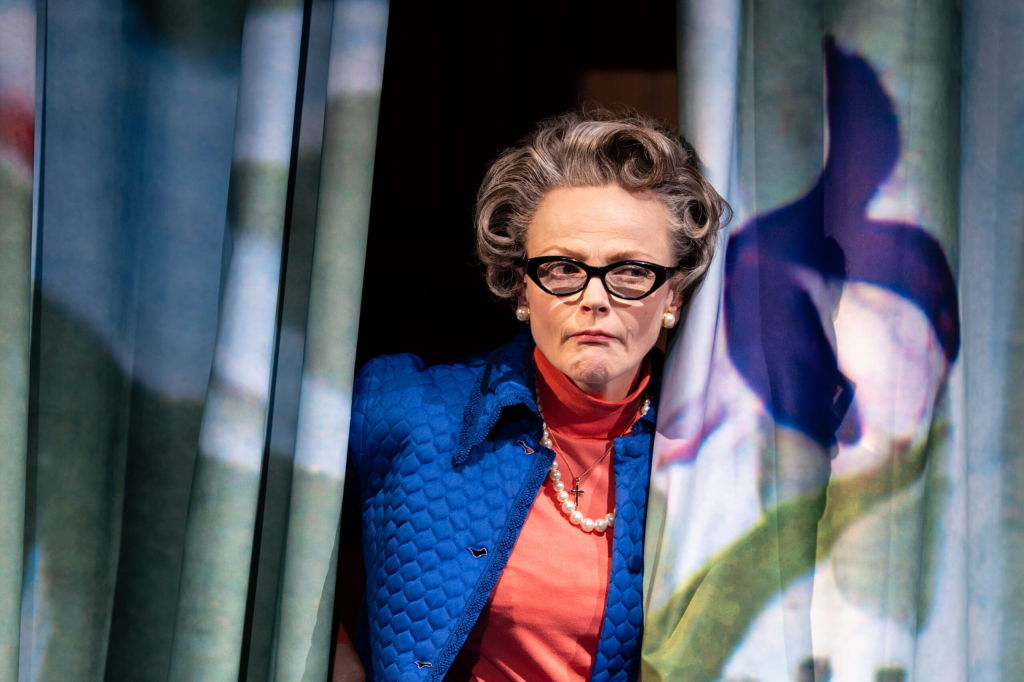
The stage is draped in garish floral curtains, through which peers a seemingly timid elderly lady – but appearances can be deceptive. Nottingham Playhouse’s “The Last Stand of Mrs. Mary Whitehouse” gives us a glimpse inside the hate-filled head of the infamous campaigner and activist. Attempting to protect children from sex, violence and homosexuality – all in the name of upholding Christian values – Whitehouse was a constant complainer throughout the 70s and 80s, and it is the impact of her various campaigns that become the focus of the play, with Maxine Peake taking on the title role. Written by Caroline Bird and directed by Sarah Frankcom, the play wastes no time in ridiculing Whitehouse’s views, but some brief diversions into Whitehouse’s younger years give us a better idea of why she is so stubborn in her grotesque opinions.

Peake is an acting tour-de-force. She expertly creates a character that is easy to hate, but with plenty of comical asides. Her facial expressions throughout help to convey Whitehouse’s true feelings, and her hate speech is delivered in the sickly sweet tones of a woman that could never imagine she was the one in the wrong. Every time someone tries to reason with her, Whitehouse has the ability to twist their words, to belittle them and look down on them. She truly believes she is better than everyone else – the “light amidst the dark”. Watching someone like this should be frustrating, yet Peake makes Whitehouse endearing in her own way, and her flippant retorts often draw laughs from the audience, despite their horrific nature.
When the story delves in Whitehouse’s youth, Peake is transformed before our very eyes, with stage hands emerging to fit her with a new wig and help her into a new costume. Peake’s mannerisms also alter – gone is the self-assured confidence of the older Whitehouse, replaced with a slight nervousness, a reluctance to spout her own views for fear of what others might think. It is her belief in God, and the support of her soon-to-be husband, that helps her find her courage. Slowly we see Whitehouse turn into the character we recognise, and it is testament to Peake’s ability that she is able to create two versions of the same character that seem so different, and yet so obviously the same.
Peake is joined on stage by Samuel Barnett, who takes on the role of every other character in the play, in a whirlwind of multi-role that keeps the audience on their toes and helps to add pace to what can sometimes be a fairly slow-moving piece. Several of Barnett’s characters are closeted homosexuals – we are introduced to a young reporter called Jacob, who seems determined to shrug off his ‘indecent thoughts’, and a music student called David who tries to fight back against Whitehouse, to no avail – and this means that several of Barnett’s characters feel a little similar, distinguished only by an over-reliance on wigs, costume and accents to help make each role distinct.
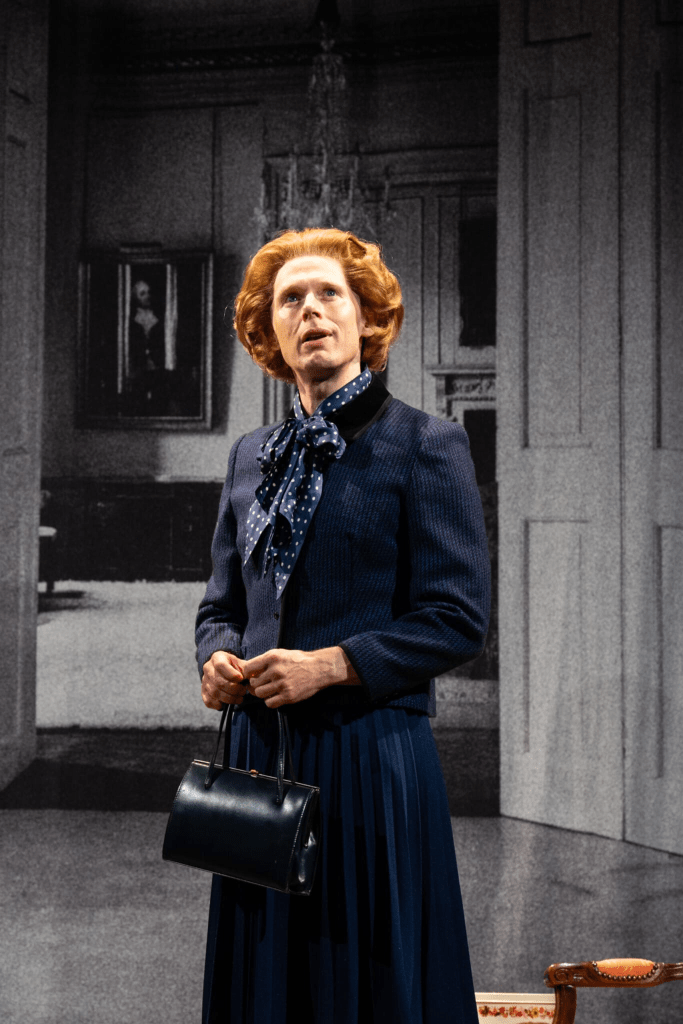
Barnett’s more outlandish characters are sure to be the ones that stay in people’s minds after the show finishes. The opening of Act Two sees him take on the role of Margaret Thatcher, in a comedic scene that imagines the Prime Minister and Whitehouse discussing the sale of sex toys, a humorous interlude that is seemingly at odds with the more serious nature of the second half of the play. His stand-out moment sees him portray feminist reporter Jill Tweedie, who ably challenges Whitehouse in a way that makes us believe she is starting to see the error of her ways. Tweedie is the perfect foil for Whitehouse – both are women who steadfastly believe they are in the right, and refuse to listen to anyone who says otherwise. It is exactly the right type of person to challenge her, and the doubts in Peake’s reaction are plain to see. Whether Whitehouse did ever question her convictions in reality is hard to tell, however.
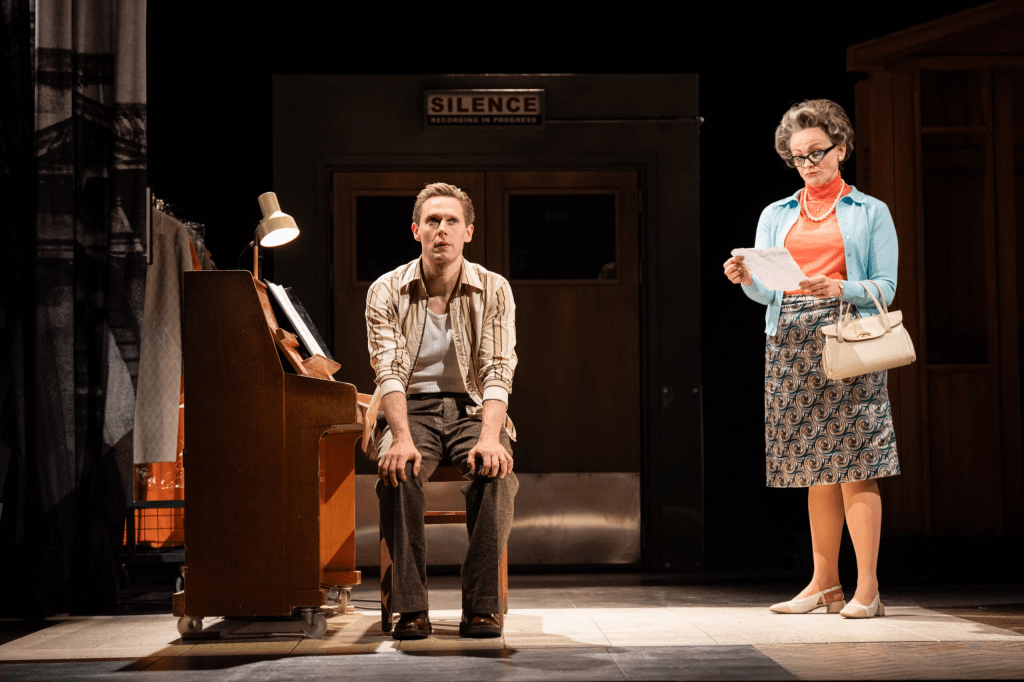
Despite Whitehouse campaigning against all sorts of liberal ideas, Bird chooses to make Whitehouse’s homophobia central to the play. This makes the play more narratively satisfying – an attempt to spread the story across a range of Whitehouse’s prejudices might make the play feel a little more disjointed – with the first half focusing mostly on Whitehouse’s campaign against Gay News after the publication of an explicit poem that mocks the crucifixion of Jesus, and the second half set against the Aids epidemic, as Whitehouse comes to realise that the downfall of Gay News could be responsible for many more people falling victim to the illness due to their lack of representation in the media.
However, there are moments where the play feels incredibly repetitive, and Whitehouse’s homophobia continually bashes us around the head to the point of gratuity. The play is long (over 2 hours 30) and, despite all the character changes, is performed with seemingly little urgency, with a plot that spends too much time wandering from the main points, showing us too many of Whitehouse’s victims when the point has already been made. By the time we are subjected to a scene in which a younger Whitehouse tries to convert a young man named Henry into a heterosexual, all in front of a radiant Christian cross, the point has been well and truly hammered home. “Less is more” is definitely the case here.
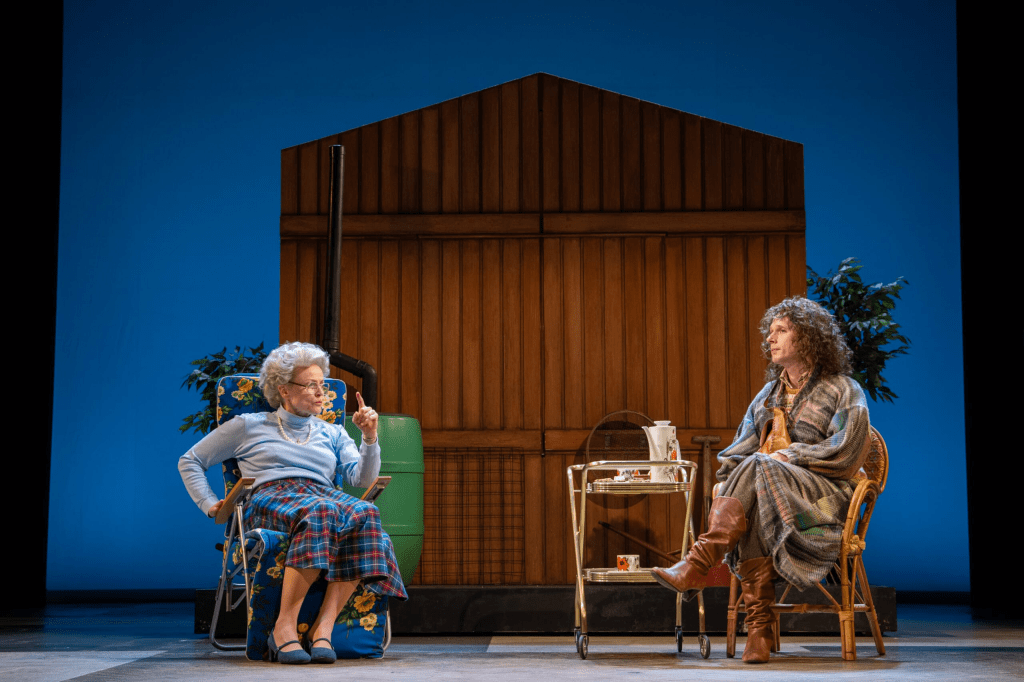
Despite all that, the final scene is a triumph, moving the story to the early 2000s, where Whitehouse is living in a care home, under the supervision of gay care worker Joseph. The transformation into an elderly woman is nothing short of mesmerising, as Peake’s sensible shoes are traded for slippers and she carefully lowers herself into a wheelchair, a slight tremble in her hands and a lop-sided grimace on her face. It is a beautiful scene, all perfectly backed by Simon and Garfunkel’s Bridge Over Troubled Water, which suddenly cuts out as Whitehouse launches into a tirade about the abominable new Channel 4 show Big Brother. But this time something is different. No one is listening to her. Joseph almost mocks her, wheeling her around the stage and feeding her cake. He holds the power now. In a flash, Whitehouse is reduced to a shadow of the past. It is not a total victory – Whitehouse never learns the error of her ways, never seeks forgiveness for the lives that she has ruined – but it feels like a victory nonetheless. It is, in it’s own way, uplifting, and a valuable message to end on, especially in today’s tumultuous climate, with figures of hatred such as Elon Musk and Tommy Robinson taking up so much of the media’s time.
This production is a worthwhile delve into a not-too-distant past, a play that is sure to educate, horrify and entertain in equal measure. Not without its faults (it really could do with being thirty minutes shorter), but worth seeing for Peake’s faultless performance if nothing else.
Tom Morley, September 2025
Review Round-up:
WhatsOnStage: The Last Stand of Mrs. Mary Whitehouse – 5 stars from WoS, calling the show a “thoroughly enjoyable, well-crafted and superbly performed piece of theatre”
Elemental Theatre: The Last Stand of Mrs. Mary Whitehouse – ETC give the show 4 stars, who speak at length about Barnett’s scene as Jill Tweedie, calling this a “standout moment” and “the result […] electrifying“
Financial Times: The Last Stand of Mrs. Mary Whitehouse – Further down the star ratings, the Financial Times award 3 stars, stating that “by trying to blend comedy into the queasy mix, it achieves tonal uncertainty”














 Broken Legs Blog
Leave a comment