

“Fat Ham” has all the usual set-up of Hamlet (a young man in emotional turmoil, dead dad, uncle married to mum), but takes the ideas in a very different, and refreshing, direction. This complicated family tree is no longer imprisoned within the walls of Elsinore, but instead transposed to a quaint family barbeque in the American South, where Juicy (Olisa Odele) is struggling to come to terms with his father’s death and his mother’s o’er-hasty marriage. There are bigger themes at play here (as if life and death weren’t big enough) – Juicy’s quest for acceptance as a queer Black southerner, mirrored by similar arcs for family friends Larry (Corey Montague-Sholay) and Opal (Jasmine Elcock). Juicy struggles to fit in, and the parallels to Shakespeare’s Dane are obvious from the get-go.

The arrival of the ghost of Juicy’s father Pap (Sule Rimi), recently murdered whilst in prison, is at first a spectacle of horror – Rimi rises through the picnic table, smoke vapour emerging from his shirt sleeves – but quickly descends into a more comedic tone, as Pap delivers some tongue-in-cheek anecdotes about the life of a ghost, before being called back to the underworld by an ominous swinging trapdoor that appears in the decking. It is during this visitation that Pap informs Juicy that he was killed on the orders of his brother (Juicy’s uncle, now step-dad) and that it is up to Juicy to exact revenge – or, in Pap’s words, “stab that motherf***er – he’s literally f***ing your mother!”
No sooner has Rimi departed for the underworld than he is back onstage as Juicy’s uncle Rev, a character that Rimi realises as subtly different, but bearing several emotional resemblances to Pap – both are quick to anger, both share the same cheeky laugh, and both are particularly vile to Juicy at times. As Rev, Rimi plays the standard villain of the piece – someone who is keen to point out Juicy’s failings, mocks him for being “weak” and has clear homophobic tendencies whilst being fanatically religious (at one point, he forces the family into a lengthy prayer in which he thanks God for making pigs, ham and BBQ sauce). Juicy’s mother Tedra (Andi Osho) is not much more likeable, failing to stand up to Rev when he is taunting her son, and being complicit in spending money meant for Juicy’s tuition fees. Her relationship with Rev is messy – at times, she seems almost scared by him, but more scared of being alone in the wake of Pap’s death. It is an interesting interpretation of Shakespeare’s usual role of Gertrude, and one that the audience should be able to sympathise with, but the play never quite hits the right chord. Tedra is too easy to dislike because of her disregard for her son, and never has a chance to redeem herself. It feels like a missed opportunity.
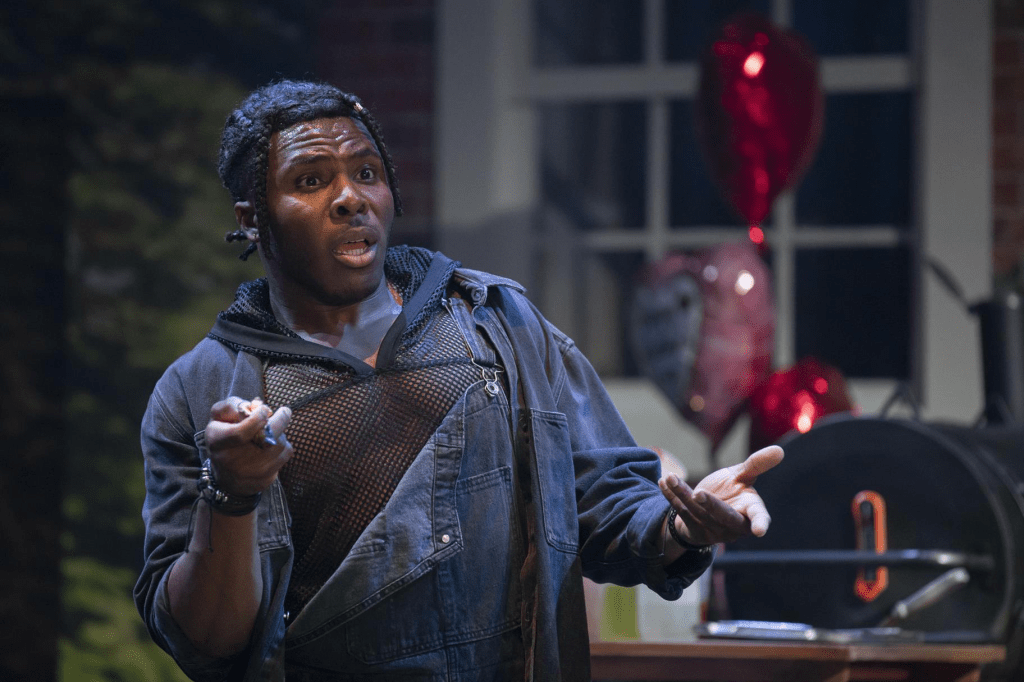
Further similarities to Hamlet arise with the arrival of local gossip Rabby (Sandra Marvin as the counterpart of Polonius) and her two children Opal and Larry. Rabby and Tedra poke fun at the childhood romances between Juicy and Opal, and yet it is clear that Larry is the more suitable match, and the play wastes no time in exploring the tension between them. The scene in which Larry, drafted into the army at an early age, yet yearning to be a performer, confesses his feelings to Juicy is tender and tense. This is the play at its best, and the audience holds a collective breath as Larry reaches out a hand to touch Juicy’s forearm. A gay romance amidst a world of bigotry is nothing new in theatre, but it is handled with utmost care here. Their relationship is not your standard love story either – the chemistry between Odele and Montague-Sholay is stilted and awkward, but that’s the point. They are not in love with each other, but with the idea of being in love, both of them starved of attention and touch. The parallels between their fleeting intimacy, and Hamlet and Ophelia’s romance, can be drawn, and yet for those who do not know Hamlet particularly well, it will not detract from your enjoyment. There is enough story here to stand on its own – although a knowledge of the original material is sure to enhance your appreciation of this piece.
Throughout the play, Odele soliloquises in much the same way as Shakespeare’s protagonist, speaking directly to the audience, and asking them for guidance as he wrestles with the idea of murdering his uncle. Many of these soliloquys are interrupted by the arrival of other characters however, and the spell is often broken by those characters then referencing the audience as well. There is a lot of ad-libbing throughout, particularly around the frequent, and often unnecessary, rearranging of stage-furniture, that is very funny, but breaks down the fourth wall in a way that disconnects us from the rest of the piece. Odele’s soliloquys, beautifully performed and superbly written, help to bring the audience closer to Juicy, and set him apart from the rest of the over-the-top characters – it is disconcerting, therefore, when he is interrupted by Tedra asking “what did you tell them?” and then directing questions towards audience members. We go from the audience simply being a figment of Juicy’s imagination, to being something recognised by the entire cast, and it all feels a little confused.
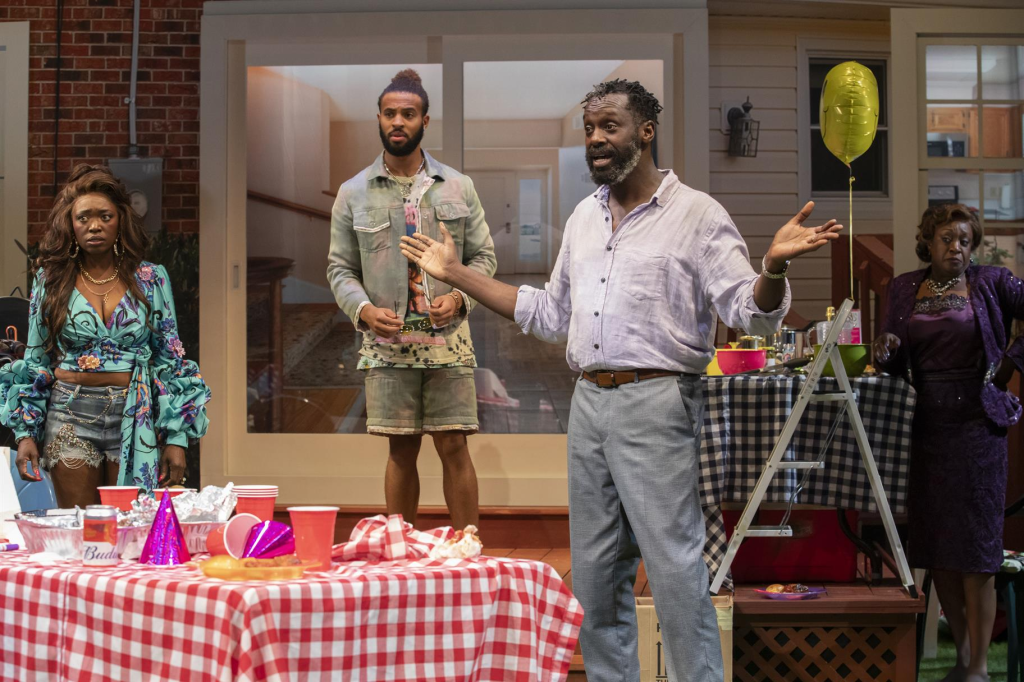
The play borrows some soliloquys directly from Shakespeare’s text – Odele gets an opportunity to speak the “If he do blench” speech, and later on utters the famous “The play’s the thing” lines, as he prepares to expose his uncle’s lies during a game of charades. Writer James Ijames was inspired to create this piece after being told he couldn’t perform Hamlet in a Southern accent – let me assure you, that is certainly no issue here, Odele’s southern drawl lends itself perfectly to Shakespeare’s words and if anything leaves you wanting more. Each time the play begins to lean further into the source material, it seems to back away too quickly, as though nervous of being unable to match Shakespeare’s original, and instead resorting to yet more innuendo and forced physical humour.
The humour is strongest when casually referencing Shakespeare’s work – after Rev speaks at length about preparing the perfect ham with BBQ rub, Juicy quickly quips “Ay, there’s the rub” – but often resorts to explicit sexual jokes which don’t quite land with your usual RSC crowd. Juicy’s friend Tio (Kieran Taylor-Ford as the hyper-sexual mirror of Horatio) delivers a long speech in which he compares coming out to receiving sexual favours from a gingerbread man, in a comparison that is not only bizarre but feels heavy-handed, especially after a much more nuanced exploration of the same topic in earlier scenes between Juicy and Larry. When Rabby discovers her son’s sexuality, we are initially treated to a dark, visceral reaction – but then the play flips back into light-hearted comedy as Rabby discloses that she used to be a stripper. The play wants to make huge statements, but is scared to do so for fear of interrupting the “fun”. It teases us with being something more, but never quite explores the themes sincerely enough.
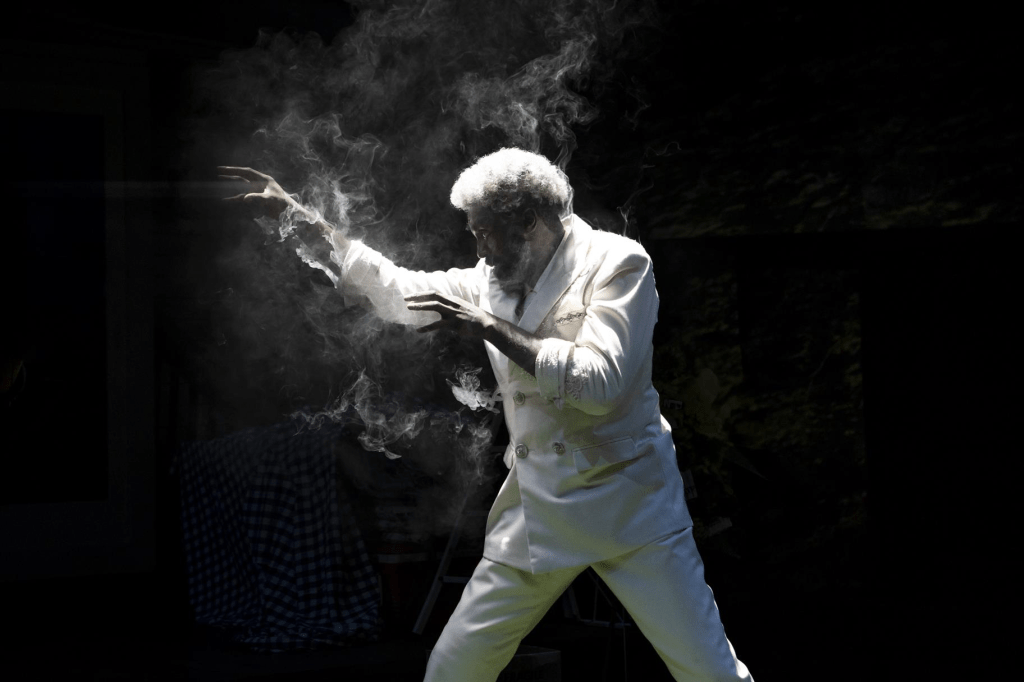
The set design from Maruti Evans is remarkable, and unlike anything I have seen before – a 2D backdrop, reminiscent of a royalty-free stock image, with several 3D elements that provide an additional entrance/exit for the actors. The transformation in the final scene is unexpected yet provides a true spectacle on which to end the show. Bradley King’s lighting design is the standout, however, turning the airy, bright backyard into something more ethereal when Pap’s ghost arrives, to an all-out nightclub by the time the actors take their final bows. It has to be seen to be believed – the way in which King is able to change the entire atmosphere of the stage with just lighting is remarkable.
Overall, the play is likely to appeal more to those who are not familiar with the original text. It is different enough to stand apart, but often fails to reach Shakespeare’s emotional highs when compared to the original. The play is robbed of a tragic ending – which is the whole point of the piece – but in the absence of a tragic ending, the story has nowhere to go. This is an enjoyable evening of theatre, but one that often does not stand up to closer scrutiny. If it gets new audiences interested in Shakespeare, then I’m all for it – but for those that are already fans of the genre, this might be an adaptation too far.
Tom Morley, August 2025
Review Round-up:
BeyondTheCurtain : Fat Ham – RSC Review – A 5 star review from BTC, who call the show “powerful, relevant and […] must be seen. An absolute slay by the RSC”
Elemental Theatre Company: Fat Ham – RSC Review – ETC also give the show 5 stars, calling it a “rare production that reframes a classic without fear […] This is Hamlet reimagined for today”
WhatsOnStage: Fat Ham at the RSC’s Swan Theatre – The play receives majority 4 and 5 star reviews, but here’s a 3-star review from WOS, who say “performances vary wildly [and the] characterisations lean too far towards caricature”








 Broken Legs Blog