

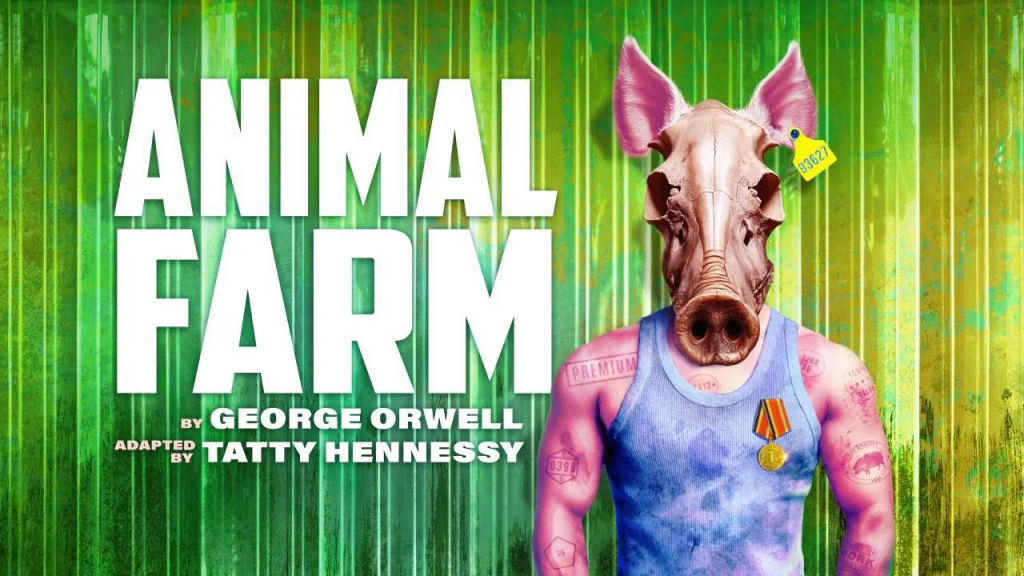
George Orwell’s novel “Animal Farm” is brought to the stage in this latest adaptation by Tatty Hennessy. Telling the story of a farmer overthrown by his animals, who then take over the farm for themselves, this production is at times gritty and dark, as the realities of governance and survival force the animals into making some difficult decisions. In terms of plot, the production, directed by Amy Leach, stays true to Orwell’s original novel, and the story is as captivating as ever, carefully tracking the rebuilding and subsequent collapse of society often described as an allegory for the rise and fall of Stalinism. Where the production struggles and falters a little is in its design, reimagining the farm as an industrial factory, and having the characters portrayed as human with animal traits, which occasionally causes confusion and detracts from the more poignant moments of the play.
An opening montage, accompanied by voice-over, introduces each of our characters, immediately making clear which animals they represent, whilst labels on clothing and skin also remind us of the character’s roles throughout. Each character possesses certain characteristics reminiscent of their animals – Clara the chicken (Brydie Service) is tired from producing too many eggs, Minty the sheep (Farshid Rokey) races around the stage, constantly distracted and easily led, and Blue the dog (Joshua Alexander-Williams) is angry and reactive. As well as this, the characters often involuntarily produce animal noises, usually in times of heightened emotion – the horses bray, the pigs squeal, the dogs bark… you get the idea. These constant reminders help the play to convey meaning and to “categorise” the animals into their groups, but it can occasionally take you out of the drama and seemingly prevents us from investing too much in the characters.
This take on “Animal Farm” is an interesting one, and the choices made are easy to understand. Without heavy costumes or puppetry, the actors can more easily portray emotion, and the tense scenes work well here. An argument over a windmill between pigs Snowball (Robin Morrissey) and Napoleon (Tachia Newell) is fascinating to watch, and it helps us easily draw comparisons with politicians both past and present. But it means that the play struggles to be symbolic at other moments. The differences between the animals and Farmer Jones (Kaya Ulasli) are difficult to make out – they all walk and talk the same way, and wear clothes whose colours are dark and muted. When Napoleon and Squealer (Tim Simper) begin to wear “human” clothes, the differences are so minor that they are unnoticeable. When they stand up on two legs, it loses impact because we have seen the actors move like this throughout. The symbolic nature of these changes, as the pigs become more man-like, is lost because of the choices that have already been made.
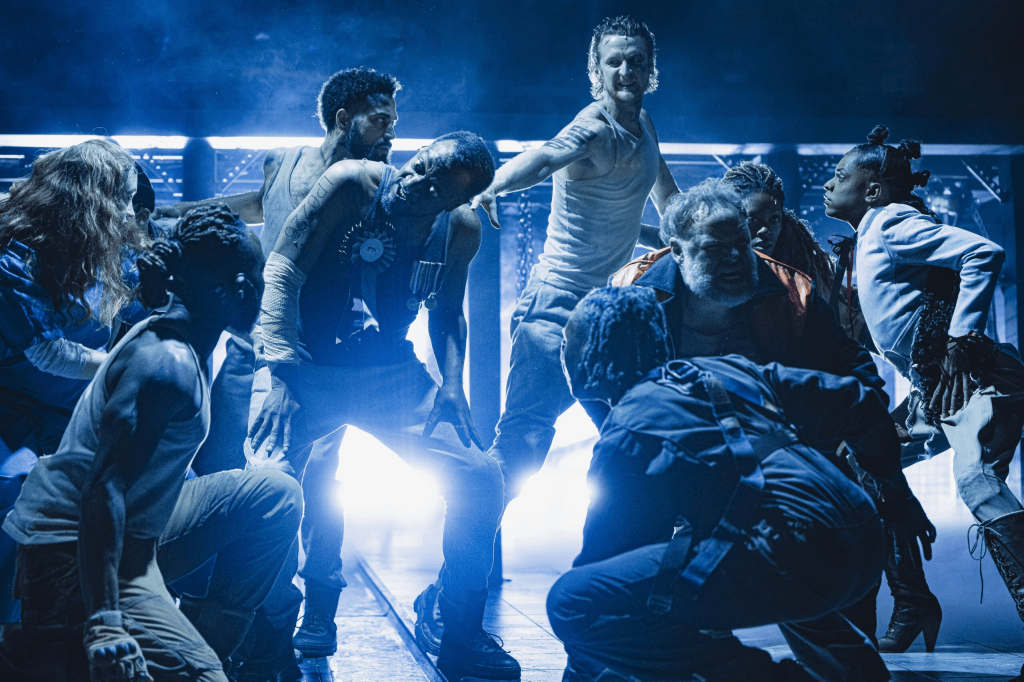
Despite Hayley Grindle’s set design being full of steel cages and metal beams, the text undeniably sets the action on a farm. Any decision to set the action in a factory is not backed up by the text – instead of changing animal groups for different classes of factory worker, they remain animals, just with a factory backdrop that seems at odds with the story this production is trying to tell.
Thankfully, the story and superb acting on display is enough to hold one’s attention. Tianah Hodding’s Clover the horse serves as the audience’s access point to the show, often calling out the problems with the animals’ plans, whilst also being gullible enough to fall for the various lies that are fed her. Service’s Clara is often looked down on by the other animals, making for some truly upsetting scenes – especially as her hopes of rearing her own chicks are suddenly stolen away from her. Each character is given their chance to shine, and serves a purpose. Shakeel Kimotho’s Mollie serves as the outsider, an animal who escapes the confines of Animal Farm after realising that life under Napoleon’s rule is not as utopian as everyone first thought. Even characters that serve more comedic roles in the first act (David Nellist’s Benjamin and Rokey’s Minty) are given more depth in the latter half of the play, making for a suitably downbeat ending.

The production features integrated BSL throughout, a seamless addition. Chants of the animals are accompanied by signs which add weight to their mantras, making their regime feel ever more oppressive and indoctrinating. This is a stellar example of inclusion and accessibility done well, and something we have come to expect of recent productions where Nottingham Playhouse are involved.
Overall, this is a production that is enjoyable but beset with too many conceptual problems. Fans of the story will find a lot to like here – any worries that the setting will change the original too much prove to be unfounded. The problem is that the setting doesn’t add anything to the piece except additional confusion – I found it hard to pick out the Farmer in the initial fight scene, and the stylised nature of the piece leaves moments such as Snowball’s removal open to interpretation (I wasn’t sure if he was dead or alive until it was clarified a few scenes later). This is a play that shines thanks to its original source material, but is prevented from reaching greater heights by a seemingly incoherent design.
Tom Morley, April 2025
For more information on how I decide on star ratings, see here: Star ratings – Broken Legs Blog
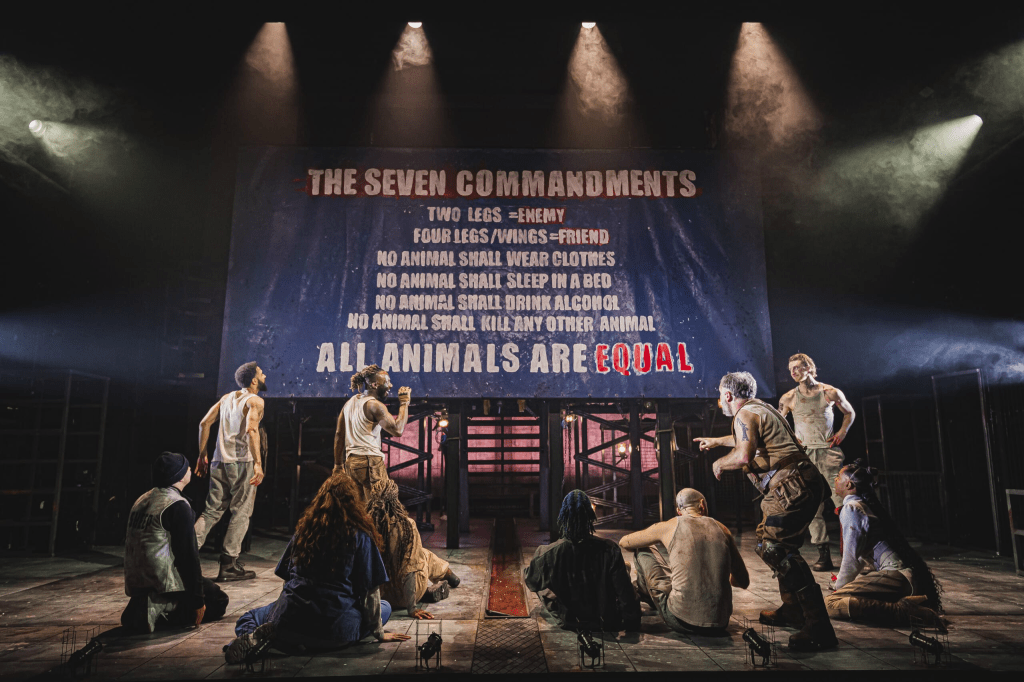
Review round-up:
East Midlands Theatre: Review: Animal Farm. Nottingham Playhouse. A glowing 5 star review from EMT, who warn the audience “Don’t expect a cosy night out – it is a visceral and vicious rendering. Necessarily so.”
Elemental Theatre: Animal Farm – Theatre Review ETC give the show 4 stars, stating that it “boasts an exceptionally gifted ensemble cast”, but that some of the design choices “lacked impact”
West End Best Friend: Review: ANIMAL FARM, Nottingham Playhouse – Tour Another 4 stars from WEBF, who call this show “a visceral and moving theatrical experience”







 Broken Legs Blog