

The RSC’s production of Christopher Marlowe’s “Edward II” presents a frank, honest interpretation of the King’s much-debated homosexuality and his obsession with young nobleman Gaveston. Marlowe’s text feels modern and relevant, the nature of Edward and Gaveston’s relationship not hidden behind metaphors, and instead presented as a proper romance, which feels groundbreaking for the time it was written, and is still incredibly refreshing to see onstage today. The RSC’s production, under the direction of Daniel Raggett, goes one step further, dressing the cast in modern-day clothes combined with Tingying Dong’s sound design which carries heavy rock-pop influences that immediately breaks any stuffiness or formality usually associated with these types of history plays.

In the titular role, RSC co-artistic director Daniel Evans presents Edward as a weak and petulant King, almost throwing temper tantrums in order to achieve what he wants. It is easy to see why the other lords are resistant to the sudden ascent of Gaveston (Eloka Ivo), who finds himself showered with titles as Edward attempts to make others appreciate Gaveston the way he does. Edward’s motivations are clearly driven by love and lust, and are not necessarily in the best interests of his country. The relationship between Evans and Ivo is intense and quick – we see very little of the two together, constantly being interrupted or torn apart by other members of the court, yet their feelings toward one another are plain to see. However, that does not make it easy to root for a King that places his own desires over his country, and throughout the play the audience are constantly torn between rooting for Edward or rooting for Mortimer (Enzo Cilenti), a powerful royal who sees that Gaveston must be removed.
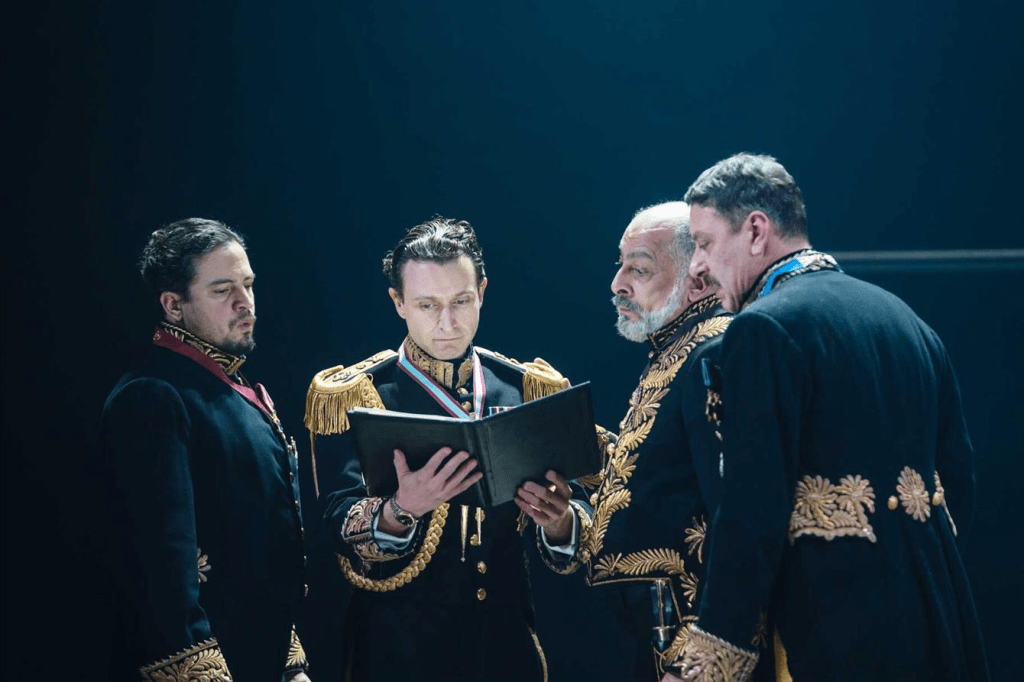
The royals’ hatred of Gaveston is not necessarily driven by blatant homophobia – in fact, the characters of Mortimer, Lancaster (Evan Milton), Warwick (Geoffrey Lumb) and Pembroke (Emilio Doorgasingh) are much more complex than that, and their scenes together as they plot to kill Gaveston and then depose the King are fascinating to watch. Whilst some language may suggest homophobia, or even racism, towards Gaveston, the main driving factors appear to be down to Edward’s ability to rule when he is constantly distracted by his lover. The fact that his lover happens to be male seems of little importance in this respect.
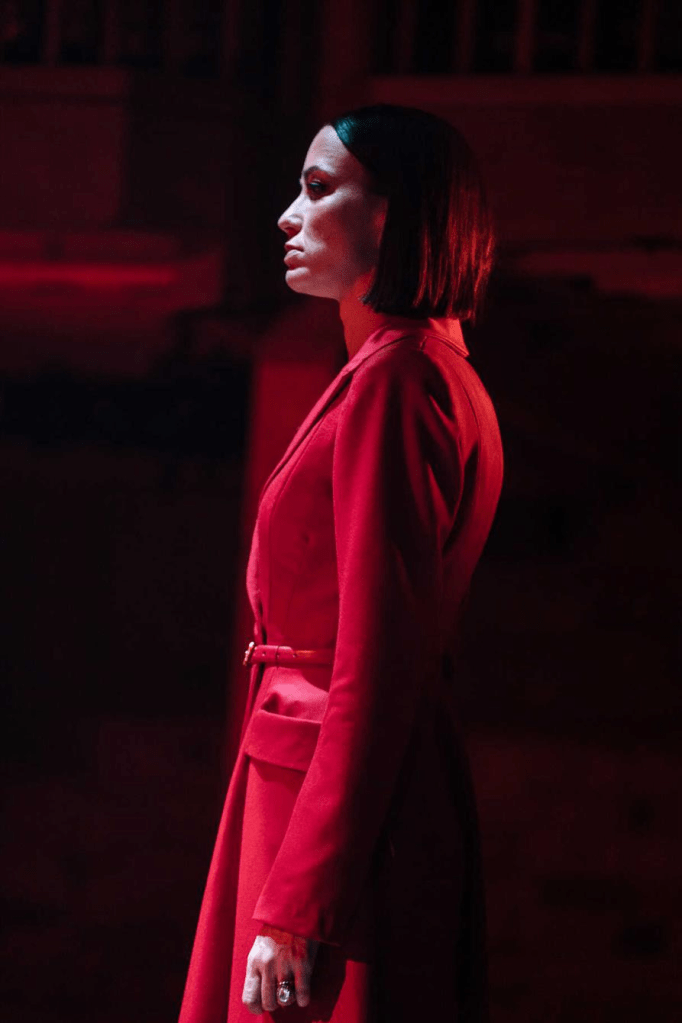
As Edward’s wife, Ruta Gedmintas presents Isabella as a Queen of much stronger temperament than her husband, understanding the sacrifices that must be made to allow her to succeed. Her affair with Mortimer complicates matters, although Cilenti and Gedmintas share very little chemistry onstage, and Isabella’s motivations for seducing Mortimer are left unclear. Joel Tennant as Edward’s son is a revelation – the young actor excels at presenting Prince Edward as a complicated youth, torn between standing by his father, or acting on the wishes of the regency.
Leslie Travers’ set design comes to life in the second half, as the shifting platform transforms the royal palace into a dungeon where Edward finds himself incarcerated. It is at this moment that the play really starts to grip you – after the fast-paced nature of the opening scenes, where plot flies thick and fast, everything slows down to present a much more intricate character study of Edward and his family. The production is a technical marvel as well, combining water, fire, smoke and blood with some incredibly realistic and ferocious fight scenes from choreographer Kev McCurdy.

Some moments in the production do not quite meet the mark however – I found the characters of Spencer (Stavros Demetraki) and Baldock (Kwaku Mills) are little too stereotypical, feeling out of place amidst the rest of the production. Their romantic relationship together gives an interesting interpretation of Gaveston’s allies, but also felt like an unnecessary focus within such a short run-time (the play only lasts 1 hour 40 minutes with no interval). Edward’s brother Kent (Henry Pettigrew) stands out as being one of Edward’s only supporters, but apart from that the character is a little bland and blends into the background.
Anyone who is familiar with Edward’s eventual demise will know that the ending to this play is not for the faint-hearted, and this production does not shy away from that aspect. The final scenes are gruesome and shocking, and anyone who struggled to root for Edward in the opening act will surely be left feeling sorry for the naïve royal by the end. As hired murderer Baldock, Jacob James Beswick presents a manipulative individual who seems to enjoy his work a little too much – his chosen method of execution leaves no doubt as to his views on Edward’s sexuality.

As someone who knew very little about Edward’s reign, this play is accessible, informative and incredibly enjoyable. The plot does not get lost in complicated politics and wars as many of Shakespeare’s histories do – instead, Marlowe’s script focuses on character and relationships, and subsequent cuts to the script leave this production feeling pacy and exciting. This is a fantastic-yet-harrowing night of theatre, and one that I fully recommend.
Tom Morley, March 2025




 Broken Legs Blog