

This blog post was written for East Midlands Theatre.
Leicester Drama Society’s recreation of Shelagh Delaney’s kitchen-sink drama “A Taste of Honey” , directed by Russell Hughes, offers a window into life in 1950s Manchester, a time and place on the cusp of changing societal norms but still rife with racism and homophobia. Whilst some of the characters hold fairly progressive viewpoints on marriage, sex and relationships, these are juxtaposed with the more traditional standards held by the older characters, making for some interesting interactions as the various characters continually clash in raw, realistic and sometimes heartbreaking ways.

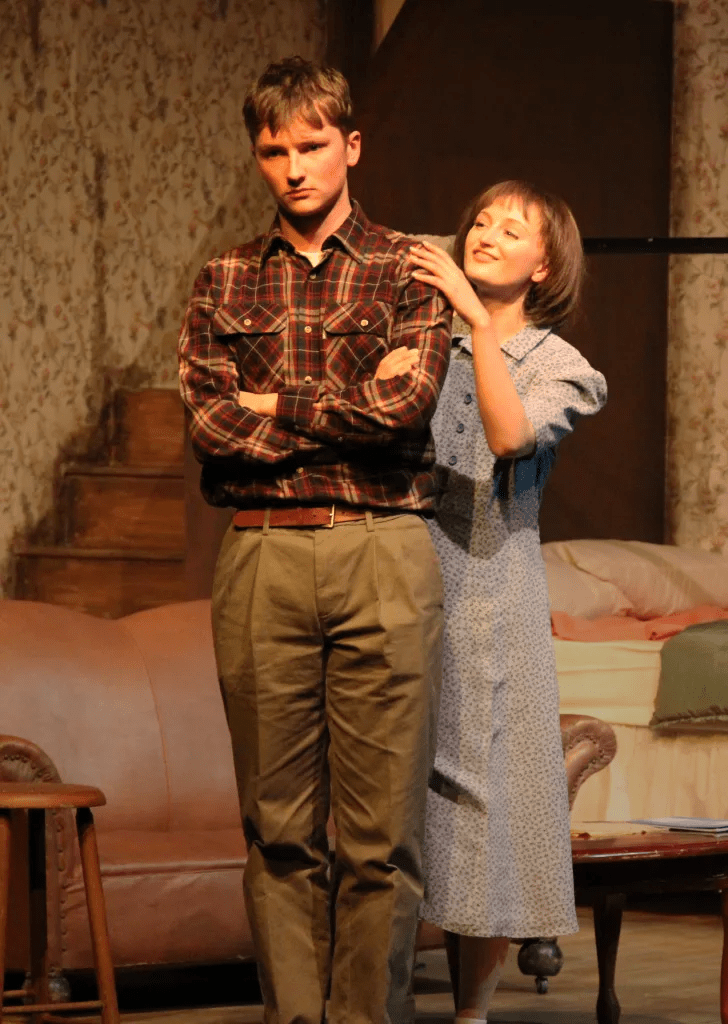
The play focuses on the story of Jo (Celeste Walton) and her mother Helen (Holly Matusiewicz) who live in a cramped, dirty flat and struggle to make ends meet. The opening scene helps the audience to clearly understand the dynamic between the two – this is a feisty relationship that often descends into full-blown shouting matches over the smallest of details. An ongoing argument about which knobs to turn on the hob make for some comedic moments, even though the ongoing arguing can be exhausting, not just for the actors onstage but also for the audience. Delaney’s script is incredibly grounded and realistic, but this can sometimes make the dialogue feel circular and repetitive, with some scenes carrying on for a little too long without offering anything new in the way of narrative. Thankfully both Walton and Matusiewicz have excellent chemistry throughout, and the way their relationship develops throughout the play is well-realised, as Jo takes on more responsibility and is forced to grow up.

The crux of the story centres around Helen’s new relationship with Peter (Freddie Dobrijevic as the wealthy, one-eyed ex-soldier) and Jo’s relationship with Jimmy (Abdullah Henly as the sailor who ultimately abandons Jo). Dobrijevic’s Peter is loud, brash and intimidating – he certainly livens up every scene he is in, although one can’t help but feel there was more to be explored with this character, a softer side that is never given chance to shine through. It doesn’t help that the majority of Peter’s stage time is devoted to continual clashes with Jo that never appear to reach any satisfying resolution. The relationship between Helen and Peter is far more interesting, and Dobrijevic and Matusiewicz paint a clear picture of a new, exciting love affair that quickly descends into something darker and more hateful. Henly is afforded very little stage time in comparison, and whilst his early scenes with Walton are enjoyable and give a nice contrast to the shouting matches that fill most of the play, it is a shame that we don’t get a better insight into his character, who disappears in the second half without proper explanation.
The second half introduces us to Jo’s flatmate Geoff (Thom Jones), a gay man who moves in with Jo after she discovers that she is pregnant with Jimmy’s child. Jones gives a confident, down-to-earth portrayal of a man struggling to hide his identity in a time fraught with bigotry. His character is a breath of fresh air, and the dynamic between him and Walton makes for captivating viewing. Their platonic relationship, as they both test the boundaries and try to work out what their new lives will look like once the baby is born, feels very modern and fresh – difficult to believe that the text was written almost 70 years ago.

The set, designed by Steph Nicholls, is fascinating, a backdrop of crumbling brickwork that clashes with the naturalism of the script but offers a clear representation of the state of the flat that Jo and Helen live in. A coffee table that is slightly too small constantly overflows with crockery, magazines and books, and a bed is separated from the rest of the room by a sad, mouldy curtain. It all helps to paint a very bleak picture, as does the costume design from John Bale – nothing too flamboyant or colourful, all greys and browns. The sound design from Stew Wale and Tim Neville leaves a little to be desired – sounds of children playing in the street emanate from the back of the audience, which I found a bit distracting when actors were trying to speak onstage.
The actors occasionally stumbled over lines and required a few prompts, but this was presumably first night nerves, and once the play was in full swing, the actors settled into their roles and grew in confidence. All characters are well-realised, and the actors do a perfectly acceptable job of bringing the world of 1950s Manchester to the stage, but for me, the story felt lacking in places, and built to a conclusion that was not entirely satisfactory. If you are looking for a play with a gritty plot to keep you on the edge of your seat, this won’t be for you – but if you want a play with strong characters that offers a clear window into the past, then this will be right up your street.
Tom Morley, March 2025













 Broken Legs Blog