

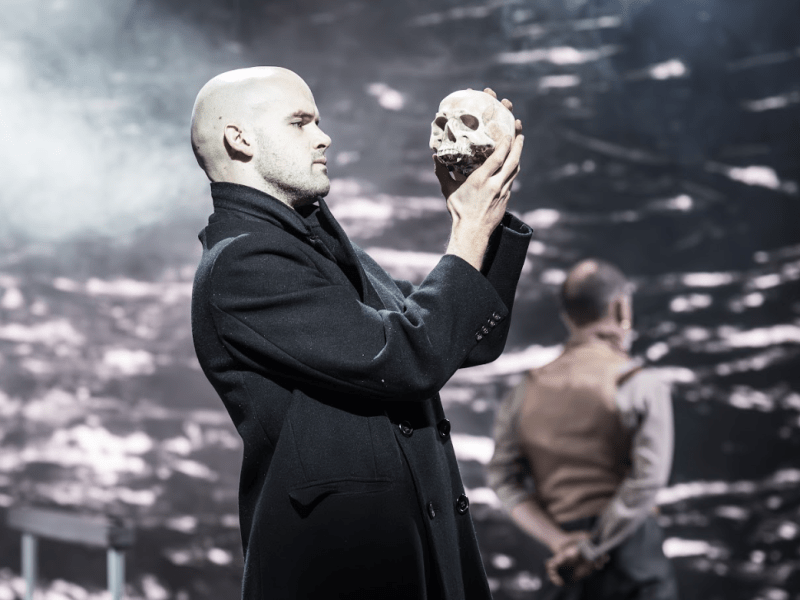
Rupert Goold’s bold new interpretation of Hamlet reimagines the Shakespearean revenge play on the Titanic, in a move that might seem confusing, works better than you may expect but still leaves one with a few too many questions. I must admit, upon hearing about the setting for this production, I was a little sceptical about how it would work – but thankfully, the strong performances from the entire cast, in particular Luke Thallon in the title role, will quickly dispel any reservations you may have.

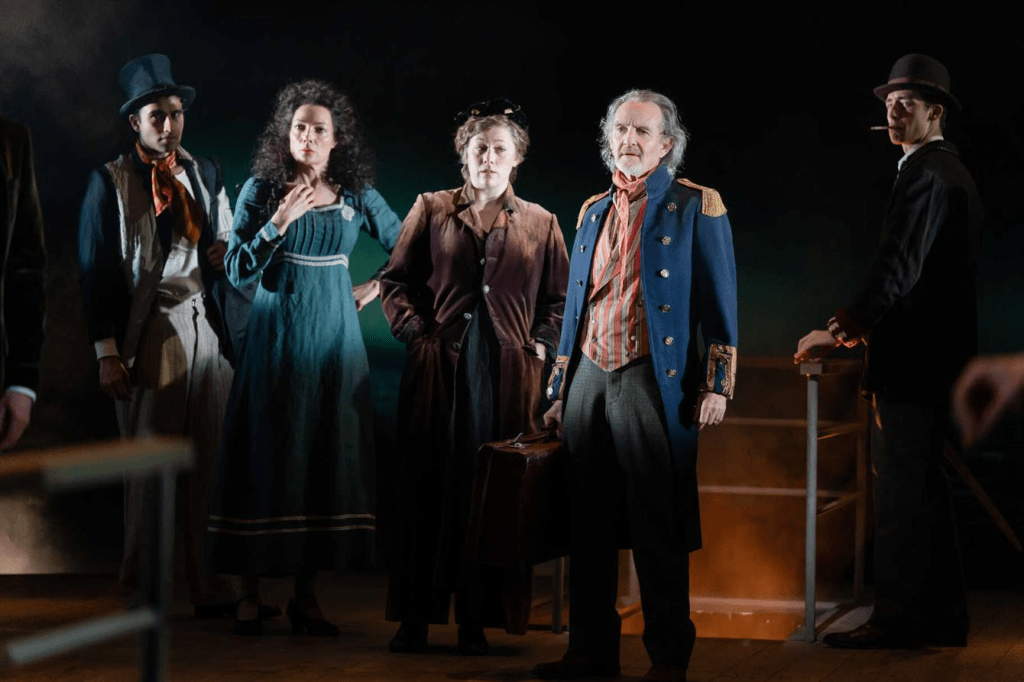
The idea of telling this tragedy on a sinking ship is one that is easy to comprehend – the parallels with the slow decay of the Danish monarchy are plain to see. Being so specific as to set it on the Titanic (there is no doubt about this – bold lettering states clearly that it is 14th April 1912) raises questions however. In particular, why the Danish king and his court are onboard the transatlantic crossing is not made clear, and the brief flashes of digital clocks that signal imminent destruction will only make sense to those who are knowledgeable about the timeline of the Titanic’s sinking. The setting makes the play feel fresh and new, and the cast have lots of fun with Evie Gurney’s period costume design, but the text struggles to keep up, and various parts of the speech are changed or removed in order to make it make sense.
Instead of being set over several weeks (or months) as the original, this production instead takes place over one night, making Hamlet’s slow decline into madness much quicker. Thallon copes well with this, however – there is a certain madness already present in Hamlet’s opening soliloquy, and this provides him a good basis from which to build on as the play continues. No change in Hamlet feels sudden or unwarranted, as Thallon becomes more agitated and nasty with every scene that passes. Nia Towle’s Ophelia fares a little less well here, though – her sudden change in the latter half of the play does not feel natural, and Towle is further hampered by the text, which offers her very little to play with. A dream sequence that sees her thrown around the ship by the ensemble is not enough to help us understand the changes in her disposition, and the onset of grief over her father’s murder feel too quick given the shortened time frame.
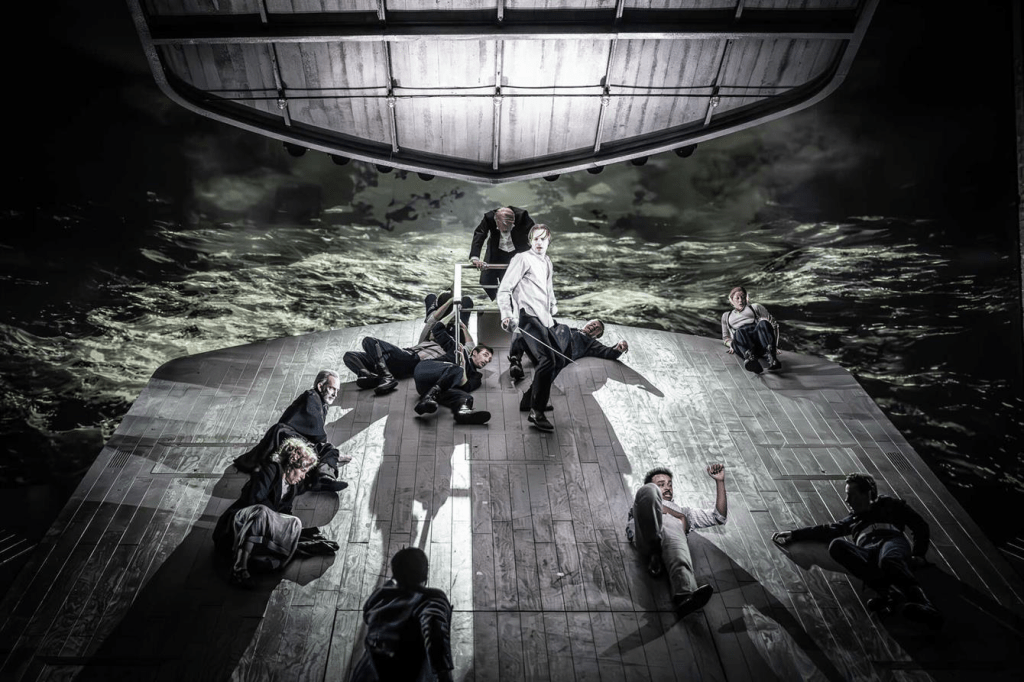
What saves the production from these uncertainties is the self-assured performances from the cast. Thallon’s Hamlet is irresistible, offering excellent comic timing throughout with snide winks at the audience, which make his sudden outbursts even more terrifying. Thallon’s performance may not delight the purists in the audience – he takes a sledgehammer to the iambic pentameter which will not be to everyone’s tastes, but it makes the text feel exciting and different, and I for one enjoyed the disturbed rhythm. Hamlet’s speeches include so many well-known lines and sayings that it is difficult not to over-perform – but Thallon spits these words with reckless abandon, throwing them away to focus on parts of the text that are often overlooked. His fourth wall breaks are also a joy, if a little on the nose – stealing sweets from an audience member and adding in occasional ad-libs go a long way to make his character likeable, but feel a little misplaced in the context of the setting.
Elliot Levey’s Polonius also provides some nice comedic moments throughout the play, rattling through dialogue in a way that befits the “tedious old fool”. However, his death occurs offstage, and the fact that we never see his body (just a smear of blood on Hamlet’s shirt) prevents Polonius’s demise from having the impact that it should. Jared Harris presents a confusing Claudius – a king that cares little for ruling (letters received about Norway are ripped up in the opening scene, and any further text referring to Fortinbras is cut) and lacks chemistry with his wife, a seemingly deliberate move, which raises the question as to why he bothered to kill his brother in the first place. Nevertheless, this is a powerful performance from Harris, who physically attacks Hamlet when demanding to know where Polonius’s body is, but sadly a lot of his scheming with Laertes (Lewis Shepherd) in the latter half of the play is removed, leaving Claudius feeling as a reactionary with little underlying cunning.
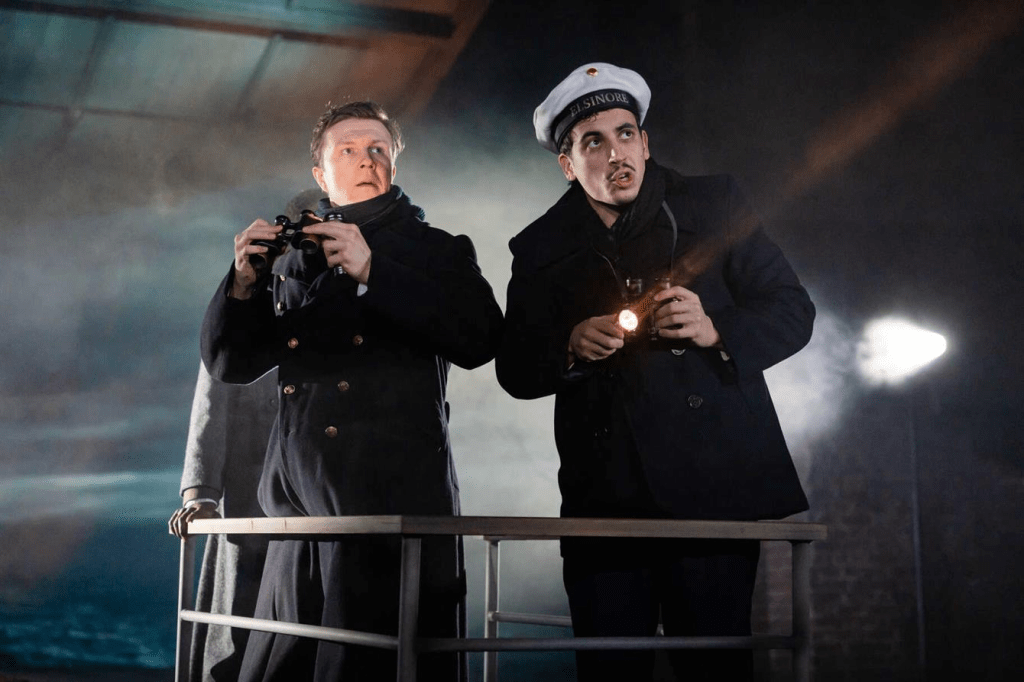
Nancy Carroll portrays a stiff, unloving Gertrude who quickly becomes terrified by her son’s sudden descent into madness. Carroll’s performance enhances Thallon’s, with both playing together perfectly to give the impression of a mother and son who have never quite bonded that way they’d hoped to. Unfortunately, Carroll had to withdraw from the production halfway through due to illness, and we were treated to Miranda Colchester’s understudy, portrayed in such a similar way that one might be forgiven for not even noticing a difference. Shepherd’s Laertes feels oddly reserved, until Ophelia’s funeral when his outbursts feel sudden and unjustified, despite earlier set-up from Polonius about his son’s hidden tendencies. Chase Brown and Tadeo Martinez present Rosencrantz and Guildenstern as likeable Americans but they appear to lack certain depth, and their relationships with Hamlet and Claudius feel unexplored and fairly bland.
Anton Lesser puts in an admirable performance as both the ghost and the Player King, and reprises the role later on to steal some of the gravedigger’s lines, as Yorick’s skull is presented as a prop from the earlier play (a necessary move since there are no graves to be dug on the Titanic!). The Mousetrap is presented as a dumb show, with the players wearing Japanese Noh masks, in a move that feels at odds with the rest of the setting and costume. Again and again, the actors and the play run into the same problems – a setting that works on the face of it, but becomes problematic as soon as you try to dig deeper into the context.
Having said that, Es Devlin’s set design is a marvel, with a stage that tilts to some dangerous angles as the ship begins to sink, and a wondrous backdrop design from Akhila Krishnan that really helps to set the scene. The stage allows for a final scene unlike any the RSC has ever seen, with actors tumbling overboard as characters bite the dust one by one.
The production is worth seeing for Thallon’s performance alone – his performance is inspired, and will earn him a lot of fans. Every line is given new importance and meaning – an impressive feat given that Hamlet is one of Shakespeare’s most performed plays (which will receive two further RSC outings later this year). Regular theatre goers may long for something a little more traditional however, especially given that this year’s RSC season also contains alternatives in Radiohead’s Hamlet: Hail to the Thief and James Ijames’s Fat Ham. The setting on board the Titanic will also have many fans, and will excite lots of people – but the problems that it raises prevent this production from soaring as it should under a performance such as Thallon’s.
Tom Morley, February 2025








 Broken Legs Blog