

This blog post was written for East Midlands Theatre.
The Lace Market Theatre’s production of “Alys, Always”, based on the novel by Harriet Lane and adapted for the stage by Lucinda Coxon, is ambitious in its scale, telling a story that takes place across an entire year, and beginning with a car accident, in which the titular Alys Kyte loses her life. Alys is represented as a disembodied voice, and the accident is portrayed thanks to clever use of sound effects (from sound designer Simon Carter) and sweeping lights (from lighting designer Allan Green). From hereon, the play becomes much more naturalistic, but this is an exciting start to what becomes a tense and gripping story.

The story focuses on Frances (Clare Moss), a book reviewer for a national newspaper who witnesses the accident and sits with Alys as she dies. Frances is noticeably shaken up by this event, and Moss does a great job of portraying a career-driven woman struggling to hold it together. When the police put her in touch with Alys’s family, she initially declines the invitation, wanting nothing more than to move on – but then, when she realises who the family is, she agrees to meet with them, and her motivations become a little more sinister.
Enter the Kytes: Alys’s widowed husband Laurence (Gurmej Virk) and her two grown-up children Polly (Millie Rushworth) and Teddy (Ollie Ennis). Laurence is a novelist, and Frances immediately senses an opportunity here, becoming more and more involved with the family as the play continues. Rushworth’s Polly is initially at risk of coming across as your classic posh-girl-from-a-rich-family caricature, but later scenes reveal extra depths to the character, as Polly struggles to deal with her grief. Her friendship with Frances is a lot of fun, made even more interesting by the knowledge that there is more driving Frances than just a desire to be a nice person. Ennis is given little to do in the first half, but makes a big impression nonetheless, his abrupt outbursts hinting that there is more to come. Indeed there is – and a scene in the second half allows Ennis to show off his acting chops as Teddy finally confronts Frances.
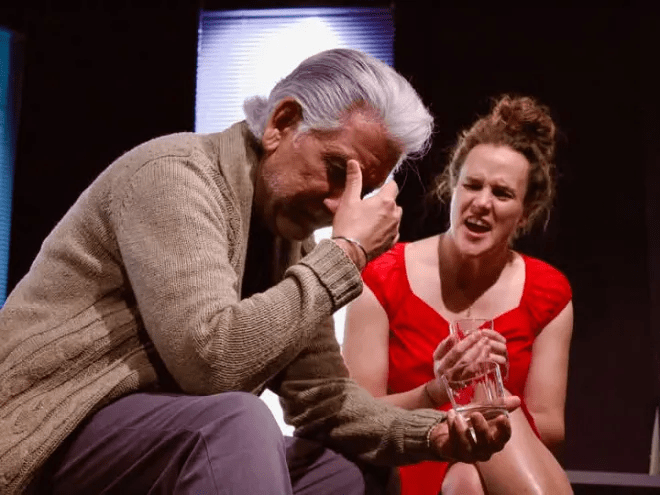
Virk’s performance as Laurence lends some gravitas to proceedings – his character is self-assured, smooth and smarmy. This is an effortless performance by Virk, who begins the play as a broken man, trying desperately to keep his family together, and becomes ever more unlikeable in the second act as his true colours are revealed.
There are plenty of moments of humour throughout, particularly in the scenes set at the newspaper office, between Frances’s colleagues Oliver (Charlie Harris), Sid (Wagner Rulli) and Mary (Michelle Smith). For anyone working in the corporate world, these scenes are sure to strike a chord, with plenty of snide comments about hot-desking, and a sense of friendly competition with an underlying nastiness. These scenes are very enjoyable, and the cast all do an excellent job in portraying your classic office bitchiness, but they do begin to feel a little repetitive at times.
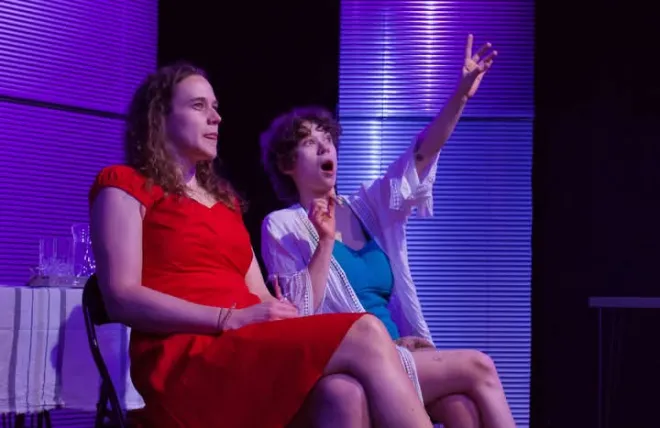
The set design from Guy Evans is a marvel, featuring metallic Venetian blinds that not only give the sense of a high-end office block, but also hark back to the secrets and lies that underlie the plot. They are also used as screens for various projections which provide naturalistic backdrops or something more representative (a scene in a bar is represented by a projection of an oversized glass of beer, for example). I have never seen a set like this before, and was very impressed by the simple-yet-effective nature of it. For a play with so many scenes, set in so many locations, this was an incredibly clever solution.
The play is filled with many supporting characters – Jane Pyke and Bernard Whelan in particular are criminally underused as Frances’s parents, and Melanie Hamilton puts in a stellar performance as the Kyte’s family friend Charlotte, although one can’t help but wish we’d seen a little more animosity between her and Frances.

When the lights come up at the end of this play, the audience are sure to be left with more questions than answers. What were Frances’s motivations, and what did she actually want to achieve? Moss’s asides to the audience allow us a brief glimpse into the character, but it feels like there is still more to be uncovered. The first act is a little meandering, and at the interval I was left completely unsure as to where the plot was going to go. The second act ramps up the tension nicely, and the play seems to be building to a dramatic climax, but never quite reaches it – Coxon’s script ends without a suitable resolution, and any promises of either Frances or Laurence getting a much-deserved comeuppance are not satisfyingly delivered.
Nonetheless, this is a production that will keep you interested, with characters and stories that are easy to become invested in. At almost two-and-a-half hours, this is a long play that passes quickly, making for an enjoyable evening of theatre by one of Nottingham’s finest amateur companies.
Tom Morley, February 2025











 Broken Legs Blog