

“If music be the food of love, play on,” proclaims Bally Gill’s Orsino in the opening scene of “Twelfth Night”, and the RSC’s latest production definitely leans into this idea, the action interspersed with musical interludes throughout, including an original Christmas song from composer Matt Maltese. The play, which, despite the festive title, never references Christmas in the text at all (although a reference to “midsummer” is altered to “midwinter”), finds its Christmas spirit through music, comedy and love which is enough to bring a smile to even the most Scrooge-like theatregoer.
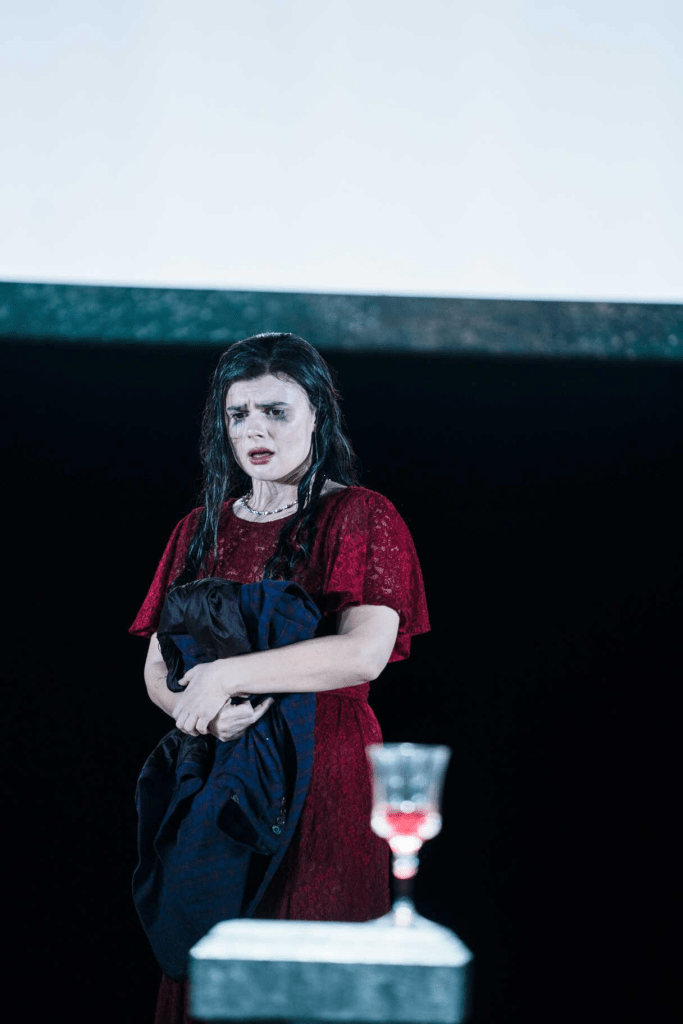
The play begins in dramatic fashion with Viola (Gwyneth Keyworth) washing up on the shores of Illyria after a shipwreck, the stage bare except for a white frame through which Viola emerges, drenched in water and gasping for breath. It is a stark image that may give the false sense of a darker tone, although this tone quickly shifts to something more light-hearted as the action moves to Orsino’s palace, and music and dancing fills the stage. Gill brings his usual childlike quality to Orsino, and his relationship with Viola (now disguised as Orsino’s servant Cesario) is cheekily conspiratorial, giving the air of a pair of schoolboys preparing to ask out a girl for the first time.
The play has no shortage of comic characters, with Joplin Sibtain and Demetri Goritsas as Sir Toby Belch and Sir Andrew Aguecheek bringing plenty of fun to proceedings, aided by Daniel Millar’s Fabian and Danielle Henry’s Maria. Goritsas’s Aguecheek has the air of a used car salesman, his American accent helping bring him false confidence despite his clear cowardice when it comes to a duel with Cesario. Sibtain’s Belch, on the other hand, is a much more grounded character, his alcoholism leading to some poignant moments amidst the mayhem. Sibtain expertly crashes between emotional states, violent outbursts giving way to more jovial instants, as he rouses the staff of Orsino’s palace for a midnight singalong. His final scene, as he breaks down in tears, his mind clearly suffering from years of abuse, is incredibly moving, and one cannot help but wish someone had stepped in to help him sooner, instead of throwing sarcastic comments around about him being a drunken layabout.

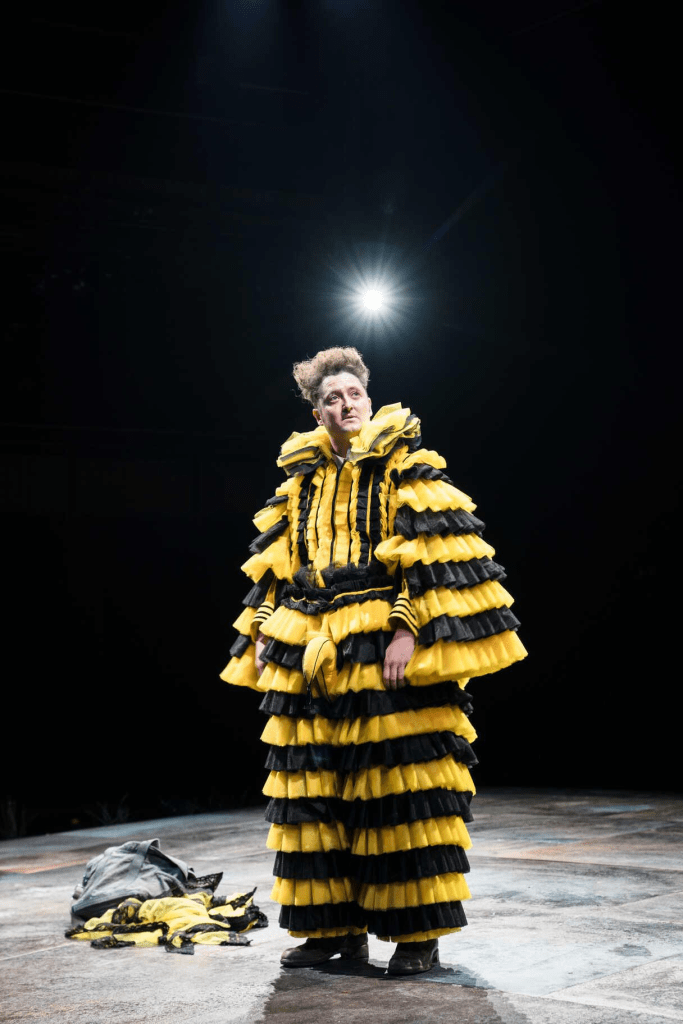
The victim of Belch and Aguecheek’s pranks is Samuel West’s uptight Malvolio, who is led to believe his mistress Olivia (Freema Agyeman) has feelings for him, and is tricked into dressing in yellow stockings in order to win her affections. The reveal of West’s final costume is a marvel, making the most of James Cotterill’s set design, with West appearing behind a large musical organ, which begins to dissemble itself to reveal the costume bit by bit, before West proceeds to shimmy down the organ’s pipes like a fireman on his pole. What begins as fun and games quickly turns into sorrow, however, and again West is more than capable of pulling on the heartstrings as the true nature of Belch’s trick is revealed.
However, it is Michael Grady-Hall’s Feste who no doubt steals the show, the often overlooked fool taking centre stage throughout, making the most of his miming talents, and enjoying a strong relationship with the audience. Grady-Hall almost conducts the entire show, a wave of his hand moves the set, a click of his fingers changes the lighting, and a wink at the audience is sure to set everyone off laughing. Even the interval doesn’t afford him a break, as he makes his way out to the stage for an impromptu game of catch with audience members. Between the clownish comedy are moments of melancholy, as Feste makes some very profound observations, and ends the play with a haunting nursery rhyme before we head out into the cold night.
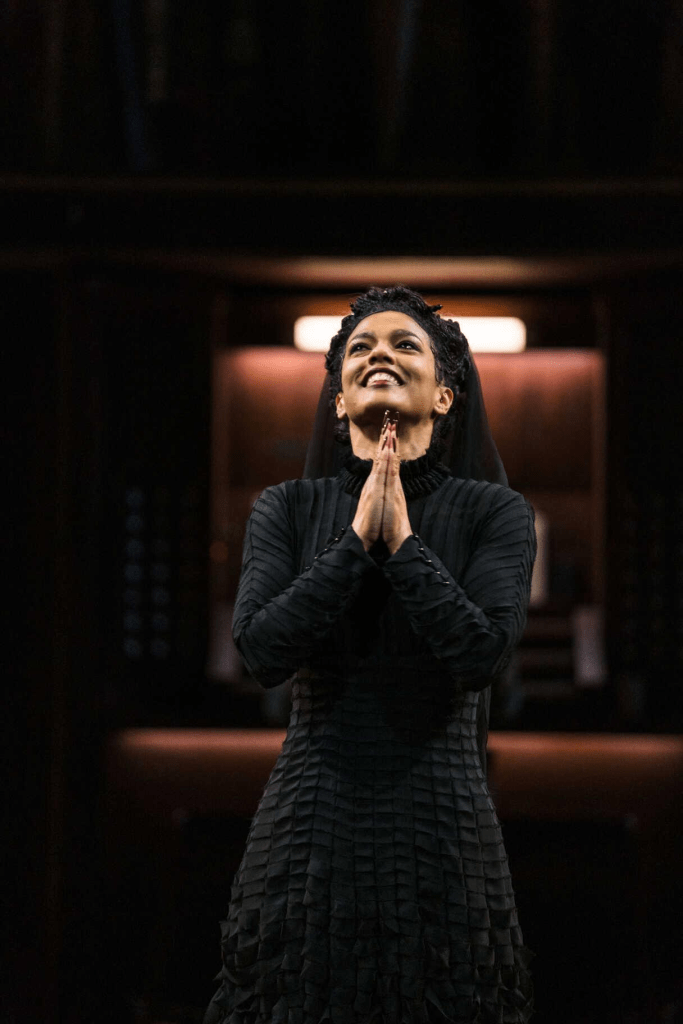
Under the direction of Prasanna Puwanarajah, the production is not afraid to lean into its queer undertones, with Orsino’s hall filled with men dancing with men, while Agyeman’s Olivia is clearly excited by the fact that she has fallen for a woman disguised as a man. Orsino’s relationship with Cesario is not shied away from either, with the pair almost sharing a kiss, and Gill mistaking Sebastian (Rhys Rusbatch) for Viola in the final scene. Although the play still enjoys its compulsory heterosexual ending, these fleeting moments help the play feel modern and fresh.
The second half feels slower than the first half, as the production seems to meander too long in the same place – the excitement of changing scenery and lighting states of the opening scenes settles down into a more standard affair, as characters race backwards and forwards without the plot seeming to move on – but the ending, as the various cases of mistaken identities are revealed, is as enjoyable as always. Each character is afforded their own moment of realisation, in a move that could feel repetitive, but instead just becomes funnier and funnier.
Overall, this is a very strong production of “Twelfth Night”, and one that feels festive without leaning on the Christmas aspect too much. The high calibre of cast was always certain to make this a success, although the lesser-known actors more than hold their own. This is a sheer joy from start to finish – a wonderful helping of “midwinter madness”.
Tom Morley, December 2024







 Broken Legs Blog