
Andrea Dunbar’s play about two young girls that are groomed by an older man is dark and disturbing, yet in this tour from Diva Productions, slips between serious drama and bawdy comedy, in a tonal shift that doesn’t sit quite right. The big question is – is this the fault of the production, or a fault of the audience? Just how much can an audience influence one’s enjoyment of a show?
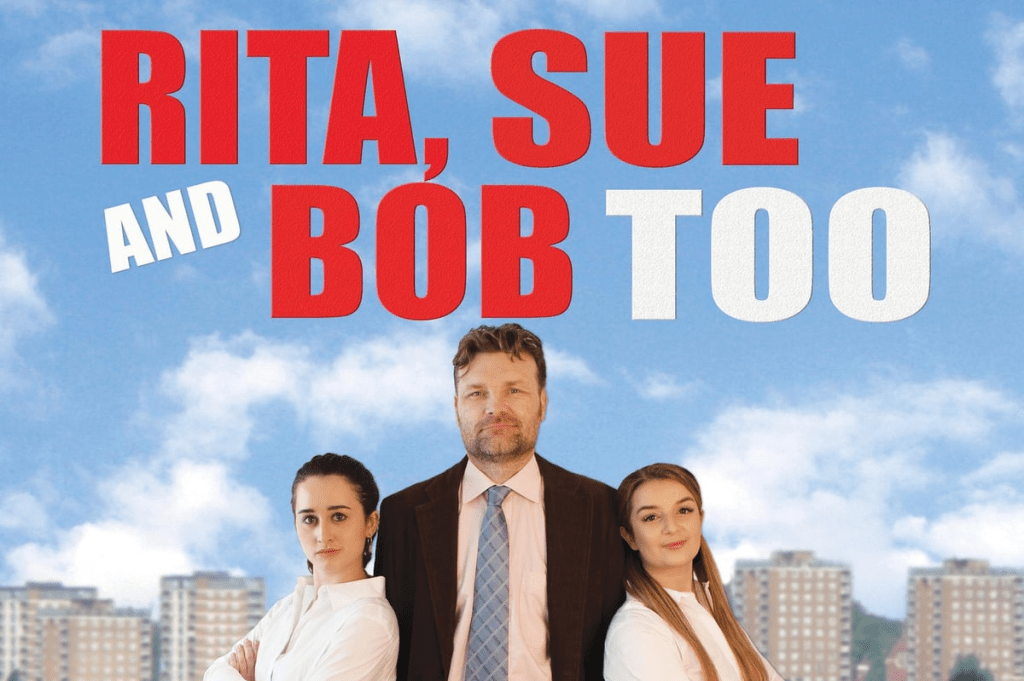
The plot seems to wander, offering a realistic look at life of the working classes in Thatcher’s Britain, but often getting stuck in endless arguments between characters that do little to progress the story. Bob (Dale Vaughan) offers to take home teenagers Rita (Emma Hooker) and Sue (Polly Lovegrove) after they have spent the evening babysitting for him and his wife. Instead of taking them directly home, he decides to drive them up to the moors, where he proceeds to coerce them into having sex with him. The opening scene, in which Bob (who, in the play, is 26 years old, but in this production looks older) rapes two 15 year old girls should feel shocking. Indeed, Vaughan, Hooker and Lovegrove play it incredibly seriously, the two girls both coming across as naive and a little unsure, but egging each other on, and trying not to lose face in front of their friend. Vaughan’s Bob is both smooth-talking and charming, but with a dangerous side, quickly turning on the girls and telling them to “shut up” when they don’t start playing to his script. It would seem this isn’t the first time Bob has done this (indeed, later it’s confirmed that he’s had previous extra-marital flings, although whether this was also with children is not made clear). This scene is made all the more harrowing by the girls’ reactions afterwards – they both tell each other that they enjoyed it, although there is a little unsurety under the surface. Despite their reservations, they both decide that this tryst must continue – each time they babysit for Bob, they’ll go “for a jump” with him on the way home. The way they discuss sex is childlike. There is no doubt (in my mind, at least) that what we are watching is distinctly wrong.
And yet, here is the downfall of the play – the majority of the audience found this scene amusing. This is perhaps the fault of the 1986 film of the same name, which took Dunbar’s script and turned it into an out-and-out comedy in a similar vein to the “Carry On” films. Dunbar’s script is based on her own tragic life – she fell pregnant at 15, had 3 children by 3 different fathers by the age of 21, battled alcoholism and ultimately died of a brain haemorrhage at 29. She was involved in the film adaptation to begin with, but ultimately distanced herself from the film when the decision was made to lighten to tone. The play and the film are two distinctly different things – it’s a shame the audience weren’t aware of that fact. The snickers and dirty laughs that came from the (mostly older) audience whenever there was nudity or the characters spoke about sex seemed to undercut the clearly distressing tone of the play. It raises the question of whether this play should even be performed, given that it will be received by an audience in this way, who clearly expected a comedic romp more akin to the film.
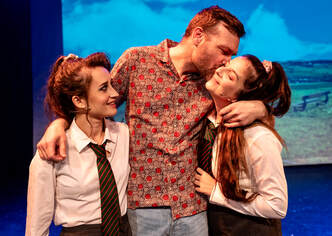
I felt that, for the most part, this production was trying its best to honour Dunbar’s legacy, and the first act was mostly played in a serious manner, the actors ignoring the audience’s bawdy reactions and catcalls. The production felt very self-aware. 80s tracks punctuated each scene, but the songs chosen were very pertinent to the story: Eurythmics’ “Sweet Dreams” warns us “some of them want to abuse us; some of them want to be abused” whilst Soft Cell’s “Tainted Love” perhaps echoes the voices in Rita and Sue’s heads that are saying “I’ve got to run away; I’ve got to get away”.
The play also makes it clear, time and time again, that Rita and Sue are both underage. The girls appear in school uniforms throughout, and when Bob’s wife Michelle (Louisa Maude) accuses Bob of sleeping with them, Bob’s response is that he doesn’t “play around with kids”. Bob is well aware that what he is doing is wrong, which makes his character even more abhorrent. How anyone could watch this and find it remotely amusing is beyond me – and the audience members that were wolf-whistling the two teenagers during the curtain call at the end should feel deeply ashamed.

By the second act, the cast start to lean more into the comedic elements, playing up to the audience reactions. This is particularly true of Lovegrove’s Sue, whose facial expressions become more pantomime, with cheeky suggestive looks to the audience at certain moments. Hooker’s Rita feels more grounded, making her ultimate fate particularly tragic. Dunbar’s final note is one that sees Bob not only get away with grooming these teenagers, but actually profit from it. It is a downbeat ending to what is a devastating story.
The comedy elements mostly come from the characters of Sue’s parents, Mum (Alison Gibson) and Dad (Andrew Ashley), who spend the majority of the show telling each other to “f*** off”. Whilst they could have been used to give more context to Sue’s relationship with Bob (a child from a broken home, with an abusive father), they are instead reduced to comedy value. In particular, Ashley stumbles about the stage as a mere caricature, and his backstory, with its links to the strikes of the 80s, is mostly ignored, the depth of his character never truly explored. After the bows, Ashley returns to the stage to introduce Black Lace’s “Gang Bang”, which plays as the audience leaves. By this point, all the subtlety and nuance of the opening act has disappeared, as had any enthusiasm or hope I’d had for this production.

The set is effective (simple pieces of furniture in front of an ever-changing projected backdrop help to bring to life a variety of scenes), and there are some snippets of great character work – a memorable scene in which Bob smashes a plate from Michelle’s hands was met with a menacing silence, only to be undercut moments later by the audience booing as though they were at a pantomime. I always try not to take audience reactions into account when writing these reviews (after all, the production team cannot control the actions of the audience), but the actors were so affected by the audience in this production that it is hard not to criticise this. The marketing for the show mimics the posters for the original film, and describes it as a “hilarious comedy drama”, which probably doesn’t help matters. Instead of using this opportunity to challenge an audience and make them reconsider the film that they clearly knew quite well, the production seems to cave in to their preconceived notions and play up to it. It makes a mockery of Dunbar’s work and the serious topics covered here. Simply arguing that the play is “of its time” is not enough, and raises the question as to why that makes it appropriate today. Never before have I felt so disappointed in an audience and a production. If you have a shred of decency, you will not go and see this show, which started off promising, but left me feeling very angry and disturbed.
Tom Morley, September 2024








 Broken Legs Blog
Leave a comment