

From the writers of “Six”, this hotly anticipated new musical “Why am I so single?” tells a story of modern day dating tragedies, offering a meta musical experience that caters to a very specific type of theatre goer, but will probably not appeal to your everyday audience member.

The musical feels semi-autobiographical, with the main characters of Oliver (Jo Foster) and Nancy (Leesa Tulley) clearly inspired by writers Toby Marlow and Lucy Moss. In fact, the majority of the marketing material focuses on Marlow and Moss – their names are plastered on every poster, Instagram post and throughout the programme – with the actual plot of the musical taking a backseat. After seeing the show, it is easy to understand why. The plot is fairly nonexistent.
The show opens with Oliver and Nancy being commissioned to write a “big fancy musical” to be performed in the West End, and Nancy arrives at Oliver’s flat for an evening of brainstorming, only for their conversation to drift off at a tangent as they both begin discussing their various dating disasters. It is an interesting premise – Marlow and Moss take the pressure to write something as successful as “Six” and turn that into their storyline, and there are opportunities to provide commentary on the pressure of the entertainment industry today. The meta nature of a musical about writing a musical is not a new one (it has previously been covered in shows such as “[Title of Show]” and “A Strange Loop”), but does provide opportunity for some interesting commentary about the rise of fandom and the impossibly high expectations it places on creatives. Unfortunately, the plot line is used simply to bookend the show, and feels like it is dropped halfway through as the writers choose to focus on the (less interesting) perils of dating instead.

Oliver and Nancy attempt to answer the question “Why am I so single?” by first recounting previous dating mishaps in the song “8 dates”. The music is catchy, and the songs are memorable, and this is where Marlow and Moss truly shine – they are excellent composers, although their lyrics leave much to be desired, with too much reliance on swearing to make the characters feel “modern” and “relatable”.
The choreography from Ellen Kane is also excellent, with a high-octane chorus providing huge dance numbers throughout that helps to keep the momentum going when the plot begins to drag. “C U Never” is a fun tap number performed by Nancy’s best friend Artie (Noah Thomas) as he tries to persuade her to delete her ex-boyfriend’s number from her phone. The musical pokes fun at internet dating profiles in the inventive number “Meet Market”, which sees the cast pushing shopping trolleys around the stage as they try to take their pick from a variety of men that all look and dress the same – although I felt that online dating was handled better in “Two Strangers“, where the commentary wasn’t quite so in your face. In fact, the insistence from the characters that online dating is their only option (“You don’t just meet anyone in a bar anymore – it’s not the 1800s”) feels a little misplaced to me – perhaps the answer to “Why am I so single?” is “because you spend all of your time online and don’t actually go out and do anything”, but this is never challenged.

By the end of the first act (and the final number of the first act is so bewildering it has to be seen to be believed), confidence that this musical may be able to provide any interesting insights is shattered. Both main characters feel incredibly entitled, pinning the blame on others rather than searching for problems with themselves, and the story seems to have got stuck in a loop, where the characters make little progression in their goal to answering their question. The second act begins with more of the same – until the powerful song “Disco Ball”, where things start to change, and the musical begins to lean into themes of sexuality and gender identity, where the show starts to feel truly unique and original.
“Disco Ball” is a mammoth number, performed excellently by Foster, as they are surrounded by chorus members and dressed in a sparkly shawl – but all of this is beautifully juxtaposed by Tulley, who sits in silence at the edge of the stage, watching the performance without reaction, and making the entire number feel a little sinister and sad. What follows is a fascinating look at queer representation in media, schools and wider society, as Oliver opens up about their past, and the character’s non-binary identity is explored deeper, rather than the throwaway lines of act one about “what are your pronouns today?” In all honesty, I think the musical could have afforded to develop this further – this is the first West End show to feature a non-binary protagonist, written by a non-binary writer – and I understand not wanting to make it the focus of the story, but a little more exploration of how it feels to be non-binary, and what that identity means, would be welcomed. Still, I believe this is positive first steps in bringing non-binary characters into mainstream media, and gives Marlow and Moss a unique edge to their writing.
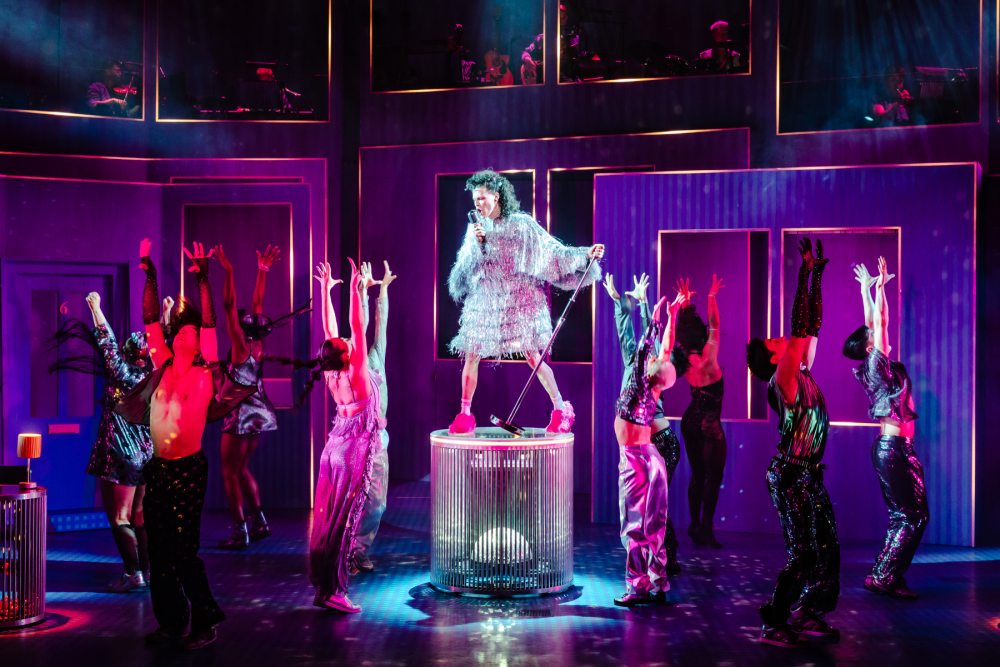
The musical really gets interesting in the latter half of the second act, as the blame game is dropped (a finale-style number called “Men R Trash” is cut short halfway through), and the characters begin to explore their own insecurities. Tulley’s rendition of “Lost” is a true highlight, a number that removes all of the glitz and glamour, and sees Tulley and Foster sat cross-legged in front of each other, finally having a proper conversation without the need for cheap jokes or insults. In fact, the final thirty minutes pretty much flawless. Had the musical been one act, and the story not dragged out to two and a half hours, it could have been perfect. The first act feels almost superfluous, and whilst the numbers are fun, and will stick in your head as you leave the theatre, I think this is definitely a case of “less is more”.
I am fully aware that I am not the target audience for this musical – indeed the tag line “Calling all ladies, gaydies and theydies” seemingly goes out of its way to exclude the straight man – and so there are probably parts of this musical that I take issue with, that will absolutely resonate with others in the audience. The standing ovation and five star reviews from other theatre sites suggest that this is a hit for certain audience members, and it is great to have that sort of representation on the stage. Don’t take my criticisms here as gospel. There is a lot to like about this musical. It is funny (a running joke about “Oliver!” gets an excellent pay-off towards the end), it is inventive (yes, the chorus are included as different household objects from Oliver’s flat, such as a fridge, a lamp and a houseplant) and by the end, it manages to feel new, original and different. It has the makings of a great musical – it just isn’t quite there yet.
Tom Morley, September 2024





 Broken Legs Blog