
This blog post was written for East Midlands Theatre.
The second in the annual Classic Thriller Season at Nottingham Theatre Royal transports us to the 60s, for Francis Durbridge’s “Fatal Encounter”, a tale of suspense, espionage and murder…

The set up is intriguing and the production, directed by Karen Henson, draws you in with likeable couple Howard (John Goodrum) and Joanna Mansfield (Hannah Blaikie), who find themselves at the centre of an intricate plot that continues to get more tangled as the story continues. Goodrum as Howard is particularly well-suited to the role – hardly ever leaving the stage during the two-hour runtime, the self-assured, charismatic book publisher is the perfect leading man to spin this convoluted tale, instantly getting the audience on-side even if the decisions he makes are not always the wisest or most ethical.
In the opening moments of the play, Howard explains that is wife Joanna has had her driving licence revoked for doing 80mph down the high street, and this serves as a perfect introduction to the wild, risk-taker that is well-realised by Blaikie. This is no throwaway line however – the driving ban proves to be integral to the plot later on. In fact, there are very few throwaway lines in this play. Even the smallest of details (Howard’s sports jacket, Joanna’s nail polish and the painting of flowers that adorns Howard’s wall) become important, and demands that the audience pay attention at all times.
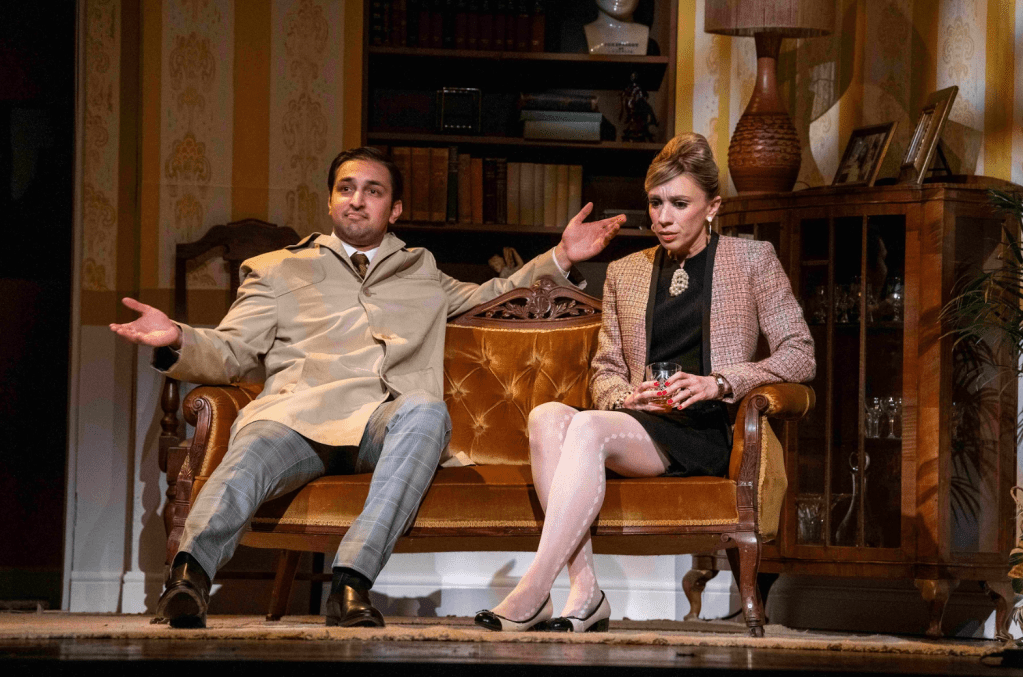
We are introduced to various supporting characters, including Howard’s business partner Grace (Kia Pope), Grace’s ex-husband Perry (Pav Maru) and local art dealer Mark (Jeremy Lloyd Thomas), before events take a shocking turn, leaving Howard and his wife attempting to cover up a murder scene in their front room. It quickly becomes clear that Joanna has secrets of her own, as do Grace and Perry, and Howard becomes the main focus for the audience as he tries to uncover these mysteries, with the help of Inspector Coldwell (Sarah Wynne Kordas).
From here, the play continues to get ever more complicated, and becomes hard to follow in places. Secret photographs, secret diaries, and secret letters add to the confusion – although a flashback towards to end of Act One helps us to make some sense of it. Characters such as small-time thief Rex Winter (David Osmond), and Howard’s friend Hilary (Susan Earnshaw) ultimately feel superfluous to the plot, providing additional B- and C-plots that add to the intrigue but are unnecessary. The final twist is signposted a mile off, and feels a little anti-climactic, but at least the story makes sense in the end.

The entire play is set in Howard’s study, but the decision to have Howard’s front door off-stage means that there are a lot of moments where the stage is left bare, and the audience must strain to hear the conversation happening at the porch. The endless ringing of the doorbell (and telephone) become a running joke however, and one which the play thoroughly leans into in the final scene.
The play includes various moments of tension, but feels dragged out in places. There seems to be very little sense of urgency from the cast, and aspects of the storyline are not always treated with the seriousness that they deserve. A stand-out moment in the penultimate scene ought to have been shocking but instead elicited laughs from the audience, with the play almost veering into pantomime territory.
Overall, the play is very well-acted, and the plot is engaging. The opening act is especially strong, and does a good job in setting up an intriguing mystery that unfortunately does not quite stick the landing. A few slip-ups with lines reminds us that this production has been put together in a matter of days (the cast were performing in last week’s “Murdered to Death” until Saturday night), and makes the success of this production even more remarkable. Despite a plot that is patchy in places, this is an enjoyable night of theatre, and is sure to engage fans of the genre.
Tom Morley, August 2024










 Broken Legs Blog
Leave a comment