

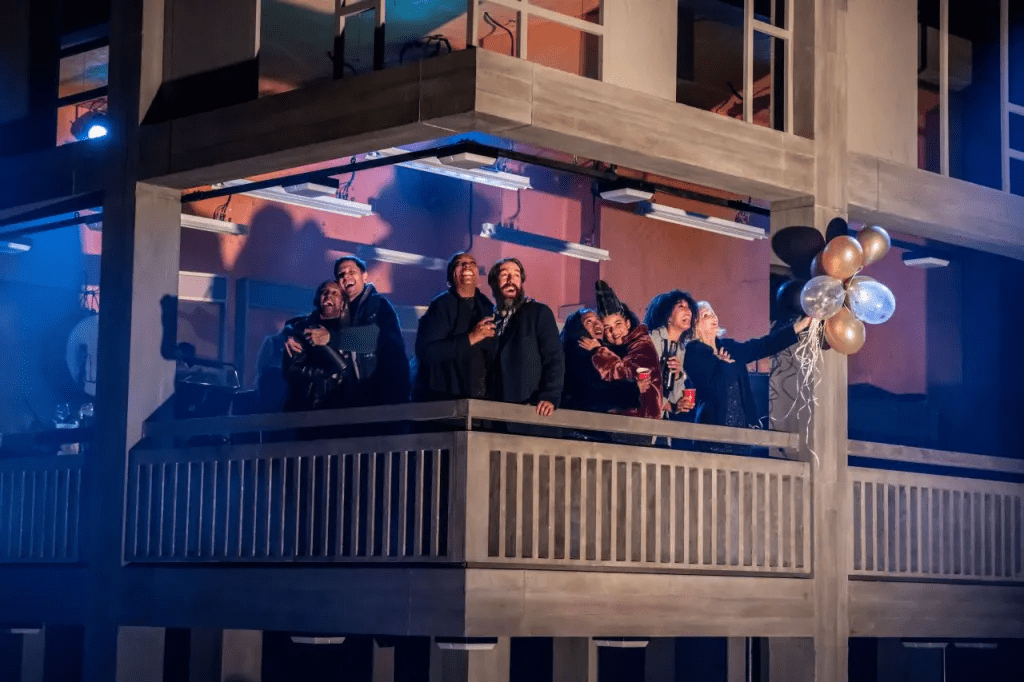
Set across 60 years in Sheffield’s Park Hill Estate, “Standing at the Sky’s Edge” tells the story of three families, each residing in the same flat in different decades. From the moment you enter the theatre, you are immersed in life at Park Hill – the foyer is full of concrete walkways, and the large stage houses several storeys of the iconic complex, with band members hiding in the windows.

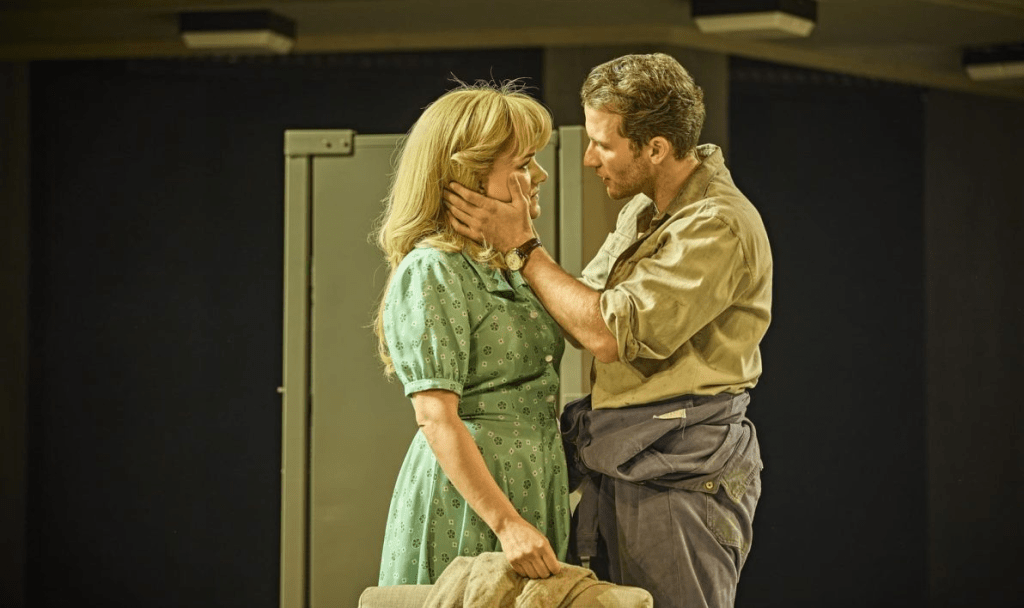
Whilst taking place at different points of the last half-century, each of the three main storylines occur simultaneously, showing how different families have occupied the same space yet experienced very different things. The first to live in the flat are steel worker Harry (Joel Harper-Jackson) and his wife Rose (Rachael Wooding). They are a very happily married couple, but things take a turn for the worse when Harry loses his job at the steelworks, and the austerity of Thatcher’s government begins to kick in.

In the 80s, Liberian refugees Grace (Sharlene Hector) and George (Baker Mukasa) arrive with their niece Joy (Elizabeth Ayodele). Whilst their history in Liberia is referred to, there is very little context given, and it would have been nice to better understand their reasons for moving to Sheffield. There seems to be many missed opportunities for Joy’s family – the potential for difficulties with racism and poverty are glossed over in favour of a more run-of-the-mill teen pregnancy storyline. Even amidst this storyline, potential trigger points such as Grace’s strict religious lifestyle or the bigotry directed as mixed-race relationships in the 80s are not explored, the show instead preferring to skip forward seven years to avoid any of these awkward conversations.
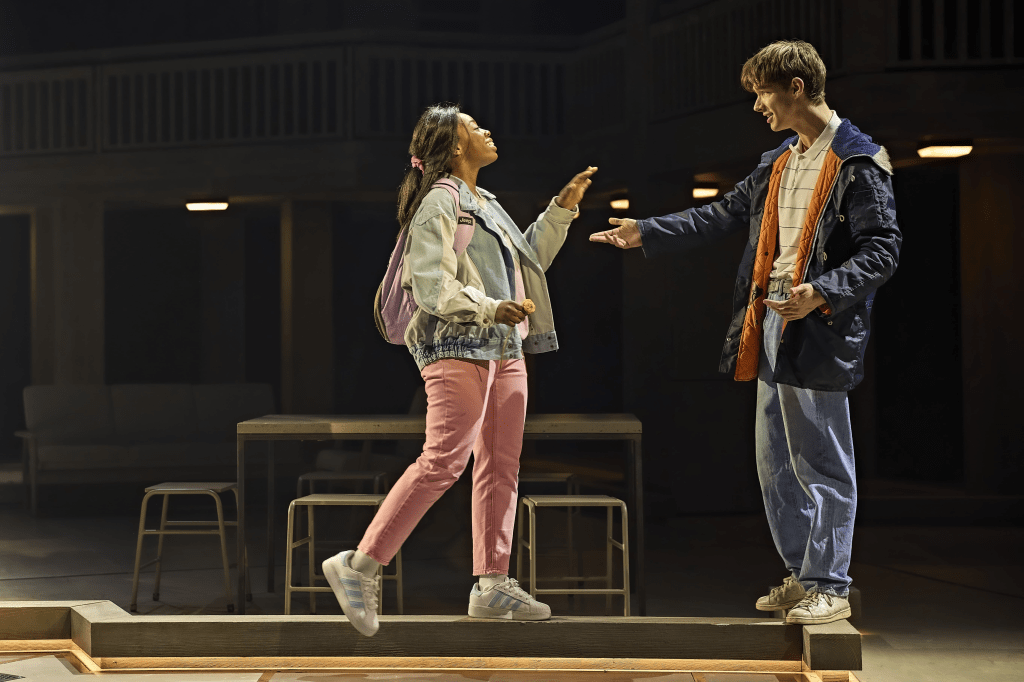
The final storyline, beginning in 2016, focuses on Londoner Poppy (Laura Pitt Pulford), who moves to Sheffield following what is described as a “difficult break-up”. The intrigue builds until the arrival of Poppy’s ex, Nicky (played by understudy Lillie-Pearl Wildman), when it is revealed that the break-up occurred after Nicky had slept with Poppy’s boss. What ensues is quite simply the plainest, dullest love story imaginable, and Poppy can only be described as unlikable and annoying.
This feels like a play of missed opportunities. Instead of focusing on the rich history associated with Park Hill, the play, written by Chris Bush, chooses to tell three incredibly bland stories. There are no references to the multitude of shops, pubs and schools which occupied the estate when it first opened in the 60s. The deterioration of the estate into dens of squatters and drug dealers is only ever spoken about, rather than experienced – Grace is told to “keep the front door locked”, but we never see exactly why. The programme mentions key events in Sheffield’s recent history, such as the Hillsborough disaster and the opening of Meadowhall, yet these are never mentioned in the play itself. Above the stage sit the words “I LOVE YOU WILL U MARRY ME”, and the audience are assured there is a sad story behind this graffiti, but the story is never explained. In fact, the play could have been set in any generic apartment complex in the country. The Sheffield setting is nothing more than a few references to Sheffield Wednesday and a joke about Henderson’s Relish.
The music of the show is based on songs by Richard Hawley, who previously used to be a member of the band Pulp. The lyrics of the songs bear no resemblance to the characters or the stories being told, except for in mood and tone. The songs exist to break up scenes, but instead feel like they slow the action down. The dancing is little more than actors walking around the stage and up and down stairs – effective in showing how busy the estate is, but quickly becoming tedious.
The ending to act one, however, is incredibly moving, as Park Hill’s decline gets accelerated by the closure of the Steel Works. The music swells as fights break out, clothes are thrown from windows and mattresses and sofas fly over balconies. Audience members in the stalls are showered in litter thrown from the dress circle. This did give me goosebumps and make me excited for a more dramatic act two – but, sadly, act two slows the action to a crawl again, and the play ends with a whimper rather than a bang.
The rich history of Park Hill would make for a very interesting stage play. Unfortunately, “Standing at the Sky’s Edge” is not interesting and does not pay true homage to the story of Park Hill. The design of the play, the set, the lighting and the acting are all fantastic. The story lets it down.
Tom Morley, June 2024








 Broken Legs Blog