

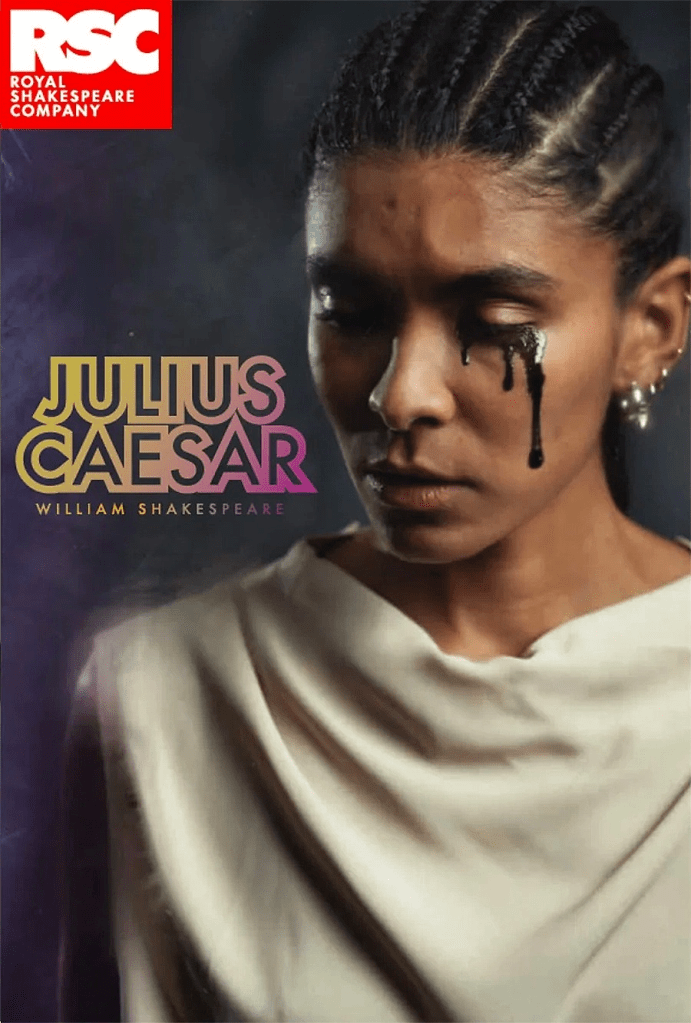
The RSC’s touring production of “Julius Caesar” is a mostly enjoyable, if somewhat baffling, affair. The play (one of my favourite Shakespeare plays) tells the story of Caesar’s murder at the hands of the Conspirators, and the subsequent war that flares up between Brutus (Thalissa Teixeira) and Marc Antony (William Robinson).
The production is done in modern dress – the Conspirators wear suits and ties, whilst Caesar (Nigel Barrett) is dressed a little more informally, with no tie and loose collar – perhaps reminiscent of a certain dishevelled prime minister who recently found himself metaphorically stabbed in the back by his fellow politicians. In fact, the comparisons between the story presented here and recent political events are plain to see, and there are moments where Caesar comes across as sleazy and dislikeable, making the audience question whether the Conspirators are actually making the correct move or not. The production never properly leans in to the modern day setting however. Apart from the dress, the play appears to take place in an “other world” – the set is bland, the atmosphere is cold, and there is nothing to suggest a bustling modern-day city or thriving Roman town.
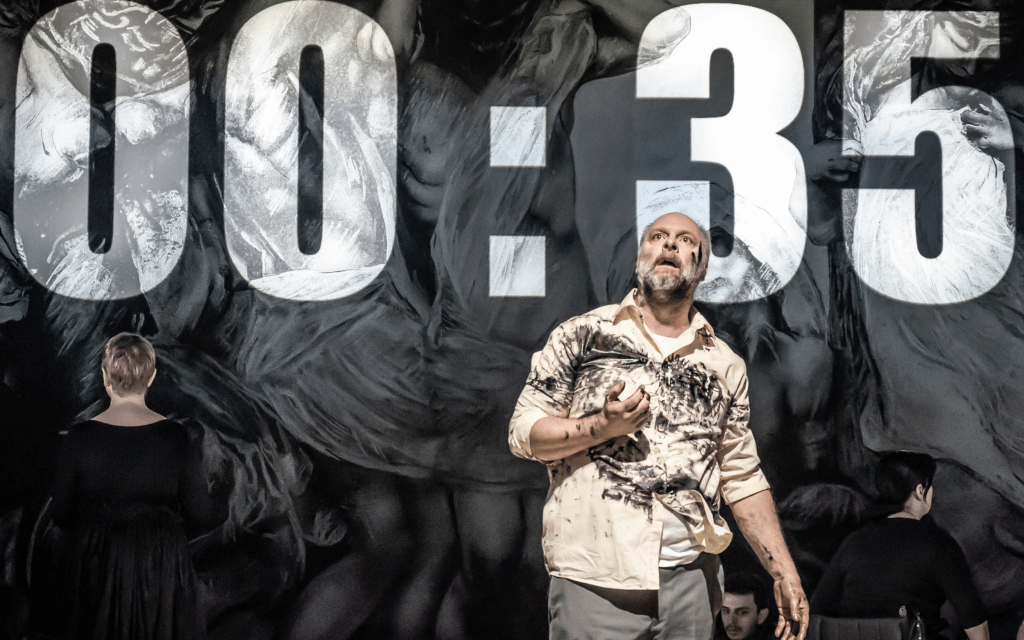
The story is fast-paced, as Brutus and Cassius (the fantastic Annabel Baldwin, who was a particular highlight) begin to win other politicians to their cause. It is here that the play really comes to life – Shakespeare sets the characters on an inevitable path to destruction, one that cannot be stopped once the wheels are in motion. The emphasis on time running out is emphasised by a large digital clock counting down the minutes during the interval.
The play contains some of Shakespeare’s most notable lines – “It was Greek to me”, spoken by Casca (Matthew Bulgo), “Let slip the dogs of war”, spoken by Antony, and “Et tu Brute?” spoken by Caesar. Yet all of the characters seem aware of the importance of these lines – they are given an unnecessary emphasis that takes the realism out of the some of the lines – almost like a nudge and a wink to the audience as the words are spoken. Except for the wonderfully underplayed “Beware the ides of March”, spoken by Soothsayer Niamh Finlay at the beginning of the play.
The death of Caesar is very stylised, as are many of the crucial moments in the play – none more so than the opening, which begins with a 10 minute interpretive dance complete with actors howling… for some reason that completely passed me by. Instead of blood, black paint is used, and the paint serves to mark the murderers so that the audience cannot be allowed to forget their actions as we move into the second half of the show.
The second half focuses on the aftermath of Caesar’s death, as Marc Antony teams up with Octavius Caesar (played by Nadi Kemp-Sayfi in Tuesday’s performance, and another highlight) to lead the war against Brutus and Cassius. Robinson’s Antony was highly emotional and passionate in the wake of Caesar’s death, and although I felt this took away from the calculating nature of some of his speeches, Robinson largely played the part well – I enjoyed part of his speech being delivered directly to the audience whilst he sat on the edge of the stage.
One of my favourite scenes was the moment at the end of the play when Brutus begs Lucius (Jamal Ajala) to help her commit suicide. As Ajala has impaired hearing, Brutus’s final speech was delivered entirely by sign language, and you could hear a pin drop as the audience held their breath, knowing exactly what was to come. Compelling theatre.
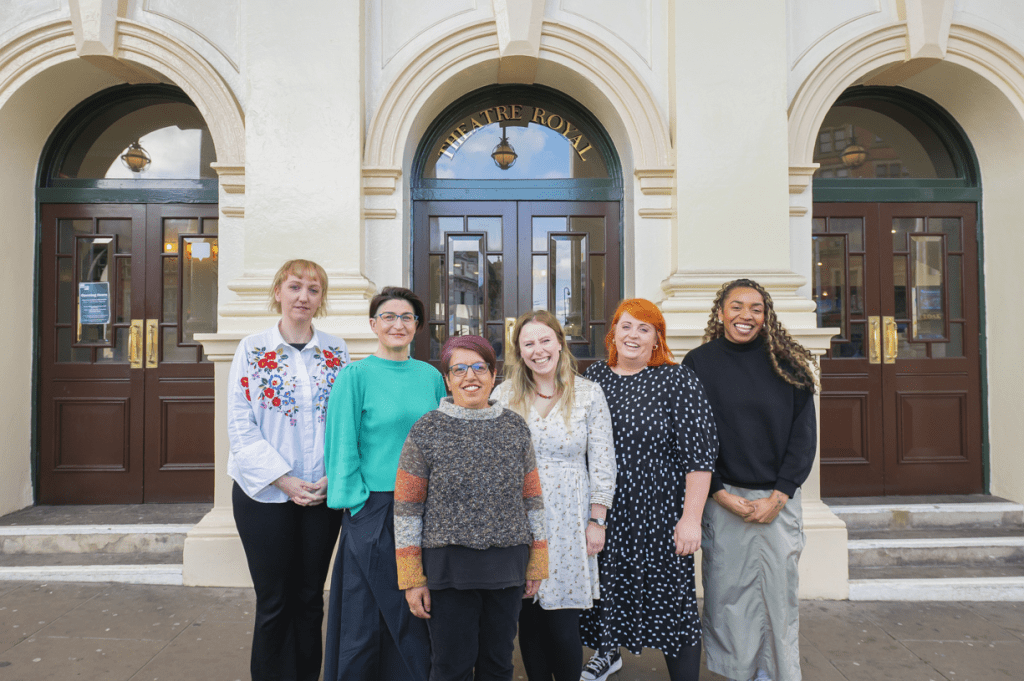
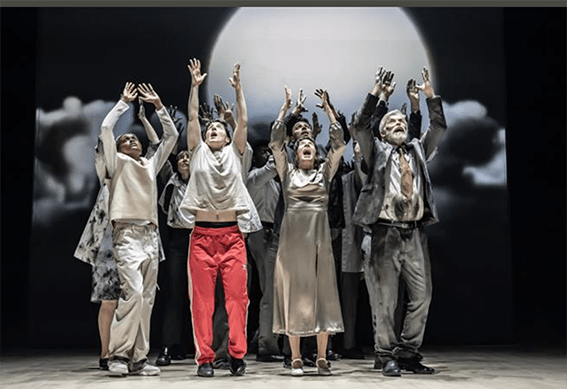
The production also featured local amateur actors, referred to as the “Community Chorus”, as part of the RSC’s attempt to make Shakespeare more inclusive and representative of communities across the UK. Each of the actors (Khaya Ayomide Job, Emily Kelsey, Orla O’Connor, Shuguftah Quiddoos, Laura Thurman and Becky Valentine) were picked as being “community leaders”, from councillors to school teachers to theatre producers. However, the purpose that these amateur actors served was very little. They weren’t given any lines or even very much to do. They appeared as “visions” whenever something bad was about to happen, but the play would have worked just as well without them. Is this really the RSC’s best attempt at being inclusive? Why not give them lines from the crowd, instead of having Finlay playing all the parts and dashing about the stage from side to side? There are plenty of opportunities in this play to use talented amateur actors to help bring the world of the play to life, and yet it seems that these were not utilised in the best way. I found this disappointing.
Overall, this is not the best production of Julius Caesar by a long shot, but it remains enjoyable, if only for the fact that Shakespeare’s script remains as precise and thrilling as ever. It should also be said that the acting is superb throughout, and there is not a weak link in the cast. It’s just the direction that seems to have let it down.
Tom Morley, May 2023





 Broken Legs Blog