

The fact that Shakespeare’s Cymbeline is not often performed, and is not particularly well-known, meant that I went along to see this production with some trepidation. Why was it not as popular as some of his other plays? Was it going to be boring? I had low expectations.
It turns out, I need not have worried. I was captivated by Cymbeline from start to finish. The RSC’s production was relatively simplistic in its design – the staging consisted of chairs or a bed when the plot required them, but was otherwise empty. Director Greg Doran, in his 50th production for the RSC, had instead decided to let the script and the cast tell this story. And what a story it was.

Cymbeline (Peter de Jersey) is King of England from a period before the Roman conquest, and, whilst the name is taken from Celtic King Cunobeline, the story is an original piece of drama thought up by Shakespeare. The play mainly revolves around Cymbeline’s daughter Imogen (Amber James, who I’ve been a fan of since seeing her in Troilus and Cressida a few years ago). Imogen is engaged to be married to her step-brother Cloten (Conor Glean, who plays the character as somewhat comedic, a bit of a buffoon). But Imogen has already married the Roman Posthumus (Ed Sayer), who finds himself banished from England.
The play is long (3 hours 15) with many twists and turns that would be impossible to do justice in a short review. The RSC production split itself into three parts – the first (entitled “The Wager”), focused on a bet between Posthumus and the sleazy Iachimo (Jamie Wilkes playing the creepy, yet still fairly likable, Roman). The second part (“Wales”) saw Imogen taken in by Belarius (Christian Patterson, whose facial expressions never failed to make the audience laugh) and his two “sons” Arviragus (Daf Thomas) and Guiderius (Scott Gutteridge).

The final part (“The War”) sees Britain go to war with Rome, and the formidable, yet also fairly likable, Caius Lucius (Theo Ogundipe). The battle scenes were intense, with the RSC again making use of their chainmail curtain, which featured in their Henry VI plays last year.
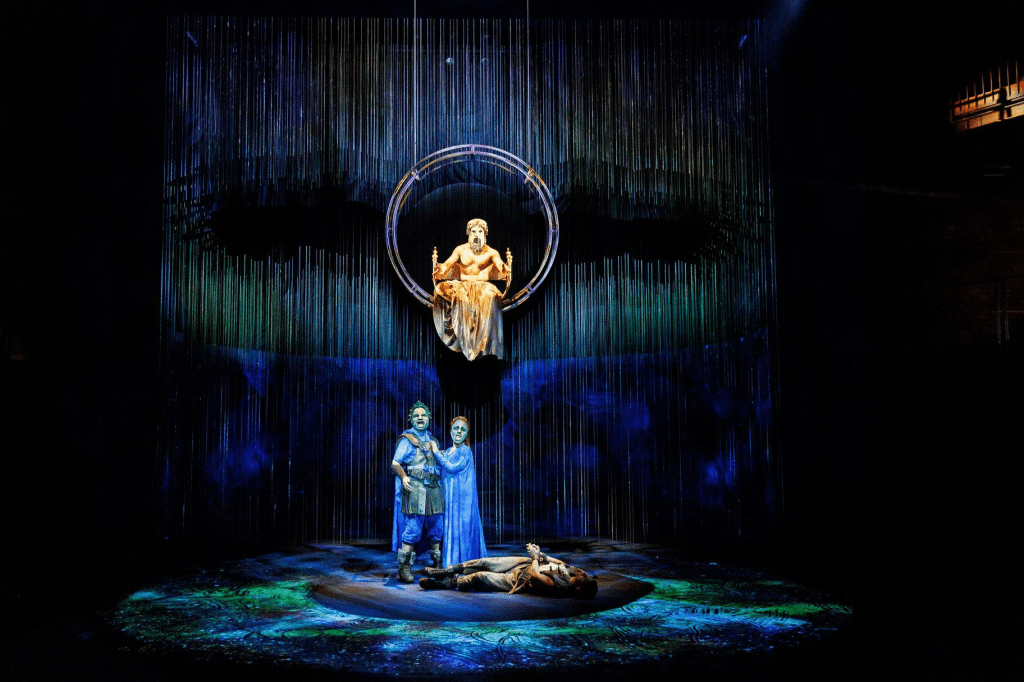
The most bizarre part of the play (it comes out of nowhere and doesn’t appear to add much to the story) sees the God Jupiter appear before Posthumus during the battle. The scene was accompanied by sudden flashes of light, with the God descending from the ceiling on a swing. It was an incredibly striking image, but felt a little out of place with the rest of the play. What was Shakespeare thinking?

The final scene, in which tricks upon tricks upon lies upon disguises are all revealed is incredibly funny, the audience all having prior knowledge of the intricate plot, and seeing the characters work out exactly what has happened is a joy. The reactions, particularly from Patterson’s Belarius, had us all in stitches.
The story is incredibly complicated, and perhaps this is why it isn’t performed more often. But the way the RSC presented it, from the opening moments in which they clearly labelled each character and their relationships, made the play feel so simple that the audience could sit back and enjoy the twists and turns without ever having to pause to decode the plot. This is a play that should be studied in schools – a plot worthy of a six season HBO TV show, and one of the best Shakespeare productions I’ve seen at the RSC.
Tom Morley, May 2023











 Broken Legs Blog