

The RSC’s new production of Shakespeare’s last (maybe) play has something for everyone to enjoy, and will excite different people in different ways. Perhaps the excitement for you will come from the stylised shipwreck in the first scene (not to my taste exactly but it can be hard to replicate a stormy sea onstage). Perhaps it will come from the music that punctuates the show, providing an extra dimension to the magic performed by Prospero and Ariel. For me, the excitement came from acting of the highest quality that made even the quietest moments onstage stand out and live on in the memory.
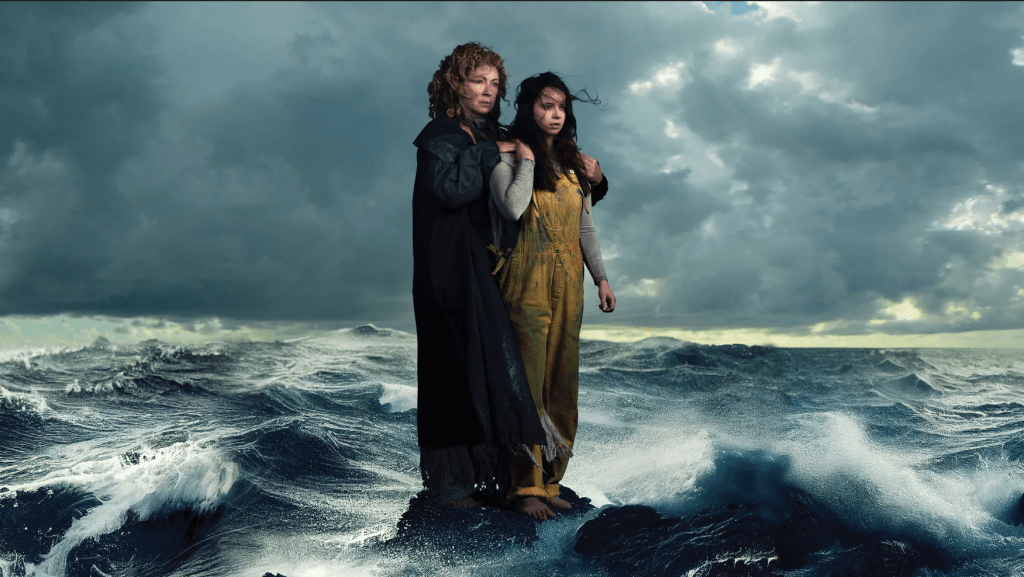
For this production, the RSC have gender-swapped several roles, most notably that of Prospero (played by Alex Kingston). Having never seen The Tempest before, if you had told me Prospero was always a female role, I’d have believed you. Kingston fully embodied the role, mystical and world-weary, with cheeky asides to the audience and an excellent dynamic with daughter Miranda (Jessica Rhodes). In fact, one of the early scenes of the play focuses mainly on Prospero and Miranda – the main purpose of which is to spout information and set the scene, which could be seen as a bit of a slog, but thankfully both actors were extremely engaging, making a possible boring scene very entertaining to watch.
Prospero, who has taught herself to become a magician, conjures up a storm to shipwreck a group of nobles on her island, one of which is her brother Antonio (Jamie Ballard). Also on the ship is the King of Naples Alonso (Peter De Jersey) and his son Ferdinand (Joseph Payne), who immediately falls in love with Miranda. Miranda’s age was hard to make out – the design of the play seemed to suggest she was younger (with Miranda carrying around a teddy for most of the opening scene), whilst Rhodes seemed to play her as a little older, late teens perhaps.
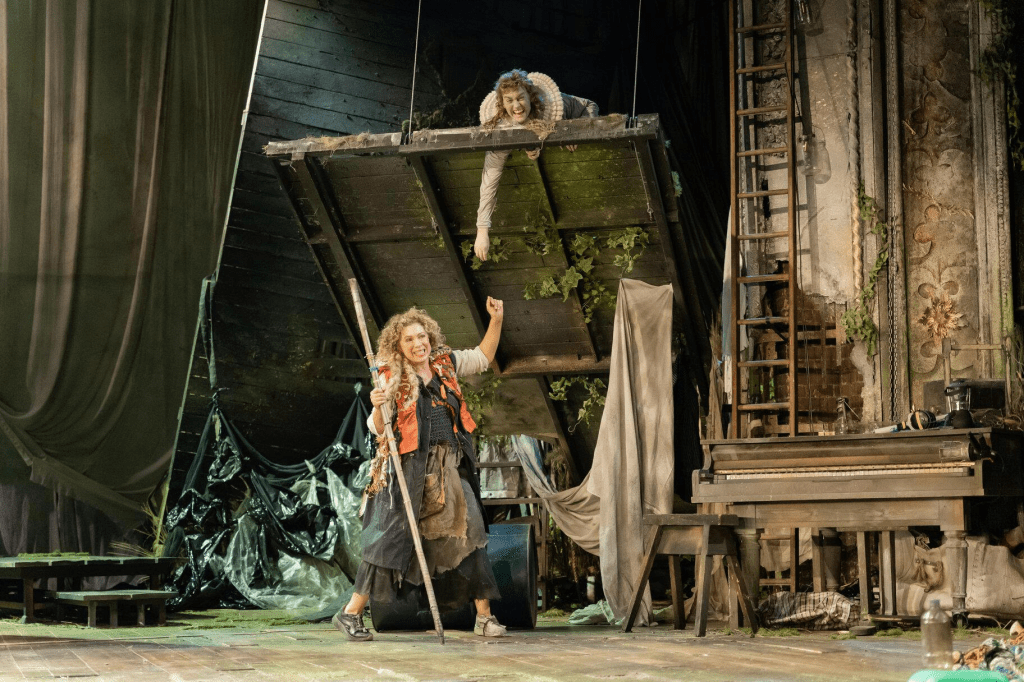
The spirit Ariel (Heledd Gwynn) helps Prospero by bewitching and tormenting the noblemen. Some of the design choices around Ariel were particularly bewildering – one scene saw a huge mirror descend from the ceiling to signify a dreamlike reality, although it didn’t feel that necessary.
Caliban (Tommy Sim’aan), a native of the island who has been enslaved by Prospero, seeks to break free of his bonds and have revenge against his mistress. It is clear that Caliban can be a problematic character in modern-day performances of “The Tempest” – whilst the journey he goes on across the play could be very meaningful (Sim’aan had whip marks on his back, and provided some very meaningful speeches, in both English and Algerian), the play teams him up with comic relief characters Trinculo (Cath Whitefield) and Stephano (Simon Startin). Both are very funny, and the play is in dire need of comic relief by this point, but one can’t help but feel it distracts a little from the horrific situation that Caliban finds himself in. He is freed by the end of the play, but Prospero is never forced to pay for imprisoning him, nor does she seem remorseful.
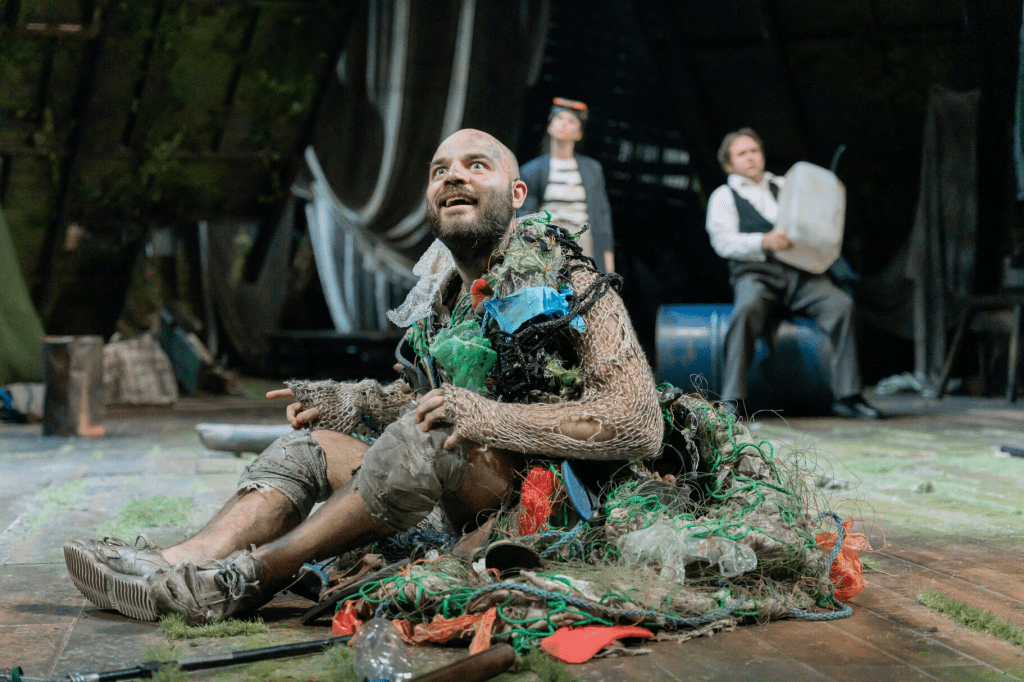
The design for the play is centred around the climate emergency (following the idea that Prospero’s manmade tempest mirrors manmade climate change in the present day), and the stage is littered with objects that look like they could have washed up on the beach. (The programme shows that some of the objects were collected on a litter pick on Weston-super-Mare beach.) Throughout the course of the play, each object is used in some respect, showing just how cleverly the play has been put together, ensuring that each object has a purpose and is placed in the correct spot for an actor to pick up at the right time.
Overall, I thoroughly enjoyed this play, and in particular, this production. The RSC never fails to amaze me in how they manage to make plays that are over 400 years old feel incredibly current, and yet with “The Tempest”, nothing has ever felt more modern and meaningful.
Tom Morley, February 2023







 Broken Legs Blog