

It takes a very special play (and ingenious story) to expertly combine huge, supernatural spectacles with a very intimate, personal story. “The Ocean at the End of the Lane” (based on the Neil Gaiman book of the same name) achieves this and then some.

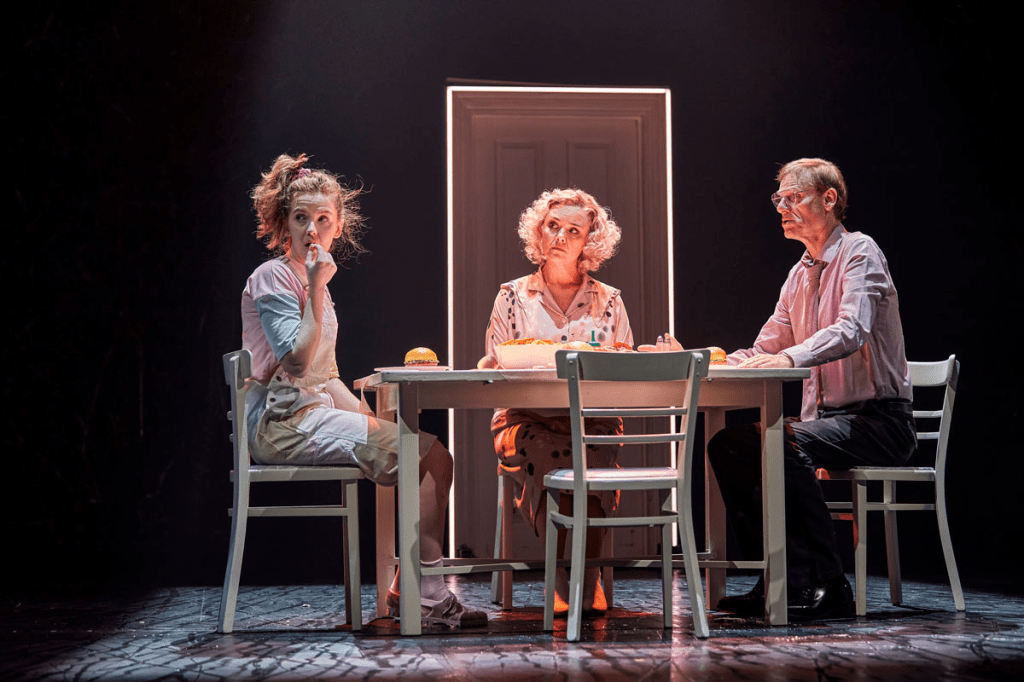
The play follows a young nameless protagonist (referred to in the programme as “The Boy”, played by Keir Ogilvy) who finds himself struggling after the death of his mother, and the suicide of their lodger. The circumstances surrounding these deaths are never explored – but that isn’t what this play is about. Instead, it focuses on the boy’s reaction to these events, and his relationships with his dad (Trevor Fox) and sis (Laurie Ogden).
Set in 1980s rural England, the boy tends to keep himself to himself, preferring the company of books over people, until he meets another young girl Lettie (Millie Hikasa). Lettie is part of the infamous Hempstock family, and it is with this introduction that the Boy finds himself thrown into a world of supernatural, and, after a seemingly slow and tentative opening act, the play kicks into gear.
Before long, the pair are battling inter-dimensional fleas and being tormented by new lodger Ursula (Charlie Brooks). The special effects are amazing – from the small moments of sleight of hand tricks, to the puppetry that helps bring the flea to life. And how does one bring an entire ocean to the stage? No spoilers from me, but it is a truly magical moment. Lighting also plays a huge part in this play, helping to create “safe spaces” for the pair – one of my favourite parts is when the Boy takes shelter in a fairy ring (a ring of mushrooms) which is signified only by orange light, and he is visited by visions of his loved ones.

The play leaves more questions than it answers, exploring the aspects of what makes a memory “real” or not. If something is imagined, can it be remembered? And if it cannot be remembered, did it really happen? The most visceral moments in the play come not from the monsters or the magic, but from the human characters themselves – Dad’s reaction when the Boy accuses Ursula of being a witch is particularly shocking.
This play won’t be everyone’s cup of tea and that’s fine. There were moments when the world-building lacked clarity, and the characters were having to provide a lot of contextual information to move the story along. But if you can look past all that, and just enjoy the characters, and the journey that they go on, then this will definitely tick all the right boxes.
Tom Morley, February 2023













 Broken Legs Blog